ABM Channels That Drive Pipeline for Mid-Market B2B Teams
Intent data and coordinated channels separate high-performing mid-market ABM from the rest.

Mid-market B2B teams sit in an odd spot: deal sizes big enough to justify account-based marketing, budgets too thin to run it the way enterprise teams do. By 2026, Mid-market ABM adoption reached 41%, after 19% in 2024, Digital Applied’s benchmark covering over 1,400 B2B teams found. Growth has been quick, yet enterprise adoption at 76% still leaves a wider gap than ambition alone explains. When your team is lean, mistakes are fatal, so a leaner group must choose its channels carefully and sequence them right.
ABM makes straightforward sense at this price point. When average contract size gets beyond roughly $50,000, and buying brings multiple stakeholders in, one-to-one bespoke programs feel like overkill, while broad-reach demand gen gets too diffuse. The 1:few approach works best here: you take clusters of 10 to 100 accounts, get them grouped using persona details, then shape messaging for a whole slice rather than one account. ABM programs produce 2.6x added pipeline for each marketing spend compared with general demand gen; 41% higher win rates follow when the account converts. The payoff is genuine. The work is real too; mid-market teams mostly underinvest across the sequence: they pour money into outbound plus paid media before the intent layer exists to show which accounts deserve outbounding first.
What makes mid-market buying committees harder to reach than the playbooks suggest
These days the buying committee is larger, and convening is slower. For deals over $50,000, the median buying group in 2026 runs 11.2 people, up from 9.7 in 2024, per data from Forrester and 6sense. Each carries out their own research at their own pace, yet mid-market teams can't lean on enterprise purchase paths to compensate, taking 121 days from initial reach to finish, against 218 for the enterprise side. Shorter cycles, a bigger group to win over, and a smaller team doing the winning.
That ought to reorder where budget goes, while many teams still lag. Per the 6sense Buyer Experience Report, 94% of those buying committees chose a vendor shortlist prior to first contact, plus 77% went with whichever one they liked best at the start. Outreach and demos, plus vendor paperwork, all chase a choice the committee had quietly settled on long before any rep made a call. The main battleground sits upstream, in awareness plus authority-building before a prospect signals interest.
That changes what "top of funnel" actually means for a mid-market team. By the time an inbound form fill or demo request lands, you're showing up with the shortlist already locked. Channels familiar to people across every committee member, not only the one person who fills in the form, count as much as deal work near the cycle’s end.
Marketing misalignment deepens the issue rather than easing it. If outreach is not coordinated, different members across the buying committee hear messages that are contradictory exactly when they talk internally. Mid-market teams don't usually have the headcount for a channel expert, so each one they use does double duty across multiple funnel stage targets or even one persona simultaneously. The budget can’t cover one channel serving just one purpose.
Intent data as the prioritization layer that makes every other channel more efficient
Intent data alone won't move any account down a funnel. Picking the accounts that need focus first matters more than the other task. Accounts flagged through intent signals reach opportunity 21.3% of the time, versus 8.4% among those that aren't, per the B2B Buying Study from 2024. Before putting any money toward paid media, the gap itself justifies buying intent tooling.
Adoption today is standard practice, with 91% of B2B marketers turning to intent data when they prioritize accounts. The work is still behind. Just 24% report strong ROI, while DemandScience's 2026 State of Performance Marketing survey of 750 top marketers revealed two-thirds see dashboards claiming wins that don't reach revenue.
Most often the cause traces to when or how widely teams apply that data. Teams grab intent signals once a buyer has shortlisted other options, or they lean on that signal to start a single channel, like email or retargeting spots, rather than doing something coordinated across channels together. The worth lives in coordination rather than the signal itself, and most groups skip the experiment because purchasing the tool was their last move.
Size counts as well when mid-market teams work in tight verticals. Intent data providers track billions of interactions monthly across thousands of sites. Intent data doesn't work as a channel, unlike LinkedIn or email. This layer picks the timing, channel, and accounts to target. Without it, budget spreads evenly across accounts no matter their buying cycle stage, nearly the worst use of funds any mid-market team could make.
LinkedIn Ads and paid social as the foundational mid-market channel
Teams often choose LinkedIn Ads as the main paid channel in mid-market ABM because firmographic targeting there covers business scale plus seniority and function, fitting each buying committee structure. You can start spending just $10 daily, and built-in integrations with tools such as the AdRoll ABM platform (once called RollWorks) let teams lacking enterprise-grade data infrastructure still launch focused ads.
LinkedIn remains locked down, though, and putting the entire paid budget there is this channel's most frequent error. Creative formats remain constrained, Cross-device measurement falls short, and you only connect with people currently active within that single platform. Leaning only on it, you lose buyers whose research time goes to trade publications and industry forums or the wider open web. G2 cited Research done by TOPO and ABM Leadership Alliance work showing programs, even LinkedIn-led ones, drive a 171% lift for average contract size, but that number assumes coordinated activation across channels rather than LinkedIn working alone.
Make LinkedIn your main channel, but don't rely on it alone. Use Content to build committee-wide awareness, Message Ads to drive persona-level engagement, and Conversation Ads with bottom-funnel accounts that are showing intent. Creative, too, must go beyond personalization that's surface-level. Swapping a brand label or industry type doesn't move a buying committee of 11 people. If your words don't hit the exact problem one job title worries about, people see it as bland and keep scrolling.
Programmatic display and CTV as the reach layer LinkedIn can't provide
Buyers research beyond LinkedIn and Meta. Buyers research on the open web, in trade publications, industry forums, and CTV as well, so the channel strategy anchored only on those networks misses much of the committee's research time. By skipping that layer, most mid-market teams shrink their audience, even though Programmatic display plus TV fill the gap.
You can measure this lift. Accounts using CTV with display through Demandbase get 46% higher domains plus a 54% lift in clicks from target accounts than display-only programs, per Demandbase's internal data. Programmatic combines intent signals with firmographic and behavioral data to find committee members before they get self-identified via a demo request or form fill, driving engagement faster than any SDR contact or inbound effort can.
Other Channels to try past Meta and LinkedIn: CTV, TikTok, programmatic display, and Reddit, each one reaching a separate persona in its own moment. The constraint is tech, not budgetary. Orchestrating across multiple DSPs means connecting CRM and your marketing automation platform, along with the intent data source that feeds your prioritization layer. Confirm your existing setup can handle it prior to committing funds. Cross-device work, linking one buyer's desktop, phone, and CTV use, is what lets committee-level measurement happen at all.
One common measurement mistake catches teams often: click-through and impressions numbers by account seem to signal momentum but never become pipeline metrics. Measurement must move toward account-level engagement lift plus opportunity creation; otherwise, that dashboard carries a repeat failure mode DemandScience flagged: numbers that don't turn into revenue.
Email and SDR outreach as the personalization engine for accounts already showing intent
Litmus says Email delivers more ROI than any other B2B channel, roughly $36 for each $1 invested. Email earns that because it is one-to-one, and after an intent signal has triggered it, lands on time rather than through a broad drip.
Mid-market teams waste the most hours on SDR outreach while getting almost nothing back. The usual failure mode means deploying SDRs prematurely or too broadly, wasting precious time on accounts still outside an active buying cycle. Flip your sequence around: use paid media plus content to create awareness first, let intent signals reveal the accounts that turned active, then have email along with SDR send outreach about what that account was researching.
Nowhere in the funnel is committee mapping more important than at this stage. Your internal advocate, that economic buyer, plus a hands-on evaluator alongside any blocker are all different people who need their own message. Personalization can't stop at a first-name field and a brand mark within the email template. It has to cover a role-specific issue, a customer study tied to that function or industry, plus where that committee sits across the buying stage. According to Marketo's research, when sales-marketing alignment means both teams agree on what makes an account worth pursuing instead of just a contact, deals won jump 67%. This alignment stays a needed prerequisite, rather than some nice-to-have layered in later.
A mid-market crew running with a few SDRs should run intent-triggered email sequences to nurture the entire list of target accounts, and keep SDR time aimed at Tier 1 accounts showing strong signals from multiple places at once.
Content and webinars as the mid-funnel channel that earns committee trust before sales contact
About 70% of B2B buying wraps up before a buyer reaches out to reps, so content handles most of that cycle, especially when a competitor already controls the story. Because buying committees average 10.1 members researching independently, 6sense finds that no one channel hits all of them. Content must fit people, not only funnel stage: category lessons with framing of issues for newer committee members, match-up guides plus evidence for evaluators reviewing diligence, and calculators for ROI with setup specifics to help the economic buyer explain costs internally.
Webinars are still the go-to channel when every mid-market dollar counts. Hubilo's benchmarks show $72 per contact, while a single trade-show prospect tops $800. Recurring webinar cadence both qualifies and educates one group at once, the sort of double duty any lean team wants from a channel. Also 87% from marketers report that using traditional lead-based methods alongside ABM can maximize revenue, while webinars and content function like support that warms the chosen account list ahead of SDR outreach.
Once the product personalization platform Folloze started folding 6sense intent data plus predictive analytics inside its ABM setup, pipeline grew 43% while paid media costs dropped by 52%. That outcome deserves a pause: precision-targeted content can replace paid exposure, not just add to it. Getting it seen still needs a deliberate plan, though. Pushing useful content to target accounts using LinkedIn plus retargeting alongside email sequences gets results. Organic traffic won't find you on its own.
AI visibility and answer engine presence as the channel mid-market teams are overlooking
Think about that 94% number: buying committees pick their shortlist ahead of any first contact. The shortlist itself gets made differently than before, and more and more the answer comes from an AI chatbot instead of a search engine. G2's 2026 research shows that among software-category buyers, 51% turn to a chatbot before Google. Similarweb's 2026 Generative AI Brand Visibility Index frames it with sharper contrast: among US buyers, 35% turn to AI at the research stage, versus 13.6% who remain on traditional search.
AI search traffic converts at a noticeably higher rate than traditional search, meaning buyers reached when a brand gets cited in an AI-generated answer are at a noticeably higher-intent stage than someone who clicks a search ad. This work is known as Answer Engine Optimization or Generative Engine Optimization, AEO and GEO: structuring brand content so ChatGPT, Google’s AI Overviews, Perplexity, and Claude actually recommend and cite the brand as they’re answering a buyer’s need.
Teams usually mess up by approaching it as SEO. It doesn't, and that mix-up wastes budget. GEO depends on third-party work, not polishing internal content, but getting strong citations plus trust in publications that the AI systems use while constructing each answer. These signals often shape if the brand is cited: machine-readable infrastructure, content structured for citation-first use, strong name coverage, an off-site authority footprint, and current content. Brands can improve visibility in chat-based AI with focused effort over time.
In mid-market ABM, GEO plus AEO function as a persistent always-on layer which fills every awareness gap before paid spend or an outbound channel activates. When an account is researching the category with the AI tool, it’s already pre-qualifying. Platforms that track AI visibility, such as Thrad, tackle a separate job: they can't tell if the brand appears organically while accounts on the target list research a category. You should track this organic visibility issue, meaning if the buying committee ever gets your brand cited by a tool, because it currently sits upstream from every other item on the list.
How to sequence these channels given a realistic mid-market budget and team
ABM doesn't show returns quickly, and acting like it does leads to poor choices after three months. First signals, engagement spikes, sales calls landed, rising opportunity creation, appear during months 3 to 6. Pipeline impact generally runs 6–12 months. Revenue impact takes somewhere between 9 and 18. Don't let quarterly fear when nothing's happening shape your Budget picks, since the lag matters.
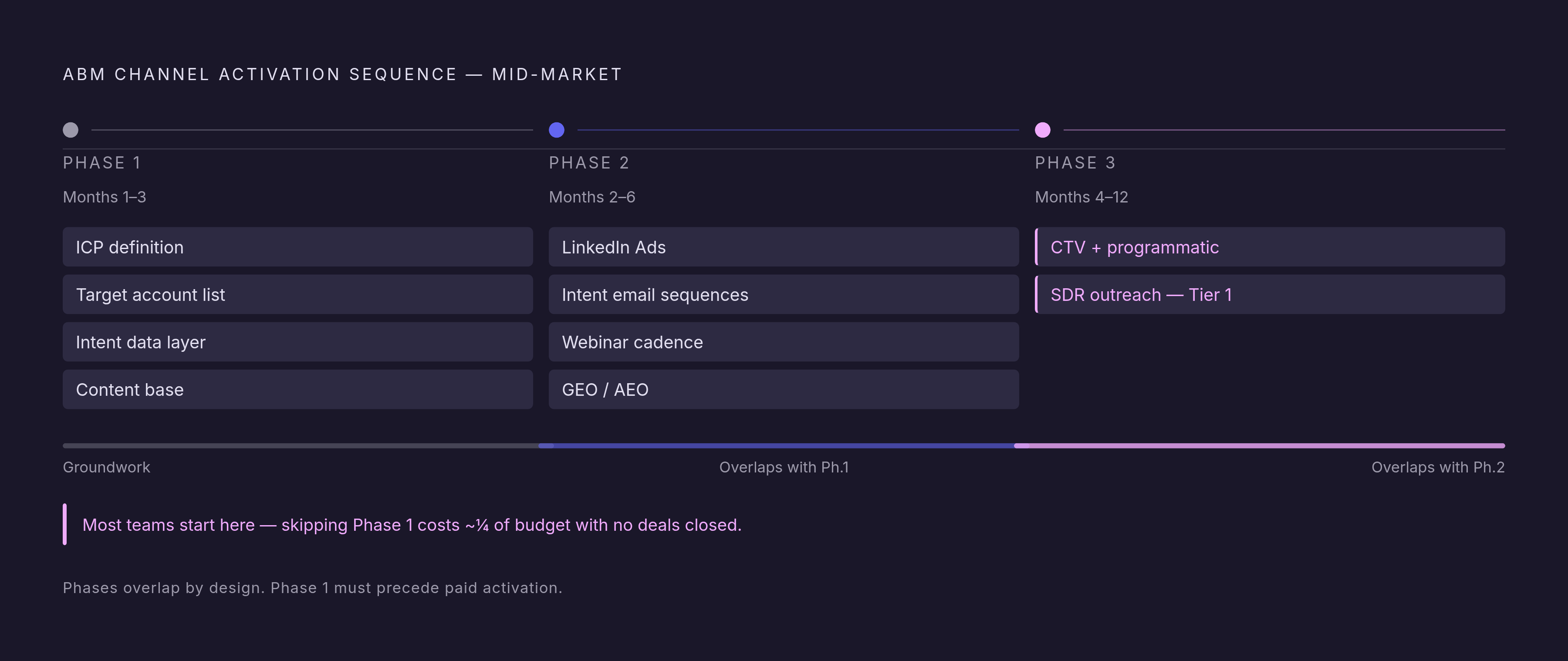
Phase one, spanning roughly months one to three, stays unglamorous yet non-negotiable: nail down your ICP, assemble the target account list, switch on the intent data layer, and have a content base in place. Even with great creative, channel budgets fail unless you finish the groundwork first.
Phase 2, months 2 through 6, is when paid activation begins. LinkedIn Ads drives awareness across the committee. When accounts start showing stronger signals, Intent-triggered email sequences take over. A steady webinar schedule keeps mid-funnel nurture going alongside the rest. GEO plus AEO keep going in parallel, compounding for less than every paid channel while pushing toward when AI-assisted buyer research begins surfacing that brand by itself.
In Phase three, running months 4 through 12, you layer in CTV plus programmatic display, aimed at accounts whose committees LinkedIn by itself can't reach in sufficient numbers. SDR outreach activates at this point as well, though just for Tier 1 accounts showing strong multi-signal intent rather than targeting the full list.
Mid-market teams usually sequence things the wrong way. They begin with paid media and SDR outreach since such channels seem busy, then add GEO and content as a late afterthought when paid results disappoint. Flip the order. Start with channels that build over time: GEO/AEO, content, organic reach. Layer paid activation onto accounts already showing signal. Hold back high-touch SDR hours until accounts are about to make an active buying choice. Teams that try to run every channel at full intensity from day one rarely have the data infrastructure or creative bandwidth to pull it off, which is the exact pattern behind DemandScience's finding that a quarter of budget goes toward campaigns that look busy but never produce a deal.
Measurement needs to change too. MQL count is a weak stand-in for how the pipeline is doing, and that gap gets bigger in this setup. Account-level pipeline measures, new deals opened, pipeline size for each account tier, deals closed segmented across tier, show the mid-market team if the sequence is doing its job.