Account-Based Marketing Content Strategy for B2B Teams
Personalized content built by account, role, and stage drives 26% higher win rates.

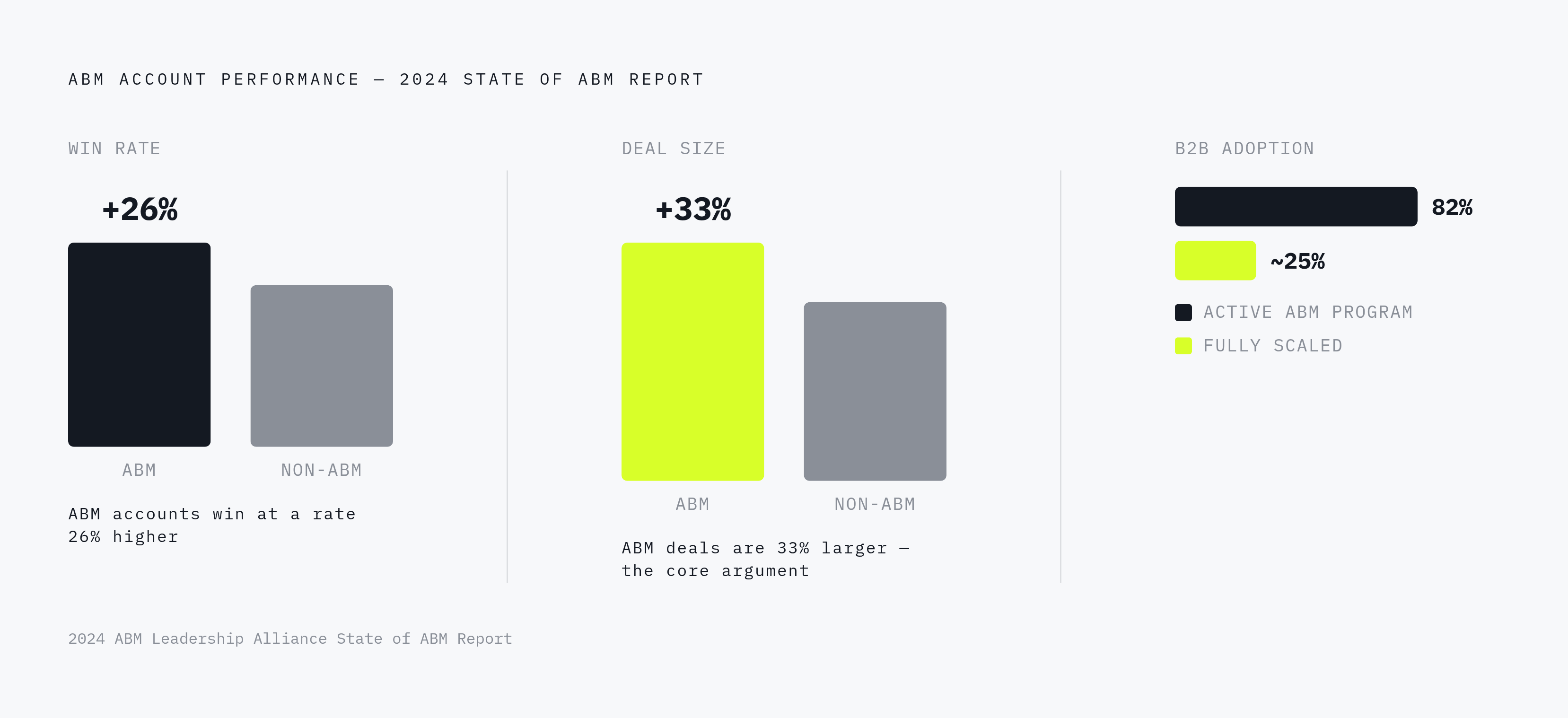
82% of B2B companies now run an active ABM program, according to the 2024 ABM Leadership Alliance State of ABM Report. Only about a quarter have a fully scaled program, and that gap between "running ABM" and "ABM that actually works" comes down to one thing more than any other: content strategy. Having a list of named accounts and calling it ABM is like buying a gym membership and calling yourself an athlete. The teams turning high-value account lists into closed revenue treat content as its own layer, built account by account, role by role, stage by stage. The ones skipping that layer are the ones asking why their win rates look flat.
That skipped step deserves a name, since it shows up everywhere: take a gated ebook already sitting on the server, slap "for [Account Name]" on the headline, and call it personalized. That approach fools no one on the receiving end. Real ABM content gets built for a specific account, role, and buying stage from the start, and the payoff for doing this right is substantial: the same 2024 report found win rates 26% higher and deal sizes 33% larger for ABM accounts versus non-ABM accounts. That gap is the whole argument for treating content as strategy, and it's worth understanding exactly how that layer gets built.
How the three-tier model determines content investment before a single asset is built
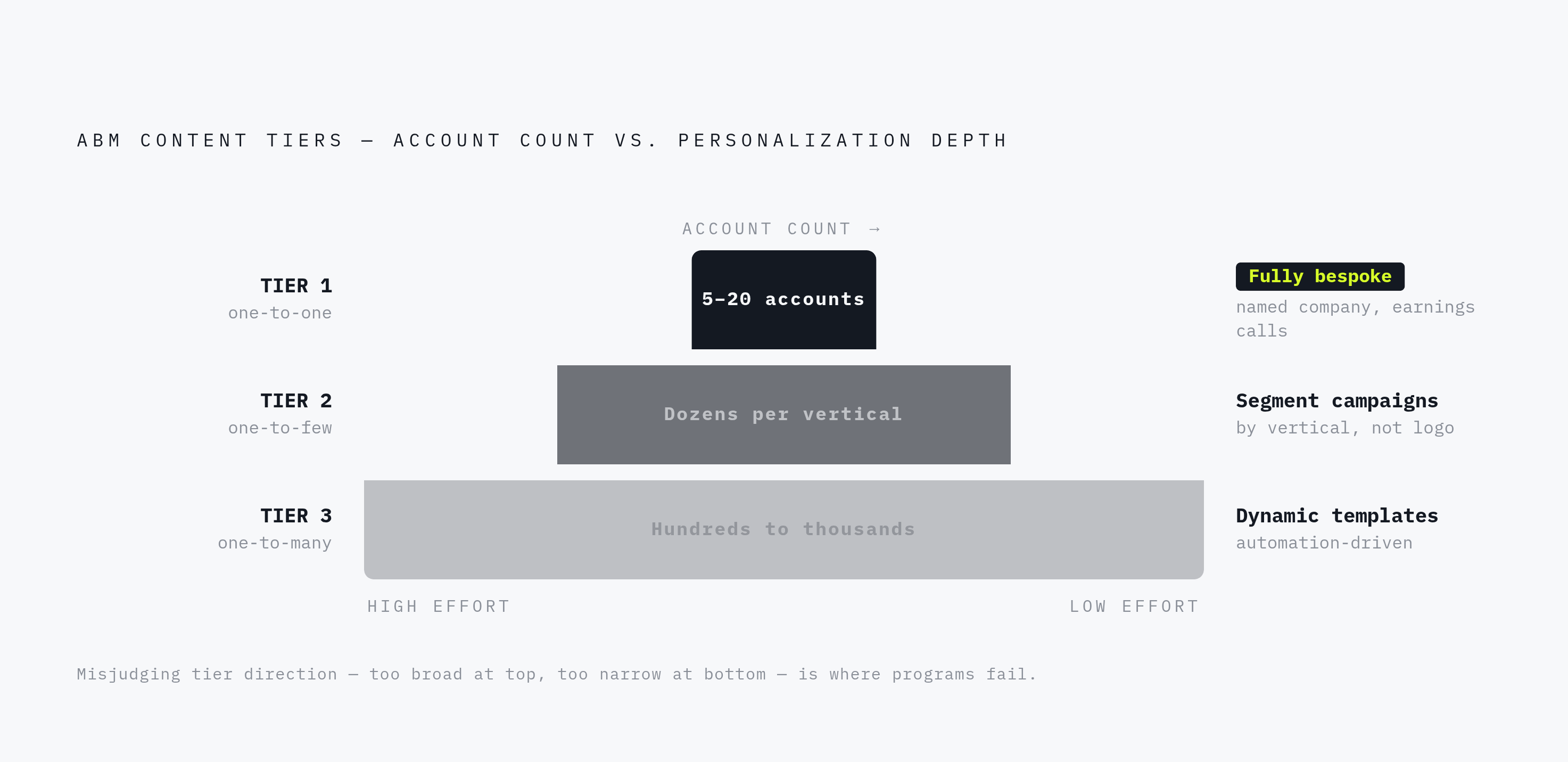
Every account doesn't deserve the same content budget, and pretending otherwise is how marketing teams burn six figures making custom video for accounts that were never going to close above five figures. The industry's answer is a three-tier model, and it earns its keep because it forces a resource decision before anyone opens a document to start writing.
Tier 1, one-to-one, covers a small cluster of the highest-value accounts, usually somewhere between five and twenty. Every asset here names the company directly, references its industry position, its stated priorities, sometimes language pulled straight from an earnings call or a public statement by an executive. The deal size has to justify that effort; nobody should be hand-building bespoke decks for a modest contract.
Tier 2, one-to-few, groups accounts by shared vertical or shared buying problem. This is the sweet spot for personalization at any real scale: a financial services compliance campaign, a healthcare data privacy campaign, a manufacturing supply chain campaign, each built for a defined segment instead of a single logo. Tier 3, one-to-many, runs on automation, dynamic content inserts reaching hundreds or thousands of named accounts at once. The accounts are pre-identified rather than anonymous, which sets it apart from traditional demand gen, but it still runs on templates, not custom work.
Skip the tier assignment, or get it wrong, and two failure modes show up fast. One is building Tier 1 assets for Tier 3 accounts, a habit no budget survives at scale. The other is sending Tier 3 templates to Tier 1 targets, which reads as exactly the lazy personalization that erodes trust with the accounts marketing cares about most. The second mistake tends to cost far more than the first. Overspending on a small account wastes money; underspending on a Tier 1 target that was ready to sign kills a deal that was already most of the way won. Bigger deal, more custom work; the math is that simple, and most teams that get it wrong get it wrong in the second direction.
Building content for buying committees, not individual leads
Here's a number that should reshape how anyone plans ABM content: the average B2B buying committee has 11 members, according to Gartner's 2025 research, spanning procurement, finance, IT security, legal, and multiple business units on a typical enterprise deal. Eleven people means eleven different sets of doubts about whether this thing actually works.
Gartner's research adds a second number that makes the first one sting: buying groups spend only 17% of their time meeting with potential suppliers at all. Content carries most of the persuading, quietly, before anyone from the vendor side is even in the room.
A single white paper cannot carry that weight, and treating one asset as if it can is the most common mistake in this entire piece. The CFO wants ROI evidence. The CISO wants a security posture that survives an audit. The end user wants proof the tool won't add three steps to a workflow that already has too many. Name the failure mode plainly: one lead downloads an asset, gets passed to sales, sales follows up with that one person, and the account goes quiet the moment that person changes jobs or just stops replying. That's how ABM programs lose committee-based deals they were positioned to win, and it's the single most common way a promising Tier 1 account goes cold for no obvious reason.
Buying committee coverage, meaning how many distinct roles at a target account have actually engaged with content, deserves standing as a primary ABM metric rather than a footnote in a quarterly deck. For Tier 1 and Tier 2 accounts, mapping each asset to a specific role and stage before writing prevents a common overcorrection: flooding the economic buyer with content while the technical evaluator gets nothing at all. There's a trust angle too, and it's not a small one. In the Edelman-LinkedIn B2B Thought Leadership Impact Report, 73% of B2B decision-makers said thought leadership content gave them a more trustworthy basis for evaluating a vendor than its marketing materials did. That's the format doing credibility work before a single sales call happens.
Matching content format and depth to account stage and buying signal
Account stage and funnel stage are not the same thing, and treating them as interchangeable is where a lot of content plans quietly fall apart. An account can look "aware" in aggregate while three committee members are still forming a view and two are already comparing vendors on G2.
Early-stage accounts, the ones still deciding whether the problem is worth solving, respond to thought leadership that doesn't lead with product: benchmark reports, vertical research, a point of view tied to their specific sector. Most of the actual buying behavior happens right here, in what's sometimes called the dark funnel, meaning research done anonymously on third-party review sites and peer communities, well before the account ever raises its hand.
Mid-stage accounts, actively comparing options, need content built around their specific context: use-case guides for their vertical, competitive comparisons framed around criteria they've already named as mattering to them, ROI models built on numbers typical of their industry rather than generic percentages pulled from nowhere in particular. Late-stage accounts need content that de-risks the signature itself: implementation roadmaps, evidence from similar companies that already made the leap, an executive business case narrative built so an internal champion can walk it upstairs without translating it first.
Intent data tells a team when to shift gears between stages. An account showing surging research activity on a competitor's review page needs something entirely different from an account still reading generic industry commentary, and getting that distinction wrong wastes the exact signal intent data exists to catch. Video earns its place specifically at mid-to-late stage, where a message built around a prospect's exact situation carries weight a static email cannot match; it justifies its cost mainly for Tier 1 accounts, where the deal size covers the production lift. It rarely justifies the cost for Tier 3, and teams that build video for Tier 3 anyway are usually solving a budget problem, not a content problem.
Rebuilding the content plan from scratch every time isn't required, though. One well-researched industry benchmark report can become a Tier 2 segment guide, a Tier 1 custom executive summary, and a Tier 3 dynamic email sequence, all from the same research work. The research gets reused; the angle and the depth do not.
Why personalization at scale requires intent data and AI working together
Intent data's job in content strategy is telling a team which accounts are researching which topics right now, turning content assignment into triage instead of guesswork. Underneath that sits a bigger shift: first-party data is becoming the foundation of the whole system as third-party cookies decline. Gated content, owned events, direct CRM integrations: this is where ABM teams are rebuilding the identity infrastructure that used to run on borrowed data.
AI's real job is scale, stretching personalization from Tier 1 bespoke work down to Tier 3 dynamic templates: generating account-specific variations, adjusting tone by role, flagging which accounts look ready to move up a tier. Yet there's a gap worth naming honestly, and it's the part most vendors leave out of the pitch. Research indicates broad adoption of generative AI tools among B2B content teams, but only a fraction have actually built AI into daily workflows with real guidelines attached. That gap is the whole problem: using AI to draft faster without strategic context just produces faster generic content. Buying an AI tool doesn't substitute for doing the tier and committee work covered above it; skipping that work just means AI writes the wrong thing faster than a human ever could.
Speed and quality get treated as a tradeoff, and that framing mostly breaks down when the inputs are right. AI paired with actual account-specific context, meaning real ICP signals, real intent data, and an editorial framework someone built on purpose, can turn out on-brand, account-relevant content at a pace manual production can't touch.
How sales and marketing alignment shapes the content plan from account selection onward
Full sales and marketing alignment is widely cited as vital to ABM success, and yet the most common failure pattern runs exactly opposite: marketing builds the campaign in isolation, sales was never consulted on account selection, and sales quietly ignores the output because nobody asked them first.
Account selection is where alignment should start, not where it gets checked afterward, and most programs get this order backwards. A target list built purely on firmographic fit, revenue band, employee count, industry code, will always miss something, because sales carries relationship intelligence and deal-timing knowledge no data vendor sells. What a rep hears in a discovery call about an account's internal politics, its stated objections, its budget cycle, is the raw material for the most credible Tier 1 content that gets made. If that intelligence never reaches whoever's writing the content, it never makes it into the asset, and the asset reads generic no matter how much research went into it.
Shared KPIs matter more here than shared tools. When marketing gets measured on MQLs and sales gets measured on pipeline, ABM content ends up optimized for the wrong outcome entirely, and no amount of alignment meetings fixes a scoreboard that's still pointed in two directions. Aligning both sides on account engagement, pipeline contribution, and deal velocity changes what actually gets greenlit for production. The weekly pipeline review, done right, becomes a content feedback loop: which accounts engaged with which asset, which message landed with which role, where buying committee coverage is thin. That's where the content plan actually gets rewritten, rarely in a quarterly planning deck nobody rereads. It's probably not a coincidence that top-performing ABM companies tend to have a dedicated ABM leader, a role sitting structurally between marketing and sales that owns content strategy as a revenue function rather than a branding exercise.
Measuring ABM content performance without single-touchpoint attribution models
Attribution ranks as a persistent ABM challenge across the industry, and it's worth being precise about why. This is a structural mismatch: single-touchpoint attribution assumes one path to purchase, and committee-based buying is multi-threaded and nonlinear by design.
Consider the CFO who never clicked a single tracked link but read three executive briefs, printed one, and approved the shortlist based on them. Last-touch or first-touch attribution renders that person invisible: the data says nothing happened, yet something very clearly did. Any team still reporting on ABM using last-touch attribution alone is measuring on the easier report to pull rather than the report that reflects reality.
A three-tier metrics hierarchy handles this better than any single-touch model can. Engagement metrics act as leading indicators, things like account engagement score and buying group coverage by role. Pipeline metrics sit in the middle, tracking target-account-to-opportunity rate, pipeline velocity, meeting conversion. Revenue metrics arrive last and carry the most weight: win rate, deal size, sales cycle length, revenue per account. Buying group coverage deserves particular attention because it does double duty, working as both measurement and diagnostic; knowing which roles at a target account haven't engaged with anything yet points straight at a content gap.
There's a timeline honesty problem too. Enterprise sales cycles mean ABM programs often require substantial time to show measurable ROI, and pulling investment early because pipeline hasn't closed measures the program well before it had a chance to prove anything. Here's the number that should worry anyone building a business case for ABM budget: Industry research suggests only a small fraction of ABM programs report closed-won revenue to leadership. Most programs are arguing their case on engagement metrics alone, leaving the most persuasive evidence sitting on the table. Build the revenue reporting structure before the program launches; waiting until leadership asks for it is waiting too long.
Putting the content strategy layer in place before scaling ABM investment
The sequence isn't optional, even when deadline pressure makes skipping steps tempting. Tier model, then committee mapping, then stage-and-signal matching, then content production, then a sales feedback loop, then a measurement framework. Each step leans on the one before it, and jumping straight to production just produces more content, not better content, a distinction that matters more than it sounds like it should.
Budget is rising fast enough that getting this sequence wrong gets pricier every year, and half of teams surveyed plan to raise ABM spend further from current levels. The maturity gap tracks the same story. Most organizations run some form of ABM, but fully scaled, mature programs stay a minority, and the difference is whether content strategy got built as deliberate architecture or assembled reactively, campaign by campaign, under deadline.
Speed becomes a real advantage once the strategy layer is in place. An account-specific brief, a clear editorial framework, and AI-assisted production can compress the time between an intent signal and a published asset considerably, which is what platforms like Letterstory, an end-to-end content automation system, are built around. The bottleneck was rarely writing speed; it was the missing brief to write from. Marketing leaders should hold onto a short list of things directly rather than handing them off: the target account list, the tier assignments, the committee role map, the content briefs, the measurement framework. These require judgment about which accounts matter and why, and that judgment doesn't come from a generic content tool or an agency retainer. It comes from the same place every number in this piece points back to: content built as the primary vehicle for moving a committee through a decision.