Account-Based Marketing vs Demand Generation for B2B
Mature ABM programs deliver 2.6 times more pipeline per dollar than demand generation.

Account-based marketing and demand generation solve different problems at different scales, and most B2B marketing leaders answer the "which one" question with gut instinct instead of math. Demand gen chases volume: fill the funnel with a broad set of qualified prospects using content, SEO, paid media, webinars, and email nurture. ABM concentrates money on a short list of high-value accounts and builds something closer to a personalized campaign for each buying committee. The real dividing line: demand gen counts leads, ABM counts accounts, and that gap in what gets measured explains almost everything that follows, including why most companies pick the wrong one.
How different the two markets are in size and investment tells you something about adoption patterns
Money moves toward whichever motion has had more time to prove itself, not whichever one works better. The demand generation services market hit $8 billion in 2024, headed toward $15 billion by 2033. ABM sat at $1.2 billion the same year, smaller by a wide margin, but growing at 12.4% annually through 2030, a pace demand gen isn't matching. The size gap is the less interesting number here. The growth-rate gap is the one that tells you where budgets are actually headed.
Most U.S. B2B digital ad spend still runs through demand gen channels, mostly because marketers keep buying what their budgets already know how to buy. That reflects muscle memory more than a verdict on which motion wins, and it's worth sitting with that distinction before treating market size as an endorsement.
Gartner's 2025 CMO Spend Survey put marketing budgets at 7.7% of revenue in both 2024 and 2025, down from an 11% average before the pandemic. Less money raises the stakes on the "which motion" question rather than lowering them; a shrinking budget is exactly the wrong time to keep funding a motion out of habit. The size gap between these two markets looks less like proof that demand gen is the smarter bet and more like a head-start artifact, the residue of whichever motion got invented first and calcified into how agencies staff up and how CMOs get promoted.
Where ABM adoption actually stands, and what "active program" obscures
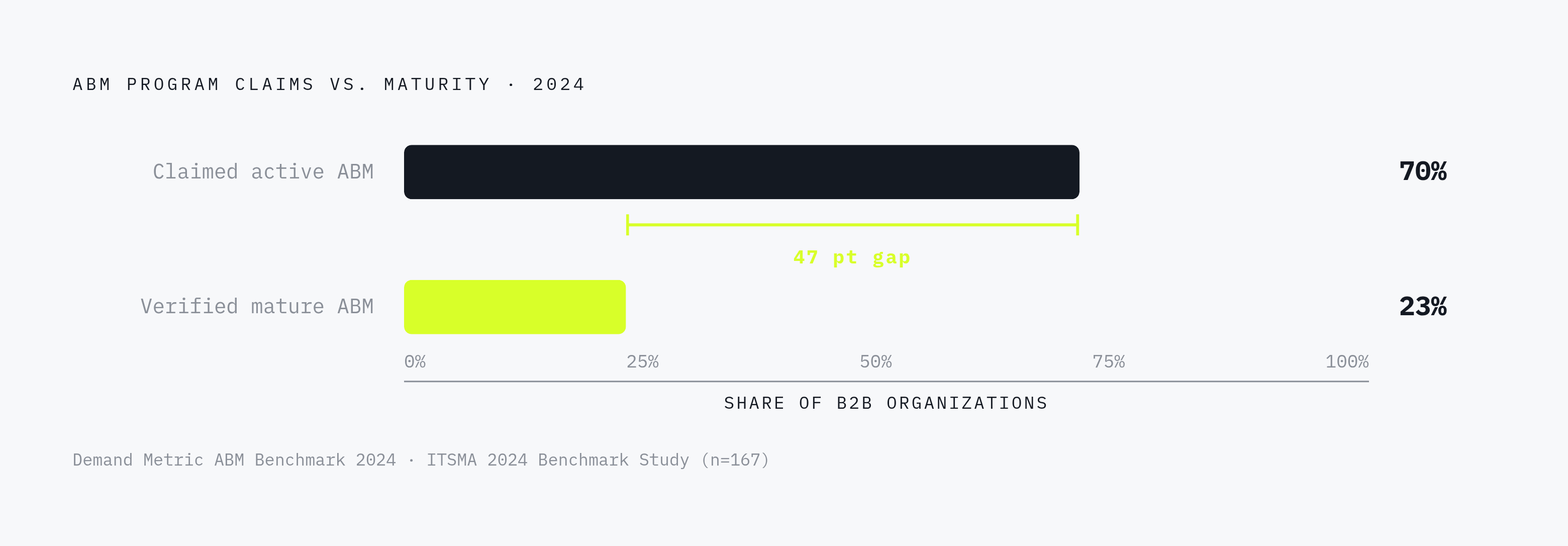
Seventy percent of B2B organizations said they were running an active ABM program in 2024, according to the Demand Metric ABM Benchmark Report, up from 49% in 2020. Read that number alone and ABM looks like it basically won the argument already.
It didn't. Only 23% of the ABM programs surveyed in the ITSMA 2024 Benchmark Study (n=167) qualified as mature: at least 24 months in market, documented account selection criteria, dedicated headcount, and integrated technology. Seventy percent claim the label; 23% built the actual infrastructure behind it. That 47-point gap is the whole story of what's wrong with how "ABM program" gets used. Most of what passes for one is a handful of personalized landing pages bolted onto an existing demand gen engine, with no targeting logic and no budget line of its own, which is a fancy way of saying it's demand gen wearing a name tag.
The Demand Gen Report's 2025 ABM Benchmark Survey found 40% of practitioners now integrating ABM directly with demand generation. The field is converging on a blend, and that matters for reading the performance numbers in the next section: those figures describe the mature 23%, not the 70% wearing the label loosely.
What the performance gap between mature ABM and broad demand gen actually looks like
Mature ABM programs delivered a 171% lift in qualified pipeline over matched non-ABM controls within 12 months of activation, per the ITSMA 2024 Benchmark Study, and that number only applies to programs at least 24 months old. Momentum ITSMA's 2024 Marketing Performance Management Study found a 208% increase in marketing-sourced revenue from ABM-engaged accounts versus inbound-only treatment. Data from the ABM Leadership Alliance and Demandbase adds texture: ABM-led programs generated 2.6 times more pipeline per marketing dollar than broad-reach demand gen, with win rates 41% higher and deal sizes 33% larger once an account converted.
Not every ABM program performs well, and the spread inside ABM itself proves it. TOPO's 2024 data put the top tier of ABM programs at a 7:1 ROI, with average programs closer to 3:1. That's a wide enough gap that fit matters as much as the motion. Run a mismatched ABM program against a $15,000 ACV product, and none of these numbers apply; the result is an expensive landing page dressed up as a strategy.
Demand gen has its own version of this gap, and it might be the more chronic one. The Content Marketing Institute found in 2024 that 74% of B2B marketers said they'd hit a goal around generating demand or leads in the prior 12 months. Only 49% said the same about generating sales or revenue. Demand gen is reliably good at creating activity; turning that activity into revenue is where it keeps falling short, survey after survey. That 25-point gap between leads hit and revenue hit is the whole argument for pairing demand gen with something that can close what it opens.
Why the growth of enterprise buying committees is pushing more programs toward ABM
Research consistently finds enterprise buying committees spanning many stakeholders, and significant purchasing decisions routinely cross multiple departments. Sell into that structure with a single-contact lead model and most of the committee never hears from a vendor directly. Ask who actually signs off on an eleven-person deal and the honest answer is: nobody alone, which is exactly the problem a single-lead funnel isn't built to solve.
The timelines make it worse. Gartner Peer Insights put the median enterprise buying cycle for deals above six figures in ACV at roughly 11 to 12 months in 2024. Buyers engage across many channels and complete a substantial portion of their evaluation before sales ever makes contact. Influence has to land at the account level, well before anyone raises a hand.
The multi-threading data makes the stakes concrete: reaching more stakeholders meaningfully increases close rates, while single-threaded outreach leaves most of the committee unengaged. Research adds a wrinkle that cuts against intuition: account-level personalization tends to improve buying-group consensus, while individual-level tactics can create confusion across a committee that hasn't aligned internally. That's the quiet failure mode of pointing a lead-based model at an 11-person committee. The model doesn't just underperform; it actively works against the thing it's trying to build, which is agreement among people who don't report to each other and mostly haven't met.
That doesn't mean every company needs ABM. It means companies selling into these committee dynamics face a structurally different problem than a company selling to one decision-maker with a purchase order, and pretending otherwise is where a lot of ABM budget goes to die.
The decision variables that determine which motion fits a given business
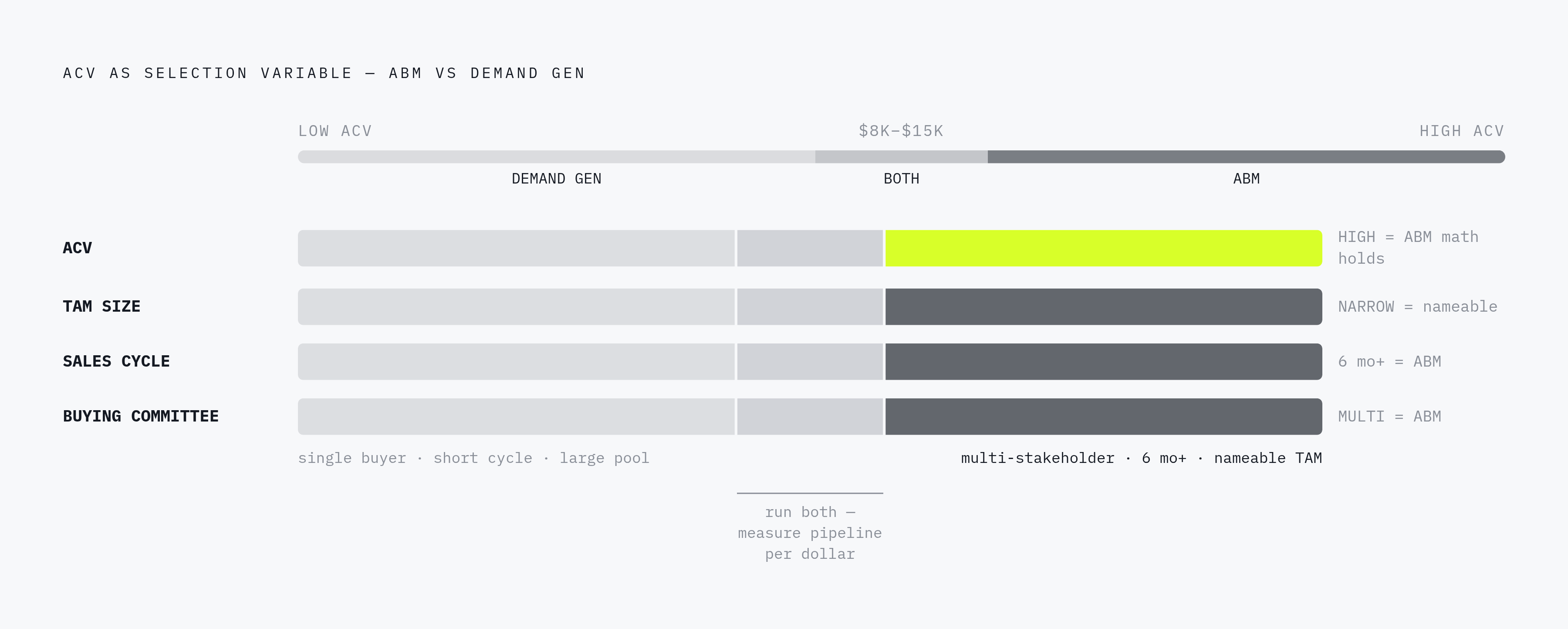
Four variables do almost all the predictive work: annual contract value, total addressable market size, sales cycle length, and buying committee complexity. Together they tell you whether personalized, account-level orchestration actually pencils out, or whether it's an expensive way to feel strategic.
ABM makes sense once ACV clears a high threshold, the sales cycle runs six months or longer, multiple stakeholders sit on the committee, and the TAM is narrow enough to name accounts individually. At low ACVs, the math flips hard: building a personalized campaign for one account usually costs more than that account will ever return, so volume economics take over by necessity, not preference. Anyone running full ABM against a self-serve $8,000 product is subsidizing a strategy their unit economics can't afford, full stop.
Demand gen also fits a context that has nothing to do with deal size: pre-product-market fit, when the real goal is figuring out which segments respond, not doubling down on an ideal customer profile nobody's validated yet. There's a middle zone too, a mid-range ACV with a semi-defined ICP, where the honest move is to run both and measure pipeline per dollar instead of guessing. As a rough anchor for the extremes: ABM fits high ACV, a narrow and nameable account list, and long cycles; demand gen fits lower ACV, a large addressable prospect pool, and shorter cycles.
Notice what's missing from that list: company size and team size. They determine how well a company executes a motion, not whether the motion's underlying logic fits the business in the first place. A 500-person company can still be running the wrong motion; size buys resources, not the right answer.
How demand generation performs on its own terms, and where its limits show up
Demand gen earns its keep before it gets compared to anything else. Forrester's 2024 B2B Marketing Attribution Study found marketing-sourced pipeline averaging 42% of total pipeline across B2B tech companies with $10 million-plus in ARR. That's demand gen carrying nearly half the load at scale, inside companies that presumably know what they're doing.
Individual tactics hold up too. Litmus put email marketing ROI at $36 for every $1 spent in 2024, one of the highest-return tactics in the entire demand gen toolkit when list quality and nurture timing are handled well. The Starr Conspiracy's Q3 2024 Benchmark Panel found ungated content getting an 8.7% engagement rate against 2.4% for gated assets. That's a wide enough gap to settle the gating debate with data instead of opinion: people are busy, and plenty will skip the form and skip the brand along with it.
The weakness is the one flagged above, the 74%/49% split between generating leads and generating revenue. Demand Gen Report's 2024 numbers put average cost per lead at $198, with SiriusDecisions putting MQL-to-opportunity conversion at 13%. At those rates, volume isn't a growth strategy so much as a mathematical necessity: the funnel has to stay wide because so little of what enters it converts. The limit here is structural, not a matter of sharper execution. Demand gen cannot manufacture consensus inside an 11-person buying committee. It builds awareness and surfaces intent signals across a broad market, genuinely useful work, but it has no mechanism for multi-threaded engagement at enterprise deal sizes. No amount of better copy fixes a structural gap like that.
Running ABM and demand generation together, and what that actually requires
Forty percent of practitioners are already blending ABM with demand generation, per the Demand Gen Report's 2025 survey, so the hybrid model isn't hypothetical. The logic is simple once it's spelled out: demand gen builds broad category awareness and surfaces intent signals across the market, and ABM takes the accounts where the deal economics justify it and runs coordinated, multi-stakeholder plays against them. Each motion feeds the other, if the sequencing is deliberate rather than accidental.
In practice, demand gen identifies which segments and accounts are actually engaging, and ABM picks up the highest-value ones for personalized orchestration. Account selection stops being a guess and becomes a data output. Making that sequence real takes more than good intentions, though. It takes a shared account list between sales and marketing, explicit criteria for when an account graduates from demand gen treatment into ABM treatment, and separate measurement frameworks for each motion. Judge both by the same metrics and one of them looks like it's failing when it isn't; that's usually ABM, since its wins show up as fewer, bigger deals rather than a spike in lead volume.
Here's the failure mode worth naming directly: calling something a hybrid while running plain demand gen tactics across every account and slapping an ABM label on top. That's exactly what produces the gap between the 70% who claim ABM and the 23% actually running it with any rigor.
Content production is where hybrid programs quietly break down. ABM needs personalized assets built at the account or segment level; demand gen needs volume across a much wider set of topics and formats. Teams that can't produce both at speed end up shortchanging one motion, usually the more labor-intensive one, which is ABM. The investment gap between the two markets partly reflects this: demand gen's volume-based playbook slots into most existing marketing stacks without much friction, while ABM's account-centric approach usually means bolting on new tools, new data sources, and workflows most teams haven't built. Letterstory, which pairs strategy-first topic planning with multi-channel publishing, is one example built to close that gap: it cuts the operational drag of running both motions by handling the content and messaging work either one depends on.
Choosing the right motion at your current growth stage
Early stage, pre-product-market fit: default to demand gen. The job at that point is learning which segments respond at all, not perfecting account orchestration against a target list that hasn't earned its own confidence yet.
Growth stage, with a defined ICP and a high ACV: ABM belongs as a primary motion, not a side experiment. The buying-committee data and the deal economics point the same direction, and treating ABM as a pilot at this stage just delays something that's coming anyway.
Scale stage, with a large addressable market and a mix of deal sizes: run the hybrid, with explicit tiering, named ABM accounts at the top of the list, demand gen coverage underneath for everyone else. The decision isn't permanent, either. A company that starts on demand gen to find its ICP tends to drift toward ABM as ACV climbs and the account list narrows. The job is building measurement infrastructure that catches that inflection point when it happens, instead of noticing it eighteen months late.
One pattern worth watching for: marketing leaders who hand this decision to an agency or a platform vendor tend to inherit whatever motion that vendor happens to specialize in, not the one their business actually needs. Owning the call is the prerequisite for everything downstream of it. And at every stage, speed of execution ends up mattering as much as the strategic choice itself. A team that can produce ABM-quality personalized content and demand gen volume without a production cycle measured in months holds a real advantage over one that can't. Strategy sets the direction, but content velocity decides whether the motion actually runs or just sits in a slide deck.