AI-Powered Content Platforms With Human Editorial Review
Human editors catch errors before publishing, not after readers spot them.

AI-driven Content platforms publish more in weeks than most newsrooms once did, though reader trust hasn't grown with the volume. Only one mechanism closes the gap: human editorial review in the workflow, not stapled on once content is already live. Platforms that fix errors before they publish justify what subscribers pay. Others spot them only afterward, when the fallout is already out in the open.
In 2026, roughly 312 million AI-assisted pages went live monthly, versus 2024’s 82 million. AI helped create 38% of company content in 2026, versus 26% during 2025 and only 14% in 2024. Marketing groups have folded AI into everyday practice universally: 86.4% now include it in their workflow, and content creation leads as the use case, at 42.5%. That adoption is evident in how marketers characterize their current roles, with 83.5% indicating AI has increased content demands and 35.7% reporting "much more".
The content is out there, in amounts no newsroom could ever produce on its own. Trust hasn't kept pace, nor should it, at least not now.
How often AI content gets things wrong
When Stanford's AI Index checked 26 leading frontier models, hallucination numbers swung wildly from 22% to 94%, swinging depending on which one ran what task. This isn't a few outliers bugging out on tough problems. It’s every leading system, inventing facts with frequency that varies wildly depending on the test.
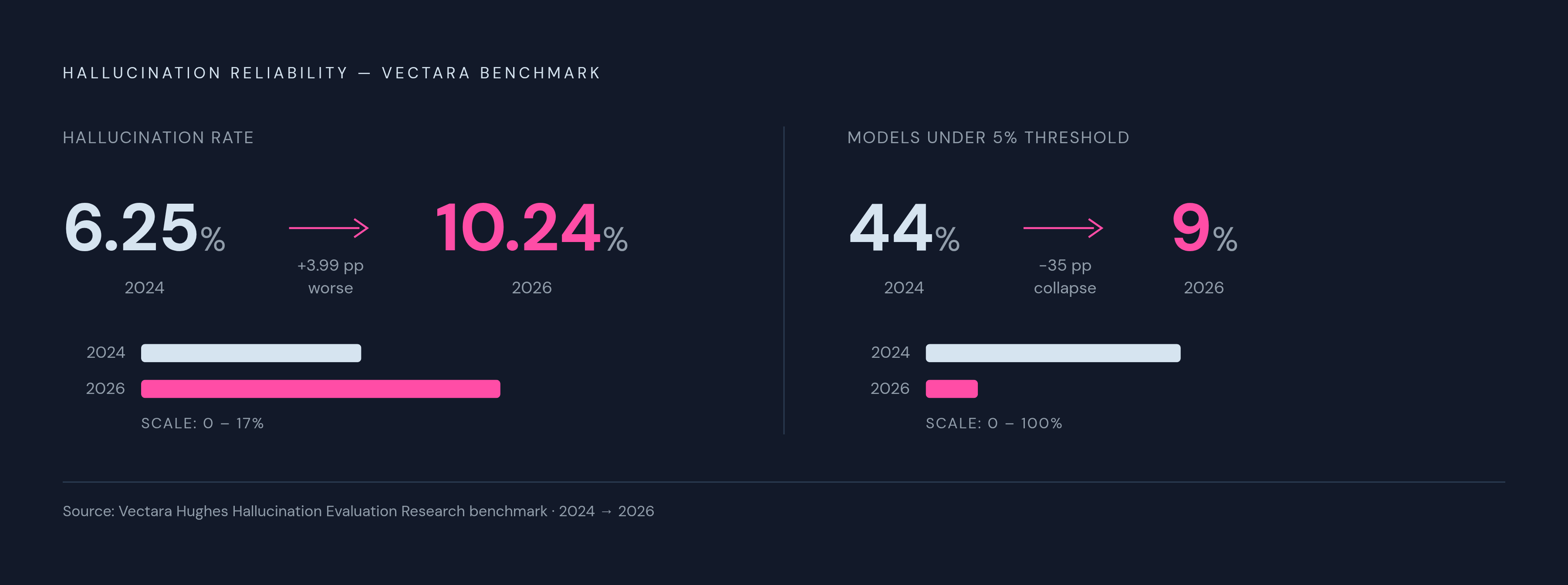
Reliability shifts between runs, too. GPT-4o's accuracy varied between 98.2% and 64.4% depending on the test setup, while DeepSeek R1 fell from over 90% to 14.4%. Strong results on one quarter's benchmark don't guarantee the next quarter's output. Vectara's summarization benchmark, tracking how often models invent details while condensing text, points to the same drift: the hallucination rate climbed from 6.25% in 2024 to 10.24% in 2026, and the portion of models keeping a hallucination rate under 5% fell from 44% to just 9%.
This stops being theoretical the moment it lands in an article. These mistakes in published articles carry real consequences. Fake quotes, bad numbers, and misdated dates ruin journalists and bring lawsuits in marketing.
Why mixing AI output with human editing outperforms either approach alone
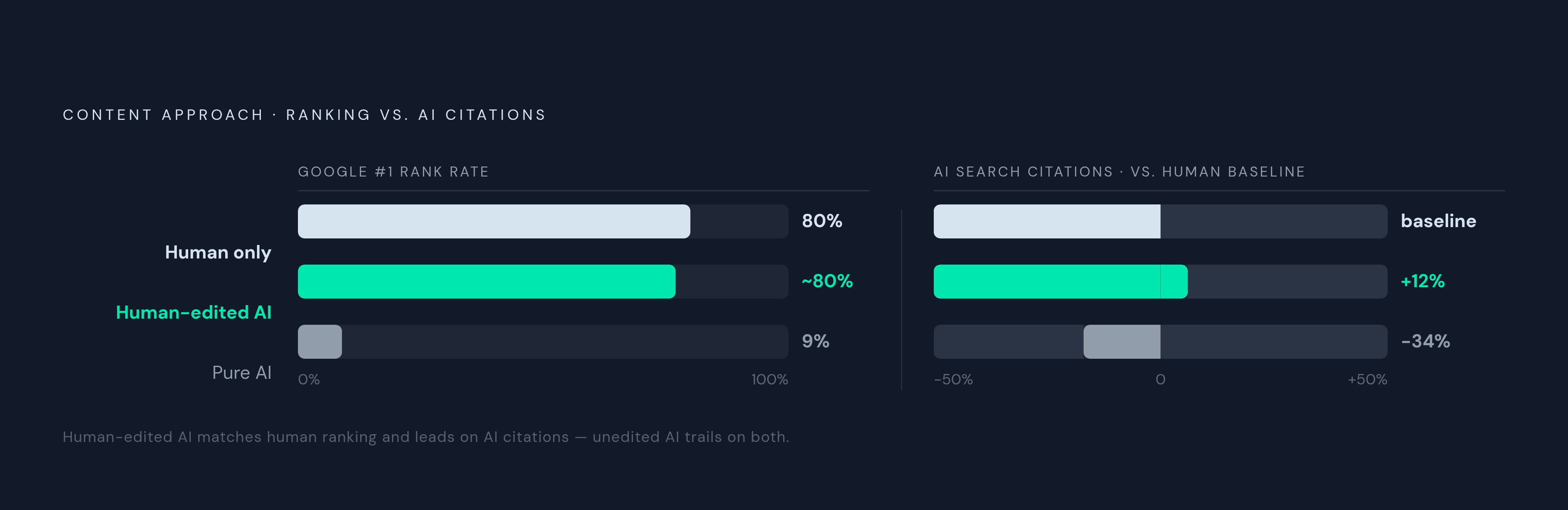
AI-generated content with no human editing sees 34% worse performance in AI citations, and Google rankings drop 28%, versus AI content after a human edit. AI-assisted content that goes through human editing earns 12% more AI search citations than stuff written entirely by a human, skipping the tools altogether. Both extremes fail. The blend wins: AI supplies structure and breadth fast, while a human editor shapes it for what ranks and reads clearly.
Semrush's ranking data shows AI-generated pages reach Google's number-one spot in just 9% of cases, compared to 80% for pages written by humans. Content Marketing Institute's findings point the same way: organizations pairing AI drafts with human editorial oversight pull more engagement and conversions than those relying on raw AI output. That editorial layer does real performance work, as the data above shows. The stats above show it: this layer delivers measurable performance work.
How a well-designed human-in-the-loop workflow functions
When Human-in-the-loop works, it threads checkpoints across every step instead of dumping the load onto a single overworked editor. From draft review to Prompt refinement, verification to brand alignment and sign-off, human input belongs throughout.
Smart platforms layer this work so editors skip what a machine catches first. Automated checks come before review, flagging factual problems, brand voice drift and SEO signals, then what clears the filters goes to a human editor. Tiering makes sure human judgment earns its place instead of burning out over typo-hunting.
Grammar, spelling, dead-link checks, readability scores, SEO formatting and brand terminology checks all run without human input. Put the human effort toward decisions a machine can't handle. Is this on brand? Does this claim check out? Would the lawyers clear it?
How Contently, Writer, Jasper, and others have architected their review layers
Contently builds its enterprise product on this principle. Each enterprise account has a managing editor folded into its account structure from the start, someone who spent decades working in newsrooms such as Wired, The New York Times, and The Wall Street Journal. It's part of the account structure from the start. That setup is part of the account structure from the start. The platform's AI Studio runs automated grammar, dead-link sweeps, and readability checks before a factcheck module checks every figure and named entity against documents, surfacing all conflicts to the editor's queue ahead of publishing. Beyond that, a vetted roster of over 160,000 freelance journalists and designers stands ready. A Fortune 500 financial services firm using Contently's governed workflow logged sales-qualified leads with a 32% jump and revision cycles with a 45% cut after half a year.
Writer tackles a separate concern. Its guardrails enforce compliance while the content is being created, not afterward. For medical, law, and financial services groups, finding a violation before there is a draft beats finding it in editorial review, because a compliance failure can mean a regulatory filing, lawsuit, or penalty. That's a regulatory filing.. Writer serves organizations where compliance concerns outweigh brand voice.
Jasper follows a different route. When a team loads its guides and messaging onto the platform, brand voice enforcement stays steady across various people writing content, something general-purpose tools lacking that context can't do.
Averi stands apart as more of a strategic content system than an editorial review platform. It includes Brand Core, Strategy Map, Content Queue, scoring weighted 55% SEO with 45% GEO, analytics, and CMS publishing. The tool targets startups and groups that lack a content strategy, rather than organizations requiring strict editorial oversight. Solo costs $99, Team $199, Agency $399, and there's a 14-day test period with no charge.
Two editorial models that show what human oversight looks like at different scales
Across its titles in the UK, Newsquest has set up over 30 "AI-assisted reporters". They use News Creator to draft as many as 30 stories each workday, and journalists review and add to each piece before it runs. This model handles high-volume, scale-based publishing, freeing reporters to do their own journalism rather than basic drafting.
Velora Cycling runs it the other way: a lone editor, the newsroom. AI handles drafts, tagging, fact-checking, choosing photos, and publishing online, yet a human editor checks it all: someone who used to work at Cyclingnews, offering insight no machine can't produce. A skilled editor with domain expertise can now produce, at former team scale, a credible specialist publication.
They differ in scale, not approach. Newsquest spreads oversight among many reporters reviewing machine drafts at scale. Velora concentrates oversight in one expert who checks everything before it runs. Both need a human layer to succeed.
The Associated Press is a helpful benchmark to look at. AP's newsroom rules let AI handle summarization and transcription, headline drafts, grammar, spelling, and optimization, yet an AP staffer has to check and fix every AI output before it publishes. AI is kept away from reporting, verification and fact-checking, as well as editorial judgment, while generative AI remains barred outright from producing or altering news photos. They have to tell readers when AI does real work on what gets published.
What happens when organizations skip the editorial layer entirely
Meta stands out as today's clearest cautionary case. The Financial Times reported that Meta is speeding its push to swap AI models for people across content review, aiming to let machines do most ad and content checks while cutting over 90% of the content review team in some areas.
The case for automation that broad is not fabricated. Faster enforcement, more even oversight applied to a workload no human team could review one by one. But automation runs like this hit the wall hallucination studies already mapped: AI cannot grasp context, nuance, and hard calls needing human judgment, the same failure modes hallucination findings had warned about.
Meta's job of moderating user-generated content in the billions isn't the same thing as making brand content with editorial accountability and obligations. Choosing an automation-first tradeoff may be entirely defensible given Meta's reach, yet entirely reckless for any brand publishing under its own identity. Mixing them up gets a content team into the sort of headline nobody wants.
The regulatory requirements that now make human review a legal obligation in some contexts
On August 2, 2026, Article 50 under the EU AI Act kicked in, so providers and deployers running particular AI tools now face transparency obligations. The EU's AI Office put out a voluntary Code of Practice for Transparency of AI-Generated Content with standardized labeling icons; large AI providers have already joined. Breaking the rules means noncompliance fines of €15 million, or 3% of global turnover per year, whichever tops out, and it reaches outside the EU to catch any deployer whose AI output is seen by people there.
Organizations can judge if their content informs citizens on civic issues and qualifies for the editorial-responsibility exemption that includes human-review. That exemption applies only to organizations that already had a genuine editorial structure, not one put together once a regulator starts asking questions.
Fines reach $53,088 each time, and a non-disclosed item is treated as its own case. One major push caught by enforcement can rack up millions in fines before attorney costs even kick in.
Evaluating whether a platform's human review layer is real or cosmetic
Is human review part of the workflow by design, or does the buyer's team have to bolt it on afterward? One way cuts down the work over time. The other just shifts the work to a different place and treats it as finished, a bad fix dressed up as a selling point.
Evaluate four things: the point in the workflow where human review gets triggered, what the automated pre-filters screen before content reaches a human editor, if brand intelligence is loaded once or re-explained with every draft, and if the platform keeps an audit log detailed enough for compliance purposes. Is human review triggered in the workflow before publish, or does after-the-fact review leave the harm already out there? Which issues do automated pre-filters flag before content reaches a human editor? Does the platform load brand intelligence once, or must it be re-explained for every draft? And does the platform maintain an audit log sufficiently detailed to satisfy a regulator?
Team scale and appetite for exposure should shape the choice, not vendor decks. Regulated fields like healthcare or financial services require pre-generation compliance enforcement over post-generation fixes, the very gap Writer targets. A niche specialist publication might get by on a single editor whose judgment spots what the machine can't, just as Velora Cycling runs. Growth shifts the setup. The need stays the same.