Coaching Styles That Actually Change Sales Behavior
A data issue dogs Sales coaching: no one can show it even occurs, or that its form resembles what affects rep behavior. Research shows 91% of companies with a formal coaching process achieve their quotas, yet a minority of sellers report receiving weekly coaching. Coaching takes up under 5% of most managers' time, while the gap between what managers and reps say about the same conversations keeps widening. The reasons aren't buried in organizational complexity. Managers cite time pressure, no way to tell if coaching landed, and, bluntly, that nobody showed them a framework.
What coaching brings when it helps
Gartner research, as quota.training cited it, found that just 26% of coaching sessions result in measurable behavior change. Most coaching, then, doesn’t shift the needle. It's a weak standard, but there's a reason for it. The interactions that clear it share one trait: they follow a structured model, applied consistently, instead of an ad hoc "let's jump on a call" conversation with nothing behind it.
The performance data supports this. Organizations running a coaching program achieve 91% of their quota, versus 85% for those without one. Coaching produces an 88% gain in sales output, compared with a 23% gain from training, so what a manager gets back from coaching time is far bigger than the value of another product-training session. Allego cited Korn Ferry research that found steady coaching programs lift win rates by 32%, boost quota attainment by 28%, and cut turnover by nearly 30%. Reps who are coached remain, and managers who have had to backfill quota-carrying roles understand that 30%.
How coaching frequency functions as the structural floor
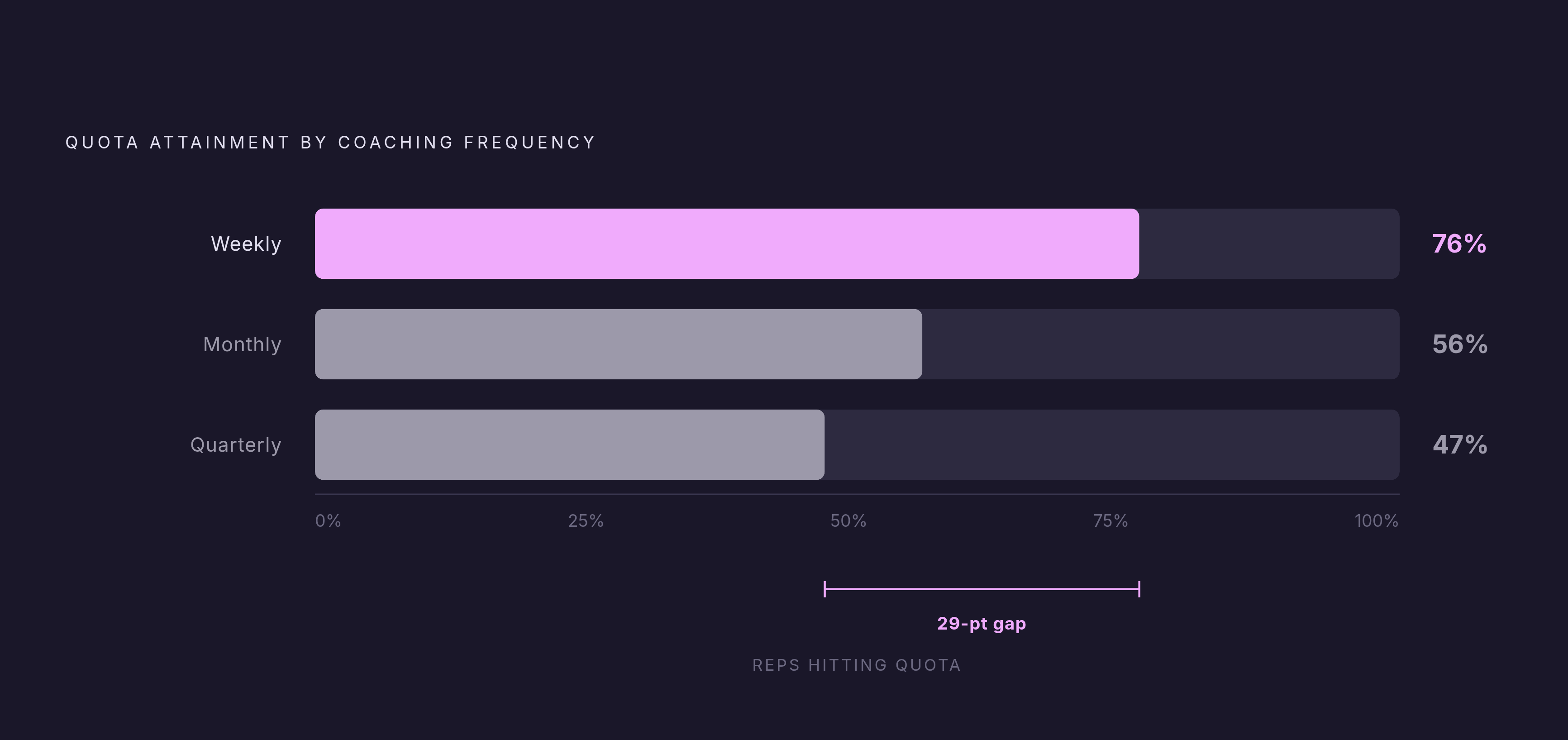
Frequency is the foundation holding it all up, and a staircase pattern shows in the data. Coached weekly, 76% of reps hit quota. Coaching drops to 56% when done monthly. Coaching just once a quarter puts the figure at 47%. The gap is nearly 30 points when comparing a rep coached weekly to one coached quarterly, and it follows cadence, not skill or patch.
One big thorough session per quarter seems productive but falls flat. Consistency matters more than length. Research shows that consistent weekly coaching beats a one-off deep-dive, and ATD figures shared by an analyst body show coaching every week trims a typical rep's ramp by 27%. People get to peak output sooner with regular coaching than rare long sessions, and ramp time costs pipeline however a leader frames it.
The fulfillment data tells the same story from the rep's perspective. According to MySalesCoach, a substantial majority of SDRs with regular, strong coaching say they're happy at work. For reps who get hardly any, it drops to a small minority. High-performing groups maintain this rhythm through a single habit: they never mix skills coaching with pipeline review or forecast meetings. Blend them, and a manager can't do either job right, feeding the widening gap separating reps from managers.
The directive-to-non-directive continuum
Coaching style is no binary choice between directing reps and using open-ended prompts. Coaching style exists along a range, and the right spot for any conversation comes down to the rep and what's happening, not the manager's preference for one style over the other.
Skills coaching leans toward the directive side, focused on pushing quick performance gains. Developmental coaching leans non-directive: it grows judgment and perspective over time. Coaching exists along a continuum from directive to non-directive. DIRECTIVE COACHING IS THE RIGHT CALL WHEN A REP IS PICKING UP A SKILL, NEEDS A PROCESS REINFORCED QUICKLY, OR HAS A GAP THAT DEMANDS URGENT FIXING, SUCH AS ADHERING TO A DISCOVERY FRAMEWORK OR MOVING A DEAL WITHIN THE MEDDICC TRACK. Directive coaching won't build the self-reliance reps need to figure things out without a manager nearby. It's the right call when a rep has the competence and simply needs space to think and own the work.
Managers who use the same approach with every rep are bringing in the bottom results here. Carew's two models show the problem in plain terms. GROWTH (Goal, Reality, Options, Way Forward, Track, Hold Accountable) fits reps who are ready and willing to work out the answer alone. Direction, for reps who are newer or unsure: Define outcome, Give the steps, Clarify understanding, Offer feedback. Running GROWTH with a rep who's still ramping up kills the session outright: he needs clear direction, not an open-ended conversation.
Matching framework to moment: GROW, SBI, OSKAR, FUEL, and GROWTH in practice
The choice of framework matters less than choosing one and staying with it. Supered.io points out that every popular method walks the talk through the same steps: name the goal, look at the reality, let the employee suggest options before anyone else does, and agree on what happens next. That sequencing matters because, when time is tight, the manager's default instinct is to hand the rep the solution. A framework's job is to head off that impulse, not to hand the manager extra paperwork.
GROW (Goal, Reality, Options, Will), from Sir John Whitmore, Alan Fine, and Graham Alexander, is the top framework in sales coaching. It’s the default in goal-setting conversations since it structurally prevents any manager from dumping solutions on a rep who hasn’t processed things yet.
SBI (Situation, Behaviour, Impact) works in its own way. It strips personal reaction and opinion from feedback, holding the conversation anchored to what’s observable. It works best for post-call debriefs, since a manager has to flag one exact instance in a call, like the rep skipping discovery, without sparking defensiveness.
OSKAR (Outcome, Scaling, Know-how, Affirm, Review) flips attention to the parts going well, not diagnosing the gaps. It's the right framework when a demoralized rep needs momentum instead of more gap hunting. Using OSKAR with a self-assured rep whose execution is sloppy wastes the conversation. Using SBI on a rep who's fried just hurts more. The situation drives the choice. The manager's habit has no say.
What reps want versus what managers believe they're giving
Reps care about coaching. Ninety-four out of a hundred say it boosted how they perform, with 82% calling it vital. Reps clearly want the coaching; that side is settled. That side fails when sales leaders, 43% of them, miss that their reps need more coaching than they get. That visibility gap sits with the manager's team, not with the rep's motivation.
Beyond the frequency mismatch, what they talk about is also wrong. Half of sellers ask for skill-building guidance, yet what managers deliver leans far more on KPI review, pipeline metrics, and deal projections. These frameworks bridge that gap: reps receive what they requested when a manager running SBI reviews an actual call, or applies GROW during a conversation about building skills. A manager running through pipeline stages for the fourth week in a row does not, even if that manager calls the conversation "coaching" on an internal survey.
Job satisfaction doesn't belong on the margins as some fluffy extra tacked onto hard metrics. Korn Ferry reports 30% lower attrition where managers hold regular sessions, a pattern the turnover data cited earlier ties straight to coaching frequency. Rep and outcome are the same metric, viewed from different sides.
What AI tooling does for coaching scale, and where it still needs human judgment
AI has quickly become part of sales coaching. 81% of sales groups work with it today, and data from Salesforce's State of Sales gathered at hyperbound.ai shows AI report 83% revenue gains against 66% for those without it. That gap is big enough that using AI no longer sets top performers apart from lagging ones. It's basically required at this point.
What actually counts on the ground is two ways of working with AI, and good teams do both instead of choosing one. AI role-play happens before a call: the rep rehearses with a simulated customer and gets it wrong where the stakes don't matter. Conversation intelligence runs the opposite way, looking at actual calls once they're over. They work in a continuous loop: conversation intelligence spots where a rep is stumbling, that determines the role-play a manager assigns, and later call reviews show if the improvement stuck.
This loop’s impact is tough to ignore. Highspot's GTM Performance Gap Report says AI-guided coaching programs improve win rates by 36%. Visa saw seller confidence climb 78% after bringing in AI-powered pitch practice. Sellers who use AI well make quota at 3.7 times the rate of those who avoid it. Still, picking the framework for each rep in each situation stays the manager's call. It just leaves that manager with more data to decide from, and offers the rep extra reps to practice with before it shows up on an actual customer call.
Building a coaching system where style, structure, and cadence reinforce each other
Coaching that shifts behavior needs all four pieces working together, and dropping one weakens the others. Frequency is the base: a fixed weekly rhythm, blocked off from pipeline and forecast meetings, so a manager can't slip into a deal-status review in place of real coaching. Style follows: the rep's development stage drives the choice between directive and non-directive approaches. Framework choice comes from that read: GROWTH or GROW for developmental conversations, SBI for call feedback more than critique. AI tooling sits above the rest, adding more role-play reps and surfacing what conversation intelligence catches between meetings.
Metrics close the loop and show if any of this is truly effective. That calls for watching indicators for discovery and call-quality, plus lagging measures such as quota attainment and win rate. Pipeline data shows early signs typically shift within 90 days, letting a boss see genuine behavior improvement long before sales results can adjust.
Most sales managers get this wrong, but that HBR research on the "middle 60%", the people who aren't failing or already at their limit, also shows where to spend time. Structured coaching compounds best when directed at the middle group before it expands outward to other performers once things are running. Pouring more coaching into the smaller group of top performers is the easy play, keeping those jewels safe, but that's a mistake: these reps already win without much support, while the middle group often benefits most from additional coaching.
One leadership style can’t carry this on its own, either. A blended approach, transformational for big-picture goals, coaching to grow each rep, servant leadership to remove friction, and transactional methods for accountability, works because the pieces reinforce each other. No one style can support a coaching system by itself. The arrangement works because the pieces strengthen one another, not because any single piece runs well on its own.
Sources
- Ultimate guide to successful sales coaching in 2026
- Sales Coaching Techniques That Actually Work: Frameworks for Every Situation - Carew Sales Training
- Sales Coaching Models: 5 Frameworks That Scale Performance
- 16 Sales Coaching Stats That Prove It's Worth It in 2026
- 2026 Sales Coaching Benchmarks: Key Insights for Teams
- deelan.ai
- salesassembly.com
- mysalescoach.com