Coaching vs. Managing in a Sales Team
Effective coaching builds lasting capability while managing maintains short-term accountability.

Managing keeps the lights on. Coaching builds the team that no longer needs the lights turned on for them. These are not two points on the same spectrum; they are fundamentally different disciplines, operating on different logic, serving different timelines, and requiring different skills to execute well. High-performing sales teams are run by people who understand the distinction precisely enough to know which one a given moment demands.
Managing is results-oriented. Quota, pipeline, process adherence, accountability. Direction flows one way: manager sets expectations, rep executes, manager measures the outcome. Feedback in management mode is generalized, calibrated around whether the process is being followed and whether the number is being hit. This is necessary work. Without it, no accountability structure exists and results become unpredictable.
The trap is that managing feels like developing people because it involves regular contact. Contact is not development. When a manager asks "where is this deal?", she experiences that conversation as investing in her rep. The rep experiences a conversation entirely about the business's needs, not his own growth. Those are not the same conversation, and conflating them is where the dysfunction begins.
Coaching operates on entirely different logic. It is development-oriented: changing behavior, building skill, improving capability over time. Communication flows both ways. The coach asks, listens, draws out. The rep arrives at insight rather than receives instruction. Feedback is personalized, because what addresses one rep's blind spots is irrelevant to another's.
Here is the mechanism that most managers miss: when a rep arrives at a solution herself, even the identical solution the manager would have handed her, she takes far greater ownership of it. That ownership is what produces behavior change. Directing produces compliance, sometimes. Coaching produces internalization. And coaching is oriented toward the journey, not the destination. It pays off in future performance, not this quarter's number, which is precisely why organizations under pressure consistently deprioritize it. The ROI is real; it just doesn't show up in time for the board meeting.
Why these two roles get collapsed into one (and what gets lost when they do)
The collapse happens at the point of promotion. Most sales managers were elevated because they were exceptional individual contributors. The skill that earned them the role is not the skill the role most requires. Organizations routinely assume that because someone was a successful salesperson, they can develop others by instinct. The cost of a formal development program looks harder to justify than the cost of leaving the gap, so the gap persists, and nobody names it.
The numbers are clarifying. Only about a third of sales managers have ever received any training or support to become more effective coaches, according to MySalesCoach's State of Sales Coaching research. Two-thirds have had none. Only one in five sales leaders currently has a coach themselves. These are not incidental omissions. They represent a structural assumption that coaching ability is inherited rather than developed, which is roughly as logical as assuming good salespeople are born that way.
The practical consequence is predictable: one-on-ones default to pipeline review, and development conversations get crowded out by deal inspection. And the people who suffer most from this arrangement are not the top performers, who are largely self-directing, and not the struggling reps, who demand urgent attention. The people who lose the most are the middle sixty percent of the team: the cohort with the most addressable upside, the performers who will move significantly with the right investment but who never quite rise to the top of the urgency queue. That is the cohort that scales a team. That is also the cohort most reliably neglected when managing and coaching get treated as interchangeable.
The gap between how much coaching managers think they give and how much reps actually receive
There is a perception gap in sales organizations that should be disqualifying for any manager who hasn't reckoned with it. The vast majority of leaders believe they are providing at least monthly coaching. Substantially fewer reps report receiving it with any regularity. The gap is not close, and it is not new.
It gets worse at the margins. A significant portion of reps say they are never or rarely coached, and nearly half rate what they do receive as below average, a figure that has risen meaningfully in just one year, per MySalesCoach's 2026 data. When the math breaks down, managers default to three predictable modes: deal inspection instead of skill development, coaching concentrated unevenly on favorites or whoever presents the most urgent problem, and feedback loops slow enough that they've lost the contextual relevance that makes them actionable.
Consider the call review numbers. Less than one percent of sales calls get reviewed by a manager, according to research from Avoma. At a span of twelve or more reps, each making dozens of calls per week, the arithmetic makes meaningful individual coaching nearly impossible without structural support. A manager doing their best in that environment is still not coaching, by any rigorous definition of the word.
I want to be direct about what this is and isn't. The gap is primarily a structural and capability problem, not a motivation problem. This matters because motivation-based diagnoses produce motivation-based interventions, and motivation-based interventions do not fix structural problems. You can't run faster if the road is washed out.
The structural reasons managers run out of time before coaching begins
Frontline managers spend somewhere between thirty and sixty percent of their time on administrative tasks and meetings, according to McKinsey research. Coaching competes with what remains. Spans of control are expanding: the average manager oversaw just under eleven reps in 2024, rising to over twelve in 2025 per Gallup data, with some organizations running spans of twelve to fifteen. The math leaves very little room for anything that isn't urgent.
When nearly a third of managers cite lack of time as the top barrier to coaching more, per MySalesCoach 2026, that is downstream of span of control and administrative load. Fixing it requires fixing structure, not scheduling discipline.
The capability gaps compound the time problem in ways that rarely get discussed honestly. A meaningful segment of managers struggle to measure coaching impact. Others acknowledge they need more support on how to coach effectively. Still others lack experience coaching across different roles and developmental stages. These are not character flaws. They are organizational failures to invest in the people doing one of the most leveraged jobs in the company, and they tend to stay invisible until the attrition numbers make them undeniable.
A manager who is overstretched, undertrained, and unable to measure impact will default to what she can measure: pipeline numbers and activity metrics. Which returns her, reliably, to managing rather than coaching — not because she chose to abdicate development, but because the environment made coaching the least defensible use of her time.
What the performance data shows when coaching actually happens
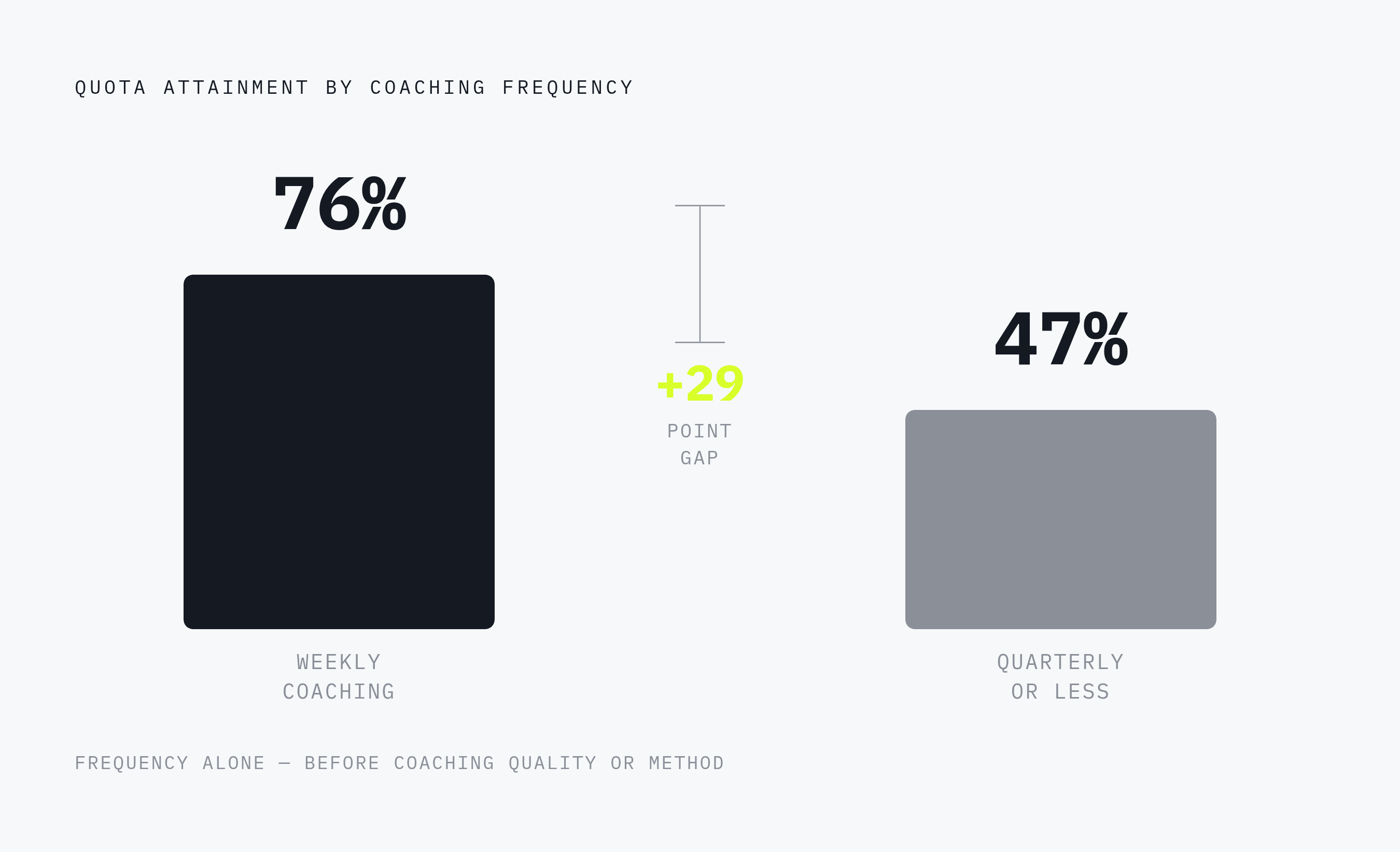
The performance data is not ambiguous, and I'll just give you the numbers straight.
Teams coached weekly achieve seventy-six percent quota attainment compared to forty-seven percent for those coached quarterly or less, per MySalesCoach research across more than thirty-seven hundred sales professionals. That is a twenty-nine percentage point gap attributable to frequency alone, before accounting for quality or method. Companies with a formal coaching process realize ninety-one percent of total quotas compared to eighty-five percent for those operating without structure, per CSO Insights data cited in Qwilr's research. These are not marginal differences. They determine whether a team makes the year.
Coaching also dramatically outperforms training when the two are compared in isolation: an eighty-eight percent increase in sales productivity from coaching versus twenty-three percent from training alone, per Qwilr. Training is a starting point. Coaching is what converts learning into durable behavior change. Most organizations have the ratio backwards, funding training events and assuming the behavior change follows.
The aggregate performance gain in most organizations comes not from the top of the distribution but from the middle. High-quality coaching can elevate quota attainment among the middle sixty percent of performers by up to nineteen percent, per Qwilr. That is the cohort that determines whether a team scales. And yet nearly three-quarters of sales managers spend less than five percent of their time coaching. Read those two numbers together and you have a precise picture of where the performance gap lives and why it persists.
What coaching does to retention (and what turnover costs when coaching is absent)
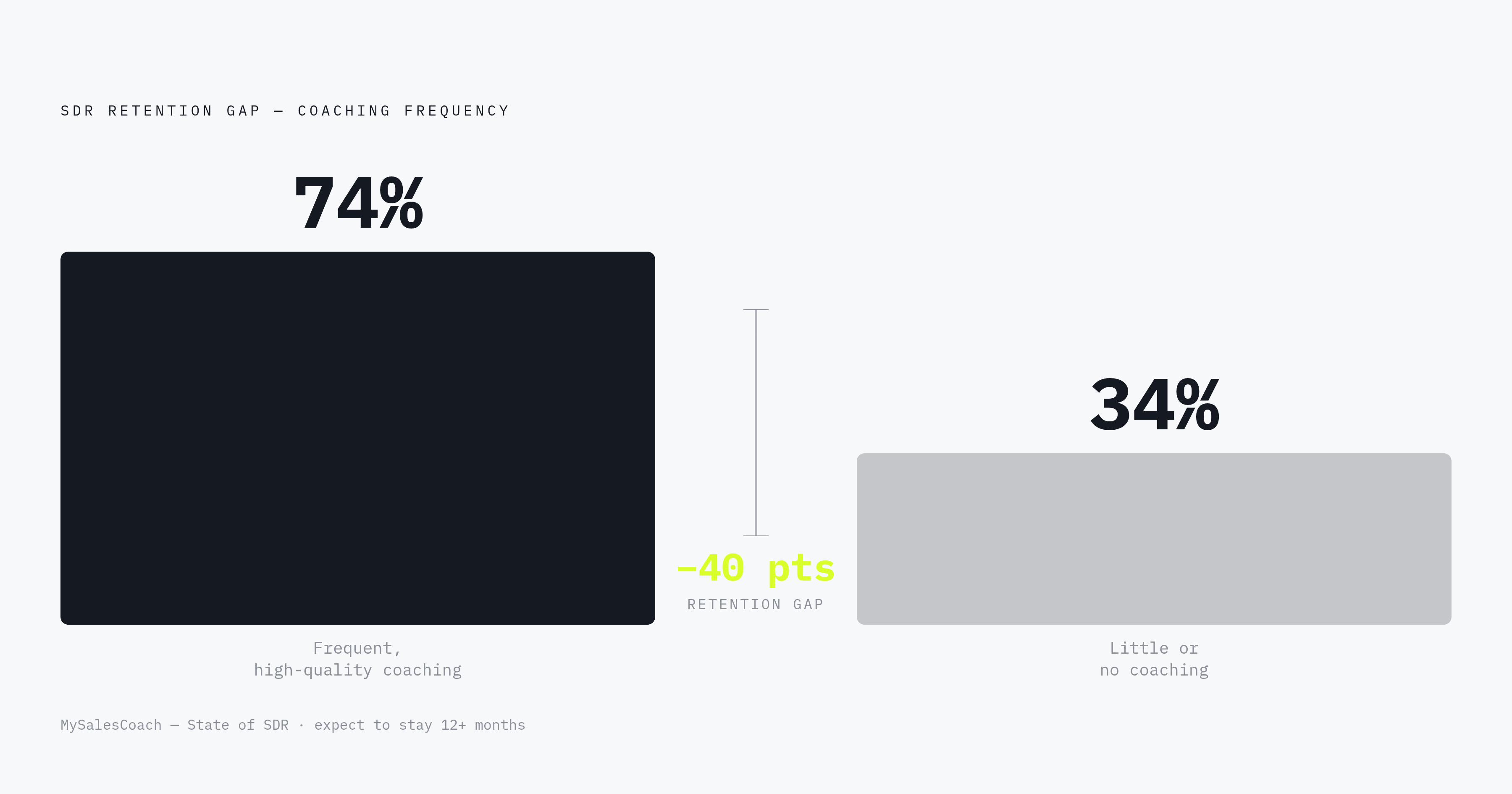
The retention data mirrors the performance data almost exactly. Among SDRs who receive frequent, high-quality coaching, nearly three-quarters expect to still be with their company in twelve months. Among those who receive little to no coaching, that figure falls to thirty-four percent, per MySalesCoach's State of SDR research. Forty percentage points, driven by coaching quality and frequency alone.
A Gallup meta-analysis found that employees who strongly agree their manager invests in their development are substantially less likely to leave within a year. LinkedIn's Workplace Learning Report found that a large majority of employees say they would stay longer at companies that invest in their growth, and that top performers feel the absence of that investment fastest. This tracks with what you see on the ground: your best people have the most options, and they will use them when they stop growing.
The cost of turnover is not abstract. Replacing a sales rep runs one and a half to two times annual salary, per Hire Velocity estimates. And the compounding effect is what makes this genuinely corrosive: during periods of high turnover, managers spend a quarter to half of their working hours on hiring. That is time away from coaching the reps currently on the team, which accelerates the conditions that produce the next round of turnover. The cycle is self-reinforcing, and it does not break by hiring faster. It breaks by retaining better. And retention runs through development.
The conflict of interest built into asking managers to be coaches
There is a structural conflict embedded in the manager-as-coach model that rarely gets named directly. A sales manager's quota is often the sum of her team's individual quotas. That alignment of incentives makes it genuinely difficult to separate coaching for a rep's long-term development from coaching to close this quarter's pipeline. The two can look identical in a given conversation, but they serve different masters, and a rep usually knows which one he's in.
An external coach occupies a categorically different position. She has no number to make, which frees the coaching conversation to follow the rep's development rather than the pipeline's urgency. The conversation can go where the rep actually needs it to go. Per Anthony Iannarino, the stakes of the coaching conversation change fundamentally when the coach has no stake in the outcome. That is not a small thing.
The rep preference data reflects this. Fifty-nine percent of reps prefer external coaching over coaching from their manager, per MySalesCoach 2026, down from sixty-six percent the year prior, which suggests internal coaching quality is improving. But the majority preference is still clear, and only twenty-three percent of reps prefer coaching from their manager. That number is worth sitting with for a moment if you're a manager who believes you're coaching effectively.
The implication here is not that managers should stop coaching. It is that the coaching a manager can provide has structural limits, and awareness of those limits is itself a form of leadership competency. This resolves not as a binary choice between internal and external coaching, but as a design question: what does the manager own, what does an external resource own, and how are the two coordinated so the rep receives a coherent developmental experience rather than competing messages from people with different agendas?
How high-performing teams structure the boundary between coaching and managing in practice
The teams that get this right start with the meetings themselves. Pipeline reviews are management conversations. Dedicated coaching sessions are development conversations. The agenda signals the mode before the conversation begins, and keeping them separate prevents one from colonizing the other. When a manager tries to do both in the same hour, deal inspection wins every time. Every time.
They also personalize by role and stage, which sounds obvious and is rarely done. SDRs need call coaching on fundamentals: prospecting, talk-to-listen ratios, handling early objections, qualifying. Account executives need deal coaching, advanced objection handling, executive presence. Delivering the same session format to everyone on the team is a quality failure, not just a quantity one. Nearly four in ten reps describe their coaching as too generic, per research from MySalesCoach and Aircall. Generic coaching is a signal that the manager is managing at scale rather than coaching individuals, and the reps know the difference.
The frequency differentials between top-performing and average teams are striking. Research from the Sales Management Association finds that top performers receive roughly fifteen coaching interactions per month while the industry average sits around four. That gap is where performance and retention diverge.
Investing in managers as coaches, rather than simply as managers, is an organizational choice. The majority who have received no coaching training are not that way by accident; they are that way because their organizations have not prioritized it. Among high-performing companies, more than half are using sales coaching more than in the past, and a majority have integrated it into their sales training programs as a foundational component rather than a supplement, per ValueSelling research.
The leader's job is to know which mode a given moment calls for. Accountability conversations require managing. Behavior change requires coaching. The discipline is in switching between them deliberately. For most managers promoted from individual contributor roles, the default is managing, and that default will hold until the organization builds something that interrupts it. The gap is structural. So is the fix.