Coaching Leadership Style Examples for Sales Teams
Weekly coaching lifts quota attainment by 29 points over quarterly check-ins.

Coaching leadership in sales is a set of specific, repeatable moves: the questions a manager asks instead of the instructions they give, the way a deal review gets run, the plan a rep walks into a big call holding. This piece is about what those moves look like in practice, because "be a better coach" is advice you can't do anything with until someone points at the exact behavior and the exact moment it applies.
Coaching, done well, means a manager acts more like someone whose job is to surface the answer already sitting inside the rep, then connect that answer to something bigger than this quarter's number, and less like a foreman handing out tickets. Directing tells a rep what to do. Coaching helps them figure out what to do and why it matters, a distinction that can sound thin on paper until you watch it play out in a real one-on-one. Five behaviors tend to show up wherever this is done well: active listening that catches tone and hesitation and not just the words themselves, a multi-year view of a rep's growth instead of a fix-it-by-Friday mentality, enough emotional intelligence to tell a confidence problem from a skills problem, feedback that shows up constantly instead of getting saved for a review cycle, and a habit of thinking about what the whole team knows, not just the one rep in the room. Directing still has its place. A manager still tells a brand-new SDR exactly what to say on a cold call. The mistake is defaulting to advice-giving in the moments that actually call for a question.
Why the gap between believing in coaching and actually doing it is costing sales teams revenue
Ask sales leaders if they coach their people and almost all of them say yes, regularly. About 90% report coaching at least monthly. Ask the reps, and the number craters. Only 62% say they get coached on any regular basis. Somewhere between the manager's calendar and the rep's inbox, a lot of coaching just evaporates, which raises an obvious question: where exactly does it go?
Look closer and it gets worse. MySalesCoach surveyed more than 3,700 sales professionals and found 41% of reps say they're never or rarely coached at all, and 45% rate the coaching they do get as below average, up from 29% the year before. That's a trend line pointed in exactly the wrong direction, and it's happening while leadership insists coaching is a top priority.
The structural explanation isn't mysterious once you look at where a manager's week actually goes. Frontline sales managers spend somewhere between 30% and 60% of their time on admin and meetings that have nothing to do with developing anyone's skill. Stack that against a growing span of control (Gallup puts it at 10.9 reps per manager in 2024, climbing to 12.1 in 2025) and the math simply doesn't close. Twelve direct reports, half the week eaten by admin: there aren't enough hours left to coach everyone, so managers default to deal inspection, which looks like coaching from ten feet away but is really just checking pipeline status. What little developmental attention survives gets spent on the top performers and the biggest headaches. The middle of the roster, which is most of the team, gets left alone.
Here's the irony worth sitting with: 74% of leading companies name sales coaching as the top priority for frontline managers. Nobody's lying about the intent. It just runs headfirst into a calendar that was never built to hold it, which is the exact gap the rest of this piece tries to close with behaviors that don't require inventing new hours in the day.
What the evidence says coaching frequency actually does to quota attainment
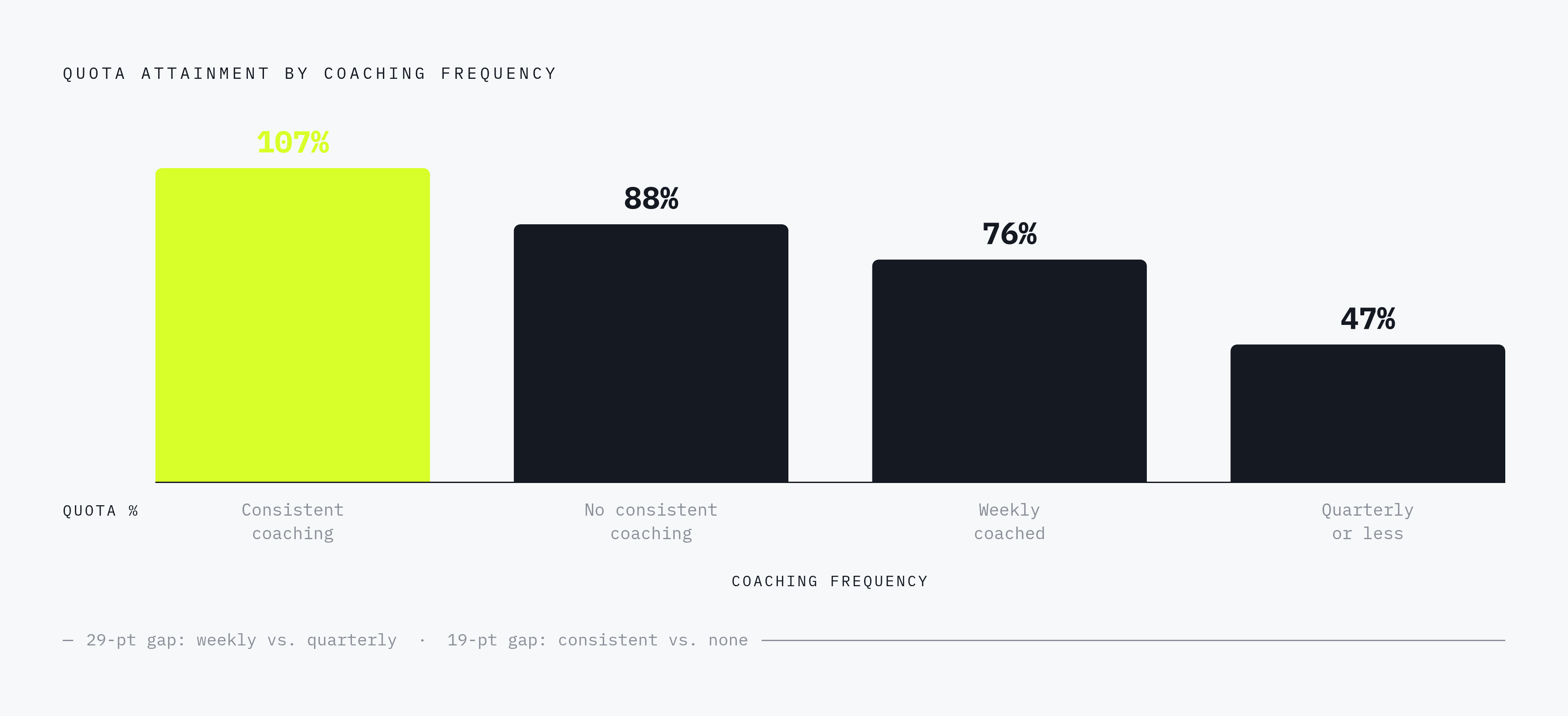
This is where the abstract turns into something you can put a number on. MySalesCoach found teams coached weekly hit 76% quota attainment, against 47% for teams coached quarterly or less. A 29-point spread, and frequency is the only variable moving.
Other research tells a similar story from a different angle. Reps who get consistent coaching hit 107% of quota, versus 88% for reps who don't; frequent, structured coaching tracks with a 21-point lift in quota attainment and a 19-point lift in win rate. Aberdeen Research adds another layer: structured coaching programs correlate with 28% higher win rates, and real-time, deal-specific coaching links to an 8.4% year-over-year revenue increase, a 95% improvement over companies skipping that level of involvement. McKinsey's work on B2B sales organizations found continuous coaching drives 19% commercial growth, against 8% for coaching that only happens now and then.
Line these up and a pattern shows up that's easy to miss if you're only looking at one study at a time. The gap between "some coaching" and "structured, frequent coaching" is bigger than the gap between "no coaching" and "some coaching." Doing it occasionally barely moves anything; doing it on a rhythm is where the return actually shows up. Which means the intent-versus-execution gap from the last section might be the single most expensive gap in the entire sales operation, and the rest of this piece is about what "structured and frequent" looks like once you get specific about it.
Asking diagnostic questions instead of issuing directives (the GROW model in a sales one-on-one)
GROW, short for Goal, Reality, Options, Will, came out of work by Sir John Whitmore and Graham Alexander and it's still the most widely used coaching framework anywhere. It also happens to be the cleanest way to watch the difference between coaching and directing play out step by step.
Picture a one-on-one running through it. Goal: "What are you actually trying to close this quarter?" Reality: "You're converting a fraction of your proposals right now. What's getting in the way?" Options: "Give me three things you could try differently." Will: "Which one are you actually running with, and what does success look like two weeks out?" Notice what's absent from that whole sequence: the manager never once says what they'd do. The rep builds the plan. The manager just holds the frame steady.
There's a gut-check managers can run on themselves mid-conversation, sometimes called the WAIT check: Why Am I Talking? The second a manager feels "what I'd do is..." forming in their mouth, or "next time, just...", they've quietly stepped out of coaching and into instruction. Nothing wrong with that, necessarily; sometimes instruction is exactly the right call. The point of the check is making the switch a choice instead of a reflex.
A GROW-structured one-on-one eats roughly the same fifteen or thirty minutes a status update would anyway. What changes is what the rep walks out holding: a plan they built themselves, versus a plan they're waiting to be handed next Tuesday. One easy way to wreck this, and it happens constantly: a manager asks "what's your plan?" and then corrects the answer the moment the rep stops talking. That's a coaching question wearing a directive's clothes, and it only counts as coaching if the manager genuinely didn't already have the answer loaded up.
Co-creating a call plan before a high-stakes meeting
An AE has a discovery call coming up with a buyer who reports to the CFO. The directing manager says "here's what to cover." The coaching manager asks questions, and whatever plan comes out the other side belongs to the rep, not to the manager who ran the meeting.
The questions doing the actual work: "What do you already know about how this buyer makes decisions?" "What's the one thing you need to learn on this call to move the deal forward?" "What objection worries you most, and how are you thinking about handling it?" None of these are softballs. They force the rep to do the pattern recognition themselves, with the manager's experience sitting behind them as a backstop rather than getting handed over as a script.
Fair question to raise here: isn't co-creation just the manager checking out? The manager still brings the years of watching similar deals go sideways or close clean; the difference is they make the rep reach for that thinking first, instead of handing over the answer before the rep's even tried. A written plan, even three lines in a shared doc, turns the whole exercise from a vague pep talk into something with a paper trail, a reference point for the debrief once the call's actually happened.
Do this ten times and something shifts that a directive never produces. A rep who's built ten pre-call plans this way starts to internalize the thinking pattern itself. A rep who's received ten pre-call instructions is, on the eleventh call, exactly as dependent as they were on the first. No more, no less.
Running deal reviews as learning sessions rather than status updates
Most deal reviews follow a script nobody wrote down but everybody knows by heart: "Where's this deal?" Rep answers. Manager offers a tactical note, maybe flags a concern, meeting ends. That's inspection, and it looks like management from the outside.
The coaching version asks different questions aimed at the rep's reasoning, not the deal's status: "What does the buyer need to believe to say yes?" "Who in their org could kill this deal, and have you actually met them?" "What would have to be true for this to close this quarter?" These don't produce a status update. They produce a rep who has to actually think through the deal's mechanics, which is a different exercise entirely, and a harder one.
High-performing teams keep deal coaching and pipeline review as two separate meetings, on purpose. Merge them and the coaching time gets swallowed by admin every single time, because admin is louder and feels more urgent in the moment. There's a team-level payoff too: when a manager works through a stalled deal with one rep in front of the group, the whole room picks up the diagnostic framework, not just the one person whose deal it was.
Microsoft's "Model, Coach, Care" framework, associated with Satya Nadella's tenure, put a name on this exact separation. Leaders were expected to model the behavior they wanted, coach the reasoning underneath it, and care about the person doing the work. That framework gets credited with helping triple the company's market value within five years, alongside a broader shift in the sales culture around cloud. It's a leadership-culture result rather than a controlled experiment isolating deal reviews as the single cause, sure, but it's a real data point for what this kind of separation looks like at scale.
Call observation and objection-library building as a team-level coaching behavior
Listening to a rep's call and then grading it is the fastest way to make someone dread call reviews. Asking "what do you feel went well?" before adding anything else changes the whole tone of the conversation, because self-assessment before feedback tends to land softer and stick better.
Conversation intelligence tools that record, transcribe, and analyze sales calls mean a manager spends less time hunting through a recording for the moment things went sideways and more time actually talking about what happened. That reclaimed time is the entire point. It turns call review from a chore into a conversation worth having.
There's a bigger structural move sitting underneath this, too: the objection library. Across enough calls, the same handful of objections keep showing up (price, timing, "we already have a vendor"), and a manager who writes down how the team's best performers actually respond to each one is building something that outlasts any single conversation. Individual coaching moments, which normally evaporate the second a one-on-one ends, get captured and turned into shared team knowledge. New reps ramp faster, and the library outlives any one manager's tenure or any one rep's memory. It's coaching built into infrastructure, which matters given that coaching's productivity lift (reported around 88% in some studies, against roughly 23% from training alone) seems to come from doing both at once. The library is where those two things actually fuse together.
Personalized development plans for reps at different career stages
A development plan built for a brand-new SDR probably doesn't fit a five-year enterprise AE. Treating both the same way just wastes a manager's limited coaching hours on the wrong problem for at least one of them.
There's a documented case from a regional bank wrestling with high turnover, where a manager held weekly one-on-one coaching sessions with each team member focused specifically on career goals and skill gaps, then built individual plans and handed out stretch work matched to what each person actually needed. Retention went up 35%, and three people on that team moved into leadership roles within eighteen months. Not a sales floor, granted, but the mechanism translates directly: attention, paid consistently and tailored to the individual, changes whether people stick around.
On a sales team specifically, the coaching priority shifts by role. SDRs usually need the most call coaching, since they're running the highest volume of a repeatable motion. AEs need deal coaching, because their job is judgment under uncertainty, over and over. Senior reps often need something else entirely: developmental coaching around influence, higher-stakes negotiation, or the early muscles of managing people. There's a trap worth naming directly here, because teams fall into it constantly: lavishing coaching attention on new hires while quietly assuming tenured reps have it figured out. RAIN Group's research found sellers are 63% more likely to be top performers when they have an effective manager, regular coaching, and solid training, and that number doesn't come with an asterisk exempting anyone who's been around five years. None of this needs an elaborate HR process, either. A shared doc with three agreed improvement areas, a rough timeline, and a standing check-in beats a formal plan that gets written once and never opened again.
Role-play and low-stakes simulation as a coaching mechanism before live deals
Role-play, in a coaching context, is the manager playing the buyer (badly or convincingly, depending on the scenario) while the rep runs the actual pitch or objection sequence. Nobody's grading anything in real time. The whole value of the exercise hinges on it being safe to fail.
Without real money or a real relationship on the line, a rep can try a framing that flops, stop mid-sentence and rethink out loud, or ask for a second to collect their thoughts, none of which is available on an actual call with an actual buyer watching the clock. The debrief afterward follows the same ask-first order as everything else here: "What felt strong?" and "Where did you feel like you lost the room?" before the manager adds a word of their own.
Some scenarios earn their keep more than others: cold-call openers, discovery calls with multiple stakeholders in the room, late-stage negotiation, and the specific, dreaded moment where the buyer says they're going with a competitor. That last one tends to expose something a deal review never will, which is whether a rep's hesitation is a confidence issue or an actual gap in process. The two look nearly identical from the outside and need completely different responses. Telling them apart is where a manager's emotional intelligence earns its keep.
What coaching leadership produces beyond quota (retention, engagement, and the manager relationship)
This isn't only about hitting a number. Gallup found that the majority of top-performing sales reps who leave a company do so because of a breakdown in the relationship with their direct manager, ahead of compensation, product, and territory combined. Strange thing to sit with: the lever most companies pull to fix retention (better comp plans, bigger spiffs, richer bonus structures) usually isn't the actual problem.
Coaching is the mechanism that builds the relationship Gallup's number is describing. A manager who invests real time in a rep's development builds a kind of loyalty a bigger commission check struggles to replicate, because money is solving a different problem than the one actually at stake. A 2025 systematic review in MDPI, synthesizing eleven high-quality empirical studies and three meta-analyses spanning 2000 to 2025, found coaching leadership strengthens employee motivation, psychological safety, and an organization's ability to adapt: outcomes that build slowly, rather than showing up cleanly on one quarter's scoreboard. A separate 2025 peer-reviewed study of 477 sales agents found coaching-style leadership outperformed transactional management on performance, with trust and role clarity doing the actual work underneath.
Every piece of this connects back to the same shape: diagnostic questions in a one-on-one, a co-created call plan, a deal review that asks about buyer psychology instead of pipeline stage, an objection library, a development plan built for the actual person, role-play before the real thing. It's the mechanism quota attainment runs on, and a manager who wants both the number and the retention has to make structural room for it, not just good intentions.
Which loops back to where this started: the gap between believing in coaching and doing it is a calendar problem as much as it's a mindset problem, and calendar problems need calendar solutions. Some sales organizations have started automating the parts of the job that have nothing to do with a rep sitting across from a manager: content calendars, campaign drafts, reporting decks, the stuff that eats hours without building a single relationship. Letterstory, an end-to-end content marketing platform that handles topic planning, drafting, and publishing, is one tool built for exactly that kind of offload. Whatever the tool, the point holds: an hour of busywork automated away from a sales manager is an hour that can go straight back into a one-on-one that actually moves the number.