Peer Coaching Programs for Sales Teams
Weekly peer coaching nearly doubles quota attainment when managers lack time to coach.

The coaching gap is not a perception problem. Research from MySalesCoach, drawing on responses from more than 3,700 B2B sales professionals, found that 41% of reps say they are never or rarely coached. Forty-five percent rate the coaching they receive as below average, a figure that rose from 29% in the prior year's survey. That's a trend moving in the wrong direction.
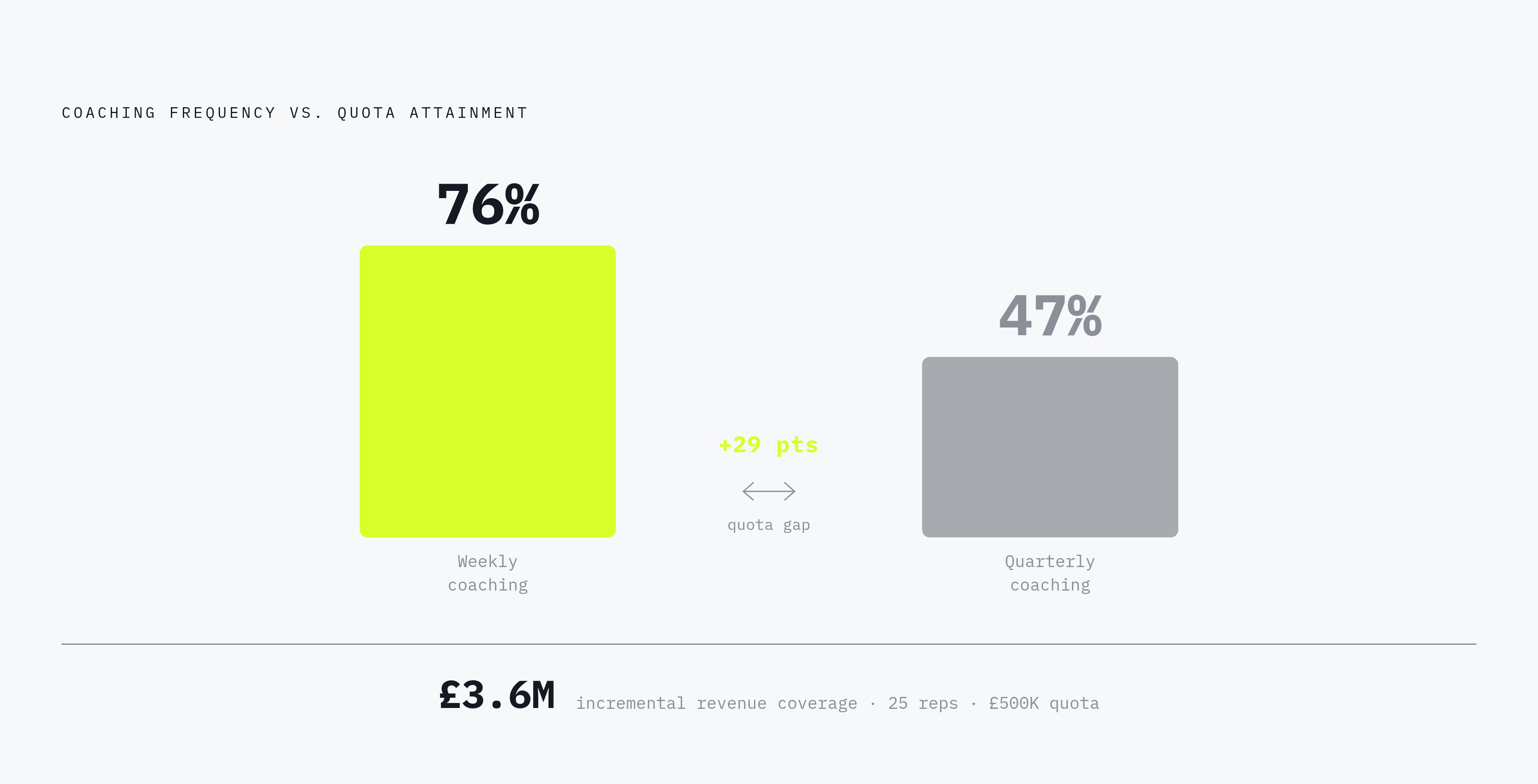
The performance implications are concrete. According to MySalesCoach's 2025 and 2026 State of Sales Coaching research, 76% of reps who receive weekly coaching hit quota, compared to 47% of those coached quarterly. That 29-percentage-point gap translates, in their modeling, to roughly £3.6 million in incremental revenue coverage annually for a 25-rep team operating at £500K quota per rep.
Why don't managers close it? Most of them were promoted for individual sales achievement, not for coaching ability. That's a structural skills gap, not a character flaw. CSO Insights research found that nearly 63% of organizations take a random or informal approach to sales coaching, with no agreed-upon plan. That same research links a structured, dynamic approach to nearly 28% improvement in quota attainment and 31% improvement in win rates compared to a random approach.
The deficit is a capacity and structure problem, not a motivation problem. Managers are stretched, often underprepared for the coaching role, and operating without a defined system. Peer programs address that directly by distributing the coaching load across the team, without requiring managers to develop an entirely new skillset from scratch.
The specific ways peer coaching improves rep performance beyond general coaching
Organizational consultant Jodi Knox describes peer coaches as "spotters" for each other's development, positioned to deliver quick, accurate feedback precisely because they're standing at the same vantage point.
When a manager coaches a rep, the relationship carries implicit stakes that shape what gets said and what gets withheld. The rep is performing a version of themselves that won't cost them anything. Peer coaching removes that filter. The power differential isn't present to distort the signal, which means the signal is cleaner and the self-assessment is more honest. I've seen reps admit real skill gaps to a peer in a 20-minute session that they'd spent six months obscuring from their manager.
Field relevance is the first place that difference shows up in rep performance. A newer rep learning from a peer who is navigating the same objections, the same territory, the same product version they're selling right now gets feedback that is immediately applicable. A manager, even a skilled one, is often a step or two removed from current deal-level reality.
Then there's accountability without authority. When a rep commits to a colleague, say, 20 prospecting calls a day, the social mechanics of following through are different than if that commitment went to a manager. Letting down a peer carries its own weight. It's relational pressure, not hierarchical, and that turns out to be more adhesive.
Peers also observe things managers never see. How a rep handles the opening 90 seconds of a cold call. How they prep before a demo. How they respond when someone is genuinely hostile on the phone. This creates a more complete diagnostic picture than anything that surfaces in a pipeline review.
The downstream numbers reinforce the case. B2B companies with peer coaching programs reduce new hire ramp time by approximately a third, according to sales coaching effectiveness research; for teams where full ramp takes four to six months, even partial compression of that timeline is materially significant. Organizations that build genuine coaching cultures also experience substantially lower voluntary turnover among top performers, because peer programs build the kind of team identity that retains people, not just the skills that make them worth retaining.
Research from Training Industry suggests that without reinforcement, roughly 84% of training content is lost within 90 days. Social learning, the mechanism peer coaching operates through, increases retention by up to 75%, per ATD research. Peer coaching isn't just a performance add-on. It's a structural fix to one of the most persistent failures in sales enablement.
How to pair reps in a way that produces useful coaching relationships
The natural failure mode here is predictable. Left to self-select, reps gravitate toward friends or obvious tenure matches. Comfortable pairings replicate existing knowledge instead of transferring new capability.
Effective pairing logic accounts for specific development goals, complementary skill gaps, and communication style compatibility, not just seniority or proximity. The goal is a relationship where each person can offer something the other actually needs.
One pairing principle worth building into the design: coaching attention naturally flows toward top performers or struggling reps, while the middle 60% of the team remains largely unaddressed. This pattern is documented in the research behind The Challenger Sale and surfaced in Seismic's analysis of coaching distribution. Core performers, given structured guidance, are the most realistic candidates to shift into high performance. Pairing programs should be deliberately calibrated to serve them.
Reverse mentoring is a useful variant that doesn't get deployed enough. Junior reps teaching veterans emerging digital prospecting techniques, social selling tactics, or new platform fluency flips the expected direction of value transfer. It prevents the program from feeling remedial for newer hires, and it keeps senior reps from calcifying in approaches that no longer move the needle.
The symbiosis requirement matters most. The coaching relationship only sustains if the coach also benefits. Coaches refine their own craft by articulating it. They build a visible leadership track record. They strengthen their case for promotion. Make that explicit when recruiting coaches, and give both parties some say in the match itself; a communication style mismatch will quietly erode the trust the whole model depends on.
What structured peer coaching sessions look like in practice
A weekly 15-minute one-on-one focused on obstacles and breakthroughs is the baseline. Short enough to sustain under quota pressure, structured enough to produce action. A standing agenda keeps it from devolving into venting: what worked, what stalled, one actionable improvement for the coming week.
Programs should define a minimum commitment explicitly rather than leaving cadence to the pair's discretion. The rapport and accountability that make these sessions valuable require consistency.
Session types should be distinguished from each other, not collapsed into one undifferentiated check-in. A call review, where both parties listen to a recorded call together, serves a different purpose than a deal review working through live pipeline, which serves a different purpose than skills practice through objection-handling role-play. Conflating them produces sessions that are too diffuse to be actionable.
Feedback quality is the crux, and this is where most programs underdeliver. Useful feedback is specific, behavioral, and tied to an observable moment: "at the 8-minute mark on that call, you restated the objection before answering, and it visibly de-escalated the conversation" is actionable. "You could be more confident" is not. Top performers are not naturally good at this. It is a skill that must be taught before the program launches, not assumed to be present.
The session is not a manager meeting. Reps should drive the agenda, surface their own gaps, and propose their own next steps. The coach's job is to ask questions, hold the frame, and let the coachee reach their own diagnosis. The moment it starts resembling a status update, it has stopped being coaching.
Training peer coaches so they can actually coach
Top sales performance and coaching ability are genuinely different skills. Selecting coaches primarily on quota attainment replicates the same structural error organizations make when they promote reps into management on the basis of individual production. The result is a technically credentialed coach who has never actually been taught to coach.
Minimum preparation should cover active listening technique, how to give specific behavioral feedback, and how to ask questions that draw out the coachee's own diagnosis rather than prescribing answers. These are learnable skills, but they require practice, not just a slide deck.
Role-playing the coaching conversation before the program launches is non-negotiable. Coaches need to experience what it feels like to sit in the coaching seat and receive feedback on how they're coaching. Without that, they'll default to giving advice, which is the opposite of what the role requires.
A shared feedback framework deployed consistently across all pairs matters more than most programs acknowledge. Without common structure, session quality becomes entirely dependent on individual coach personality. The program can't learn from itself, can't identify what's working, and can't improve the next cohort's preparation.
Allocating real training budget for coaches, whether that means external workshops, structured coaching certification, or dedicated facilitation, signals that the coaching role is a genuine career investment. That signal is what makes high performers willing to take it on. Without it, you're asking people to donate time they could spend closing.
Accountability checkpoints that keep the program from quietly dying
Programs don't fail dramatically. They drift. One missed session becomes two, then the pair is technically active but hasn't met in three weeks, and then the program exists in name only while everyone pretends otherwise.
Documentation is the first structural defense. Track when sessions occurred, what was covered, and what action items were set. This isn't surveillance; it's the minimum condition required to evaluate whether the program is working. Without it, it becomes impossible to separate coaching quality from deal randomness when assessing impact.
A program-level review every four to six weeks serves a structural function, not a performance evaluation function. The questions it answers are operational: Are sessions happening? Are agendas being followed? Do any pairs need to be adjusted? That's distinct from reviewing deals or individual metrics, and conflating the two undermines the independence of the coaching relationship.
The manager's role in this structure shifts. They are not running the coaching; they are holding the program's architecture. That means asking better questions in pipeline reviews when they see evidence of peer coaching conversations shifting deal strategy, and flagging stalled pairs before they go cold. A pair that hasn't met in two weeks is a program problem, and restarting a cold pair requires more effort than maintaining a warm one.
How to recognize peer coaches and keep them engaged over time
If coaching contribution is invisible in performance evaluations, the best performers will deprioritize it under quota pressure. This is not a culture problem; it is a structural inevitability. Recognition needs to be formal.
Concrete mechanisms: include mentorship effectiveness as a criterion in performance reviews. Build visible promotion pathways that credit coaching contribution. Use public recognition in team meetings or leaderboard formats for coaches who consistently support their peers. These are not soft gestures; they are the structural signals that determine whether coaching is treated as real work or charitable volunteer activity.
The compounding argument deserves to be made directly to coaches, not just to the organization. A rep who coaches consolidates their own knowledge, develops a leadership track record, and becomes more retainable. Per MySalesCoach's data, consistent quality coaching more than doubles the likelihood of an SDR staying.
The most durable programs generate their own continuity. After the first cohort, the strongest peer coaches become the template for training the next round. The program should be designed from the start with that succession logic in mind: not dependent on perpetual manager recruitment, but capable of propagating itself through the coaches it produces. That's the difference between a program and a practice, and it's the only version worth building. For sales enablement teams tasked with documenting and distributing these frameworks, tools like Letterstory can accelerate getting that institutional knowledge into publishable, repeatable content.