Content Lift Attribution Models for B2B Revenue Teams
A framework for measuring how content drives pipeline in complex B2B buying cycles.

- Written by
- Sales Coach Picks Editors
- Published
- October 9, 2026
- Reading time
- 9 min read
- Sources cited
- 2 sources ↓
What this covers
Content lift attribution poses a specific question: does content generate pipeline, and by how much? The typical B2B attribution setup, designed for paid channels and lead-focused reporting, lacks the capacity to answer it. Content remains invisible on the dashboard precisely because of the same mechanisms that make it effective. This piece introduces the three-tier framework pairing MTA and MMM with incrementality testing, the approach revenue organizations in B2B now use to isolate content's contribution apart from other channels in the mix, along with the configuration choices determining whether it works or merely reproduces that same undercount using better software.
Say someone reads a comparison blog in January as a prospect. They never fill out a form or attend a webinar. Because of that, nobody in marketing can show it mattered, and finance has no reason to think it did. That is much like how B2B purchases usually unfold. Tools that count only one interaction or use a brief lookback period miss earlier influence in the cycle, since they assume a far shorter and simpler journey. This setup hurts content most, since it mainly supports prospects in the upper and middle parts of the funnel. It shapes interest well before prospects identify themselves or create any signal a CRM can record.
When attribution infrastructure is missing, a buyer may click a Google ad, attend a webinar, grab a case study, then respond to sales outreach before signing, yet the CRM will reduce the journey to a single recorded touch, typically the last interaction. Untracked buyer activity only deepens the gap. Those assets influence what the buyer values and how the deal is judged well before purchase, but the reporting stack gives them no credit.
That is the consequence that shows up in budget conversations. Executives staring at a dashboard dominated by paid search and a "Direct" line for most of pipeline cannot trace revenue back to content, SEO, or educational programs, since the analytics behind them were never designed to surface that work and the silent gap is taken as proof of no value.
Why the unit of analysis, not just the model, is where most content attribution fails
Content attribution often looks like a modeling issue, but underneath it is a question of which unit is being measured. In B2C, attribution centers on a single buyer’s path to a largely solo purchase. In B2B, attribution must stay at the account level, because buying unfolds across organizations as multiple stakeholders engage with content in different ways and advance on distinct but connected paths. Measuring only individual contacts in this setting leaves much of the buying group invisible. Only an account-level model can surface the engineer’s three un-gated technical analyses, the finance lead’s pricing-comparison download, plus the end user’s year of company-blog reading before the deal opened.
One asset can reach technical evaluators, economic buyers, and end-user champions through distinct channels and distinct effects. The account has to be the unit of measurement prior to any model selection. Miss that and each layer above it, whether MTA, MMM, or incrementality testing, carries the identical blind spot regardless of its configuration.
The Three-Tier MTA/MMM/Incrementality Model
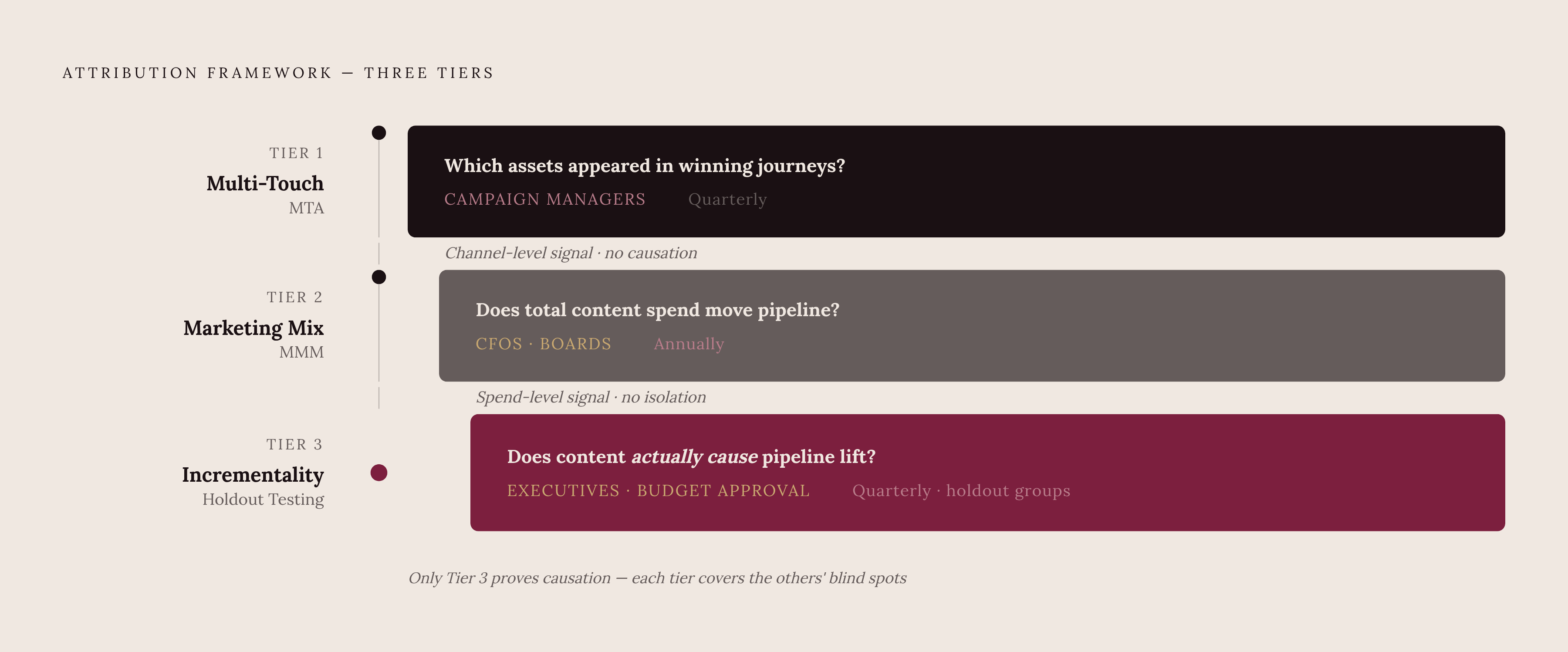
Today’s B2B attribution works as a three-layer system rather than a single model, with each layer covering a question the others are not designed to handle. Each quarter, multi-touch attribution identifies the particular content assets encountered by accounts before they converted. On a yearly cycle, marketing mix modeling evaluates whether total content investment moves in step with changes in pipeline. Incrementality tests follow a separate timetable, typically yielding quarterly findings on whether seeing content creates pipeline lift beyond what would have happened without it.
Every tier answers to a different stakeholder with a different question in mind. The manager running a campaign and weighing which asset to push next should turn to MTA. For a CFO or board members weighing whether content outlays count as genuine investment or a discretionary expense, incrementality testing is required; it alone proves cause. Merging all three into a single model, dashboard, or figure yields a result that leaves every one of those audiences unsatisfied, since each is asking something distinct. Think of the three tiers as layers that work together, each covering the blind spots of the other two, rather than rival methods that force a team to choose one and throw the others away.
What multi-touch attribution can and cannot tell you about content's role in the buying journey
MTA is useful for identifying, among won accounts, the content pieces that appeared in tracked interactions along the way. But MTA is limited by its own mechanics: unseen touchpoints cannot receive credit. Since most B2B purchases involve substantial untracked research, MTA will inevitably undervalue content because it cannot detect the influence it is meant to assess.
Model choice still matters within that limit. Six months before close, a comparison blog helped the buyer decide what to evaluate. Yet because the demo request arrived just two weeks before signature, time-decay attribution assigns it the bulk of the credit, leaving content with less weight than it truly had in the choice.
Until the fundamental customer path is documented, everything else is irrelevant. Knecht Strategies' research indicates 67% of B2B groups still depend on last-touch attribution, and lacking the infrastructure to track webinar participation, case study retrievals, and content interaction, this information vanishes before any model can allocate credit to it. Getting the full journey capture in place has to happen before picking a model. Running an advanced model on partial data just yields a more assured incorrect answer, not a superior one.
MTA still cannot settle causation, even under complete capture and the most appropriate model. Dark-funnel exposure that leaves no measurable touchpoint stays invisible to it, as do buying-committee readers who consume all the company’s content without ever submitting a form. The next two tiers address those remaining holes: causation, untracked dark-funnel influence, plus unseen members of the buying committee.
Marketing Mix Modeling for Content's Aggregate Contribution
MMM estimates how content contributes in situations where key engagement happens off the measurable path, beyond MTA's reach. Rather than trace each buyer step, MMM relates spending on content, release rhythm, and syndication reach to results such as new pipeline, pipeline influence, and cohort-level win rates. It can operate without every touchpoint being captured. What it does require is outcome and spending data over time, well suited to environments where podcasts, communities, and syndicated pieces can advance deals without appearing in CRM.
MMM’s annual cadence aligns with the actual funding cycles of content programs. A board weighing an expanded content team, a commissioned research report, or a new podcast series wants to know if aggregate content spending shifts pipeline results across a meaningful stretch, and MMM provides that answer.
MMM does not capture committee-level variation, tie one asset to one outcome, or by itself establish causation. It supplies a portfolio-level read unavailable from MTA: the degree to which total content investment moves with pipeline once the model controls for advertising, seasonal patterns, and sales-team actions. That read can justify the budget, even when no single asset gets the same proof. Data sufficiency is the real limiter. With less than several years of steady spend and outcome history, teams can still build a model, but it should not guide directors’ decisions.
Incrementality Testing: Proving Content Causes Pipeline
MTA reveals where content surfaced. MMM reveals whether content aligns with outcomes. Neither approach proves the content itself drove any outcome. Incrementality testing addresses this limitation via a holdout approach: target accounts are divided at random into test and control groups, one keeps receiving the program unchanged, the other has that exposure suspended for a set period, and finally their pipeline generation and progression rates are compared. The lift is whatever separates the two groups, a figure that owes nothing to tracking pixels, attribution models, or guesses about the buyer's path.
Since it is not built on tracking, incrementality testing sidesteps MTA’s dark-funnel limitation. It makes no attempt to log which touchpoints a specific buyer saw. Instead, it compares conversion between accounts assigned to the content program and similar accounts left unexposed, without needing any exposure to have been logged. In a holdout, randomization happens at the account level: entire accounts, rather than individual contacts, go into test or control. The test remains valid even if most buying-committee members in those accounts stay anonymous.
Unlike MTA, which is built to assign credit rather than withhold it, incrementality testing can reveal when a content program drives almost zero value. Since MTA treats mere presence along a path as proof of impact, widely distributed touchpoints claim value even if buyers were already destined to purchase. By comparing those who saw the content with those who did not, a holdout experiment exposes this overstatement whenever outcomes remain essentially identical.
The cost is a slower clock. For a test to be reliable, each group needs enough accounts to separate signal from random variation, while B2B timelines, especially in upper-funnel programs, often run past the usual digital-ad span of 2 to 4 weeks and the geo-test norm of 4 to 8 weeks. Findings are available, at most, once per quarter, so incrementality testing is used to confirm impact, not as a day-to-day or week-to-week campaign management lever. It sits apart from MTA, serving people who work on a different cycle and need different answers.
Self-Reported Attribution and the Three-Tier Model
A strong three-tier model still has a blind spot: the content impact missed by tracking tools and holdout tests when someone finds the brand through an uninstrumented channel. Maybe someone sent them a piece, endorsed you inside a private group, or briefly brought you up on a podcast. They create no pixel, add nothing to the CRM, and produce no control group you can measure. To recover that signal, you have to ask directly. At a valuable conversion moment, whether someone is submitting a demo request or completing a signed contract, include the “how did you hear about us” prompt as an open text box so buyers can describe where the relationship began.
Self-reported attribution fails at scale, hinges on whether buyers recall and disclose their journey accurately, and records only the one interaction they credit rather than the complete sequence of content that built toward conversion. It serves as a qualitative benchmark against the remaining three tiers.
The method matters most where its story conflicts with the measurement stack. When respondents repeatedly point to one analyst publication or branded audio series, yet MTA gives it no credit and MMM shows no signal, give that program a dedicated incrementality test to see if the often-mentioned but untracked channel is truly driving the claimed lift.
Configuring Attribution Windows and Account-Level Data Models
Many model-choice complaints are really setup problems, with attribution-window settings the usual culprit. With a 30-day lookback on a 6 to 12 months purchase journey, early awareness and consideration content gets too little credit regardless of how the remaining touchpoints are evaluated. Poor window settings penalize content more than conversion-focused ads or rep activity, since those interactions usually happen late in the cycle, making the real remedy a window that matches when buyers engage with content.
A broader window cannot make up for account data that leaves the buying committee out of view. The foundation is account-level identity resolution: it connects touchpoints from multiple contacts within the same company into a single account journey so everything else here can work. If that layer is missing, untracked committee engagement stays hidden, no matter how wide the attribution window becomes.
A second setup call, revenue recognition timing, assigns content credit yet is too easy to ignore: if pipeline is logged too far after the content exposure, early-stage work from a long sales cycle can vanish from the number. Set the window, account structure, and recognition trigger properly, and content’s contribution is measured fairly rather than hidden again inside a polished version of the same undercount.
Methodology & sources
- MMM vs. Multi-Touch Attribution: Which Should You Use in 2026?
Informed the article's explanation of how MTA and MMM differ in what they measure and when each is appropriate, including the distinction between touchpoint-level credit and aggregate spend-to-outcome modeling.
- Marketing Mix Modeling: A Complete Guide for Strategic Marketers
Supported the article's description of MMM's mechanics, including its reliance on spend and outcome data over time rather than individual touchpoint tracking.