Competitive Battle Card Maintenance and Update Cadence
Different battle card sections decay at different rates, so update them separately.

How battle card sections change
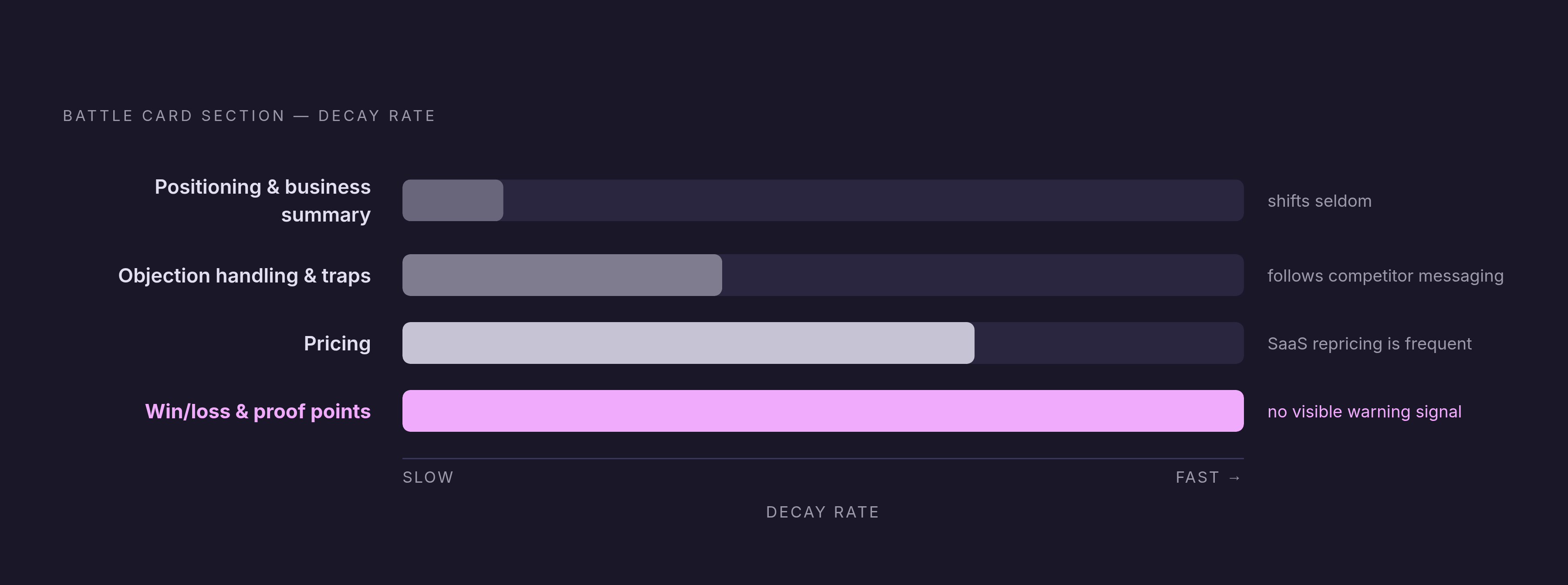
Treating one battle card as a lone document with one release timestamp hides more than it shows. Some parts hold up for months. Some parts lose accuracy by Tuesday, so if nobody spots the gap, the whole card inherits the credibility of its weakest element.
A rival's narrative shifts seldom, so positioning language and business summaries usually stay accurate. Pricing behaves very differently. Because SaaS firms frequently adjust their tiers and discounting, the pricing on a card gets outdated fast after going live.
Objection handling questions and trap-setting prompts end up somewhere in between. They drift when competitor messaging shifts and reps return from lost deals with new phrases buyers used. Proof points and Win/loss zones rank as the trickiest part: they degrade without warning, since keeping them calibrated takes real deal-level input. A stale win/loss area gets missed, unlike a bad cost on the screen. Deal by deal it drifts from truth, until a rep drops turf the card swore was solid.
A maintenance schedule should follow each section's decay pace, not blend them together. One review stamped across the document gives any rep no clue which blocks seem safe or need a double-check before speaking on a call.
The two-speed cadence that keeps cards current without consuming the team
For SaaS alongside other rapidly changing fields, monthly reviews are the minimum, and quarterly check-ins should be a backup, not the norm. This pace works only where rivals seldom reprice and don't reposition, a situation CI groups think happens more than it does.
For the handful of rivals that keep turning up in current deals, a monthly pass isn't enough. Update them at least biweekly. Focus that effort on competitors who truly lose deals: applying it to every rival makes the tracking review too heavy for the card's owner.
This cadence moves at a pair of rates. One track follows the scheduled monthly pass: its owner spends roughly 20 minutes going through unreviewed updates, fixing any blocks that call for it, then restamping each one as new and current. The other one runs on events. A move in new pricing, shift in repositioning, or big release is high-severity, which directly triggers the update in 48 hours, since that timing fits the usual gap after any competitor's news and the next live call in which reps are blindsided.
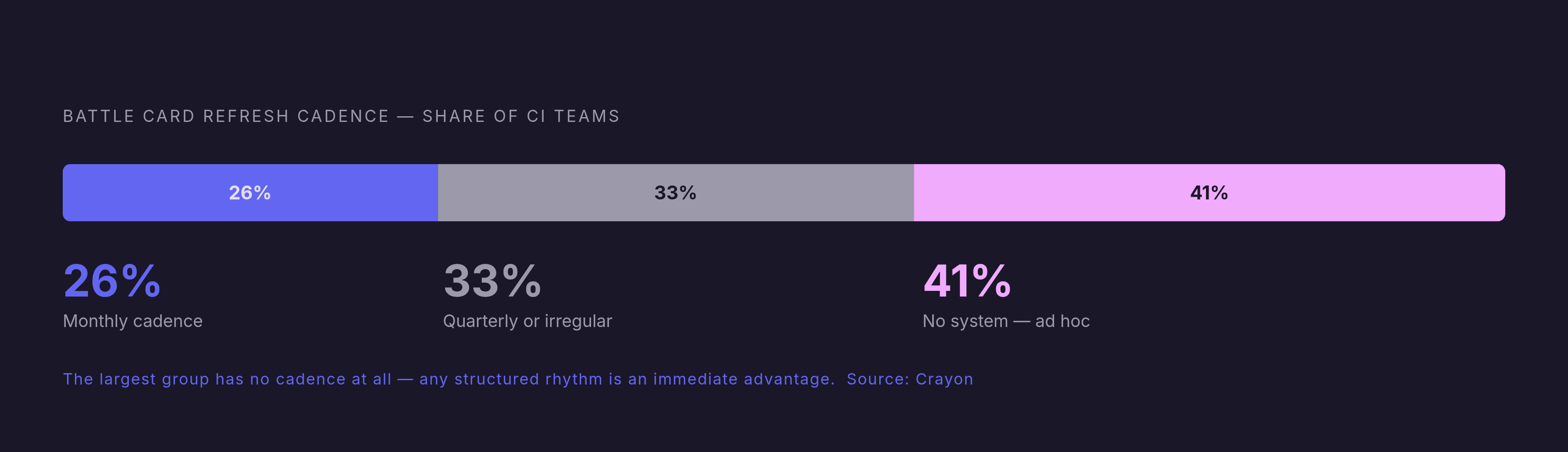
Going through each section on its own schedule keeps it workable. A rep who sees "price checked 2026-07-22" on the pricing section knows how much weight to put on it, independent of when the objection-handling section was last touched. Crayon's figures show how unusual this setup remains: just 26% of CI groups refresh battle cards each month, while 41% call their workflow ad hoc. Any group using a simple dual-pace rhythm already beats most others, since hardly anyone follows any system.
What triggers an out-of-cycle update and who decides
A card leaves the schedule for updating only if a competitor alters its pricing, changes packaging, launches something that closes one gap sales was exploiting, shifts its positioning, or is bought. Anything not on that list holds off until its turn, period.
Triggers fall into buckets: pricing, features, positioning. To do this right, stay selective about what warrants interrupting the cadence, since a small update or article shouldn't. Alert fatigue takes a genuine toll. If the owner flags every small ripple, the real triggers fade into the background.
How fast things move inside sales organizations raises the stakes here. Gartner surveyed 227 chief sales officers and reported that sales teams had typically pulled off about four big changes in the previous twelve months. With the buyer's world shifting so quickly, competitive context has to move faster than a quarterly review allows. Forrester made a related point in a March 2026 piece titled "Stop Treating Revenue Enablement Platforms as Set and Forget": platforms amplify whatever content discipline, or chaos, already exists in the organization, making that discipline or chaos visible at scale rather than creating it. Using trigger rules lets discipline beat chaos, not begin documenting changes later.
Splitting responsibility across people breaks the whole thing, and one dedicated owner beats a shared setup every time. Every card is owned by one CI head or someone from marketing, who answers regarding the scheduled pass and that trigger-based review. Splitting the work among several people looks collaborative in theory, but in reality nobody actually reviews current pricing info each Tuesday, since every person assumes another already has.
Reps can be the trigger too, and they're usually the quickest option. They spot a new objection, notice a new competitor move, or catch new pricing mid call, ahead of any monitoring system. A lightweight feedback loop, a dedicated Slack channel, a CRM field, a short post-call form, gets that intelligence to the card owner within a day instead of losing it in a rep's notes forever.
How AI tooling fits into maintenance
Keeping cards current by hand can't match that pace. Updating cards current for multiple leading competitors manually takes a big chunk of an experienced PMM's calendar, though groups using AI-assisted tools see that effort drop sharply.
Klue's Compete Agent keeps a constant eye on competitor sites, G2 feedback, and reports, then fires off pointed "Deal Tips" into a rep's Slack feed or CRM record as soon as a rival shows up in an active deal, a clear picture of where self-running CI software stands in 2026. SiftHub handles sharing another way, pushing battle card content inside Slack and Salesforce, plus a browser plugin alongside the Answer Agent tool which responds to questions during calls, letting any rep enter a specific competitive ask mid-meeting to receive that current answer almost instantly. Kompyte puts its weight on monitoring, relying on AI filtering so alert counts stay manageable for the person checking incoming updates.
The best choice comes down to where the bottleneck is, and picking poorly wastes money without helping. Klue and Crayon suit organizations with an established CI operation. For Highspot plus Showpad, the issue is elsewhere: enablement with content readiness at scale matters most when reach and adoption lag, not sourcing. CI platforms like Crayon and Klue require investment, while options like Playwise HQ offer a no-cost plan and Pro pricing at $250 per month, per Guideflow.
These tools don't make the choices that actually count, and AI shine doesn't shift who does what. People still choose what competitive move reshapes the narrative, handle approving positioning language for each card, and keep teams accountable for a card's facts. Automation takes care of flagging and sourcing. Enablement groups build the framework, sign off on that narrative, then set its cadence.
Format and length decisions that determine whether reps open the card at all
Even a fully current card may do no good when nobody opens that card. A SaaS team learned this the hard way, cutting a long reference sheet into one sheet with just three parts: main arguments, answers to concerns, and questions to corner buyers. Adoption rose from below 10% to above 70% within three months, with no shift in the competitive intelligence itself. The intel wasn't improved. It simply became easier to apply, and that difference is the whole point.
Research shows most enablement material goes unused, and battle cards are no exception. Format demands maintenance on its own, with a review schedule distinct from any content review.
A full sales aid may span multiple sections: rival snapshot, feature gaps, pros and cons, deal outcomes, pushback replies, rep scripts, baiting prompts, price notes, and evidence. Most CI groups fall into this tradeoff: filling out every section creates a solid analytical document but also a card nobody opens during a call. Putting sections in order and scoring them for pace, not being complete, is what really counts.
Klue's review covering 150 battle cards showed that all highest-retention cards included talk tracks along with proof points, yet within the whole set, a mere 19% of the cards included proof points in any form, while only 43% of cards featured talk tracks. Proof points are a high-value but often overlooked part of battle cards, and they're what reps lean on most when actually putting it to work. This gap shows what correlates with adoption versus what groups actually create, and it's the clearest proof most cards get optimized for bad goals.
The card's placement matters just as much as its content. During a live call, reps use a card pinned inside CRM, or one surfaced through Slack. Even with great content inside, reps skip a card buried in a team folder that takes 3 clicks plus a look to reach. When a card stops getting opened, the material has likely gone stale or the rep's daily routine changed in a way the card missed.
Checking if the cadence works
Adoption serves as the primary indicator, tracking how many reps viewed the card across 30 days and comparing that to competitive deals actually happening during that period. If a rival sits in a dozen live opportunities and the asset gets read only twice, the rhythm isn't getting to reps, no matter what the timing check states in writing.
Beating specific competitors in Win percentage serves as lagging proof. Crayon's study says 71% of businesses with battle cards had higher win numbers, and of that group, 93% saw improvement exceeding 20%. Use that benchmark to guide every single card or group.
Block-level interaction numbers, where available, reveal the sections reps actually open versus those they consistently ignore. When nobody opens it, the format's off or the content's out of date, and that's upkeep work, not a use issue. That fix is the card owner's job, not sales.
Rep input pace is a metric of its own, and most groups miss it. The cadence stays on track when a rep flags a new objection and it hits the card within days. When the gap stretches to quarters, the card falls behind what it ought to cover. An auto-notify setup that pings the owner once a section outlives its update deadline spots problems before salespeople hit them on calls, not afterward. Crayon reports 44% of firms still have no competitor visibility inside the CRM; the fix is to make competitive context mandatory when a deal ends, giving win-loss results a place to land first.
Keeping the discipline to portfolio scale for clients
For Agencies, this issue gets multiplied rather than doubled. Every client uses a different competitor set, different trigger points, and a different cadence, so maintenance rises exponentially per account, because a competitor change for that customer affects no other and cannot be batched together.
The fix stays the same: one owner for each card, block-level dates, plus the two-speed cadence. At portfolio scale, the shift is in the coordination most single CI tools weren't built to handle for many client accounts running together. Leading teams often redesign workflows when adopting AI, rather than layering it onto existing processes. Firms need to fold that cadence straight into how they handle each client, instead of treating competitive maintenance like extra tasks squeezed around deliverables.
Account groups require one workspace that displays, for all client programs simultaneously, card ownership, blocks late for review, and clients with a recent trigger occurrence. A centralized system for tracking competitive content across clients ensures account managers can monitor cadence effectiveness in real time.
There's another piece to this now, and it's picking up speed. Agency teams increasingly need to speak with real credibility about how a client's brand shows up inside AI-generated answers relative to its competitors, a category of battle card content that didn't exist two years ago and runs on its own monitoring logic entirely separate from pricing or positioning drift. Some enablement tools now help teams track how a client’s brand appears in AI-generated responses, treating this as a distinct maintenance task. When agencies handle competitive work for multiple clients, One person owning a centralized system prevents discipline from collapsing under portfolio demands.