Flexible Billing Models for Agency Content Platform Subscriptions
AI agents are replacing per-seat headcount as the true measure of software worth.

- Written by
- Sales Coach Picks Editors
- Published
- October 3, 2026
- Reading time
- 9 min read
- Sources cited
- 4 sources ↓
What this covers
Under a per-seat model, an agency is billed for user count rather than actual output. That logic held while more work still meant more people. Once an AI agent can absorb tasks formerly spread across a few entry-level employees, the model fails because greater agency efficiency ought to lower costs, while per-seat pricing pushes the other way. The platform ends up charging agencies a premium for the very labor-saving result it sells. The billing structures discussed here all respond to a conflict agencies and vendors can no longer make work commercially.
S4 Capital's Monks gives a clear view of how shops respond when that realization lands. By year's end Monks anticipates that subscriptions will make up roughly one quarter of what it takes in, a share it credits to the data it has piled up, which shows what the system underneath genuinely costs to operate. That approach, charging from what a system truly costs to run instead of counting who is signed on, only works once headcount no longer anchors the invoice.
This is a structural shift, not a cosmetic one. AI agents, not features, are becoming the core measure of what software is worth. Seats and feature tiers, among other traditional stand-ins for worth, now fail to describe what buyers are truly paying for. Platforms with no settled way of pricing agent-driven work already trail the agencies and vendors now tackling that question.
The four billing structures competing to replace per-seat pricing
Several billing models are competing to replace per-seat pricing in the content tools space, each with its own view of where work matters and who should bear volatility.
The first option charges a set monthly fee, often split into several subscription levels. While straightforward to forecast and pitch, this model breaks down once client activity varies widely within a firm's portfolio, causing it to fall out of favor at agencies handling heavy volumes.
Next comes pricing tied to usage or consumption, where the client is charged according to the specific value they use, whether that be content pieces, tokens, API calls, or ingested data. In a month where a client needs fewer posts, they pay less, and if they need more, their cost scales accordingly, ensuring the invoice reflects the actual work performed instead of the number of seats.
The third option is a hybrid model: clients pay a set monthly base covering essential platform use, planning, analytics, and an agreed number of outputs, then incur metered overage charges once they exceed that threshold. This way, the client enjoys stable monthly costs under normal circumstances, while the agency gains protection during periods of unusually high demand.
The fourth model pays the vendor based on concrete results the platform delivers. The four models each handle seat-compression differently, while the next section examines risk allocation when forecasts miss.
How each model distributes risk between the agency and the platform vendor
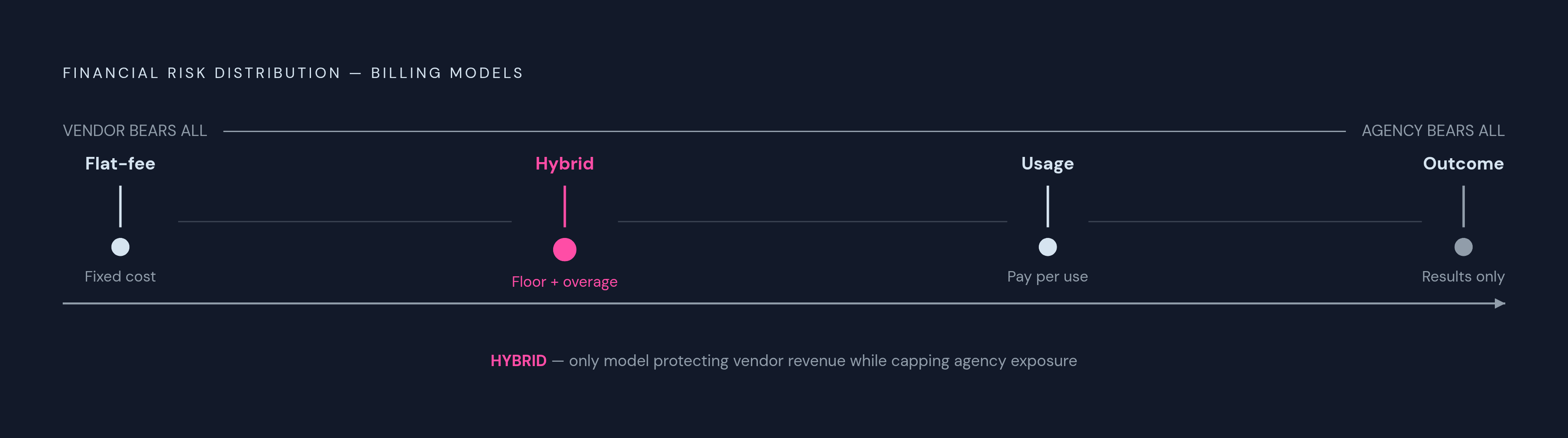
What really separates these four billing structures isn't the features they include or the price on the rate card. It hinges on who bears the losses if demand suddenly jumps, if a client pulls the plug on a campaign mid-run, or if AI tools halve what the agency itself uses.
Under a flat-fee or tiered model, the vendor shoulders nearly every bit of the demand uncertainty. The agency owes an identical fee no matter how much it produces in a given month, which benefits the agency when output is high and effectively subsidizes it through the vendor when output is low. This structure limits the vendor's expansion since income stays flat regardless of how much the client uses, with the bill set beforehand.
Charging solely for usage shifts all financial exposure to the agency. Limits on spend, prepaid credit packages, and live consumption notifications help reduce this risk, yet developing such systems creates extra product and billing burdens that modest platform providers struggle to shoulder.
New Relic's shift to a consumption-first model illustrates what vendors face when usage alone drives revenue and nothing guarantees a minimum. That takeaway applies broadly: pricing based on usage alone endangers a vendor's retention and growth rather than merely being kinder to buyers.
Hybrid pricing is built to divide exposure deliberately. A guaranteed minimum secures the seller’s base revenue, giving finance at the agency a figure to plan against. The overage piece then sits between them: both sides gain when usage is high, and neither side takes the whole hit when it is not.
Tying fees to results places nearly all the financial exposure on the vendor. Without quantifiable outcomes, the platform receives zero compensation. Such a structure broadcasts the clearest possible alignment between parties, yet it functions only when outcomes tie directly to what the platform did and can be quantified swiftly for payment.
Why hybrid models have become the dominant choice
The market's leaning toward hybrid billing comes down to this: of the four structures, it alone protects vendor revenue while giving buyers a spending target and rewarding faster work instead of penalizing it.
The churn figures show the same thing clearly. Platforms near content management systems start with much higher baseline churn exposure, so choosing the right billing structure is less about optimization and more about staying alive.
The growth numbers point the same way. Set against what the churn data show, the trend says the same thing from two sides: the fee model a platform picks shapes both the length of a customer's stay and the room that customer's spend has to grow.
The unpredictability problem that hybrid and usage-based models create for agency finance teams
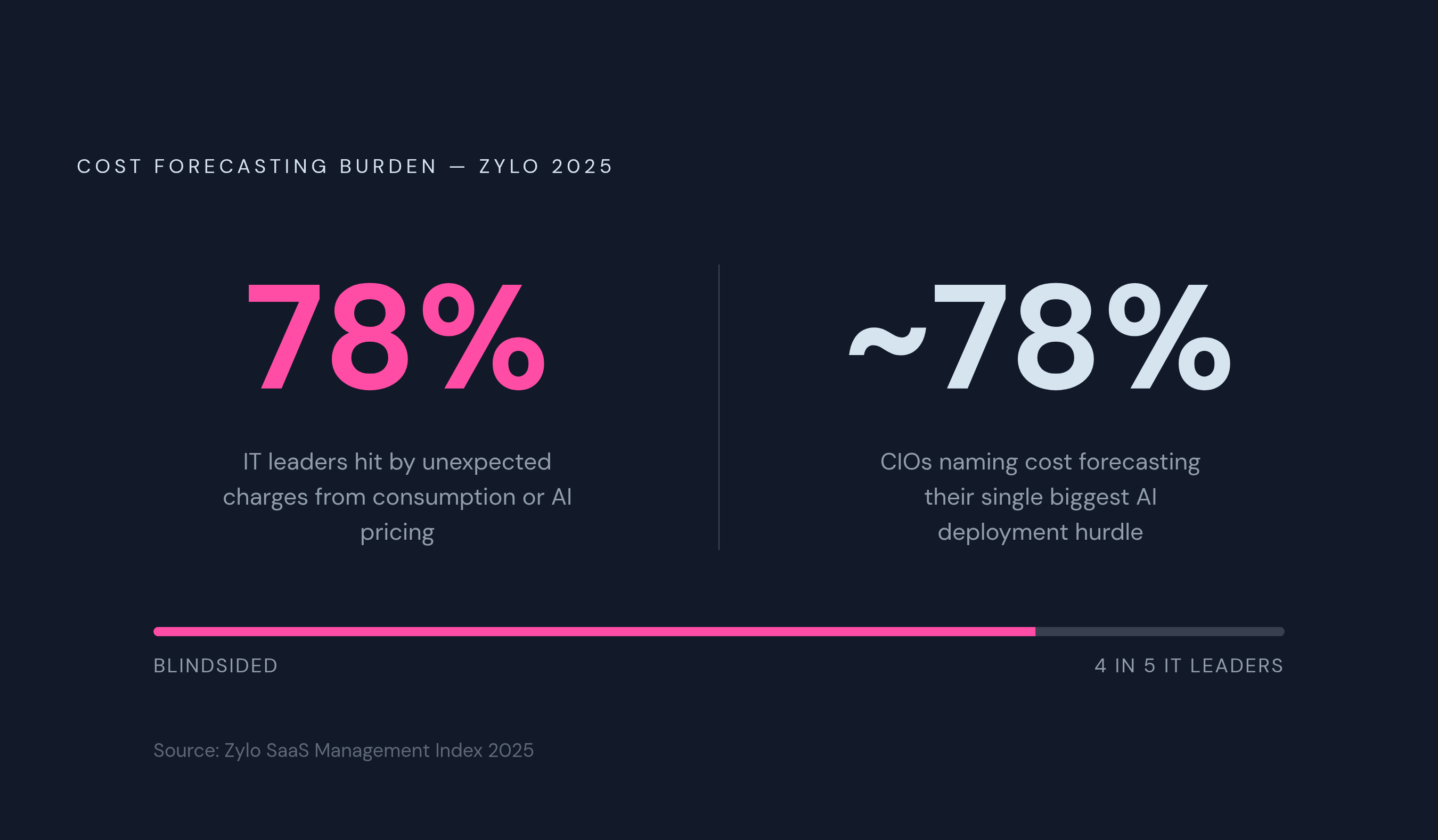
Hybrid pricing tied to consumption may suit agency operations well, but it also makes revenue harder for finance to forecast. Finance should confront that burden directly rather than minimize it, since no critique of those recommended approaches carries more weight.
In its 2025 research, Zylo puts a figure on the problem: 78% of the IT leaders surveyed report charges they didn't expect from consumption models or AI pricing, and roughly as many CIOs say forecasting costs is their single biggest hurdle when they deploy AI. What Zylo captured is a problem rooted in operations rather than in perception. For agency finance teams the pressure comes from both directions: SaaS vendors pass unpredictable platform costs upstream, while clients downstream want invoices that hold steady from one month to the next. Whichever billing arrangement an agency agrees to with its vendor ends up steering both sides of the agency's profit and loss.
These tools are already in use and holding up okay in the real world, and what follows looks at the setup that turns the genuine, manageable unpredictability into something plannable.
What agencies should examine when a platform's billing model is on the table
A half-dozen things to ask show if a billing structure fits an agency's usage or punishes it quietly, each linking to the risk review above.
Start by asking whether the chosen billing metric reflects what the agency truly provides to its clients. Vendors find it simple to tally tokens alongside API calls and data ingestion, yet none of these map neatly onto line items a buyer would spot when paying. Delivering completed assets, closing out briefs, or shipping final work aligns far better with client invoices, meaning software billing at that stage greatly eases internal bookkeeping.
Second, ask whether a spend floor exists and whether it actually supports the agency's day-to-day cost base. If the floor in a hybrid setup cannot carry the core workload, meaning strategic planning, ongoing reporting, and a baseline level of deliverables, the deal slides into pure consumption pricing and takes on every bit of the revenue unpredictability that brings. New Relic's struggles with keeping customers show most clearly what occurs when a consumption model lacks a floor sturdy enough to anchor revenue.
Third, agencies should test how adaptable the contract is: are limits, usage triggers, and a defined route to renegotiation written into the deal? Fixed per-seat fees are quickly losing ground as vendors adopt models that let charges adjust during the contract term. Agencies will have the most leverage if they secure elasticity clauses early, ahead of the point when vendors treat them as boilerplate and off limits.
Fourth is payment frequency: will it align with how the agency manages its cash flow? A yearly plan lowers attrition and may secure stronger pricing, though firms must reliably predict usage to justify such pledges, a capability many still lack.
Fifth, check whether the platform tracks usage at the same granularity the agency uses for client billing. When client invoices are tied to individual deliverables, the platform has to measure usage on that same basis. Any mismatch between the two causes margin leakage that compounds each month it stays uncorrected.
The sixth concerns how the work itself lines up with what the next section covers: does the billing model suit the client the agency actually handles, given a result might be attributable right away under HighRadius's outcome-based structure or only through a contested chain of influence typical of awareness work.
Matching billing model to agency profile: SMB clients, enterprise clients, and mixed books
No billing model suits all agencies, since the answer turns on where an agency's clients fall: mostly smaller and mid-market businesses, mostly enterprise accounts, or a mix of both. The platform billing structure an agency can realistically absorb is set by client billing preferences upstream.
Agencies with a client base that is SMB-weighted are serving clients whose first ask is simplicity: one number each month, expressed in a unit that needs no translating. That pull steers the agency to a hybrid setup: a fixed monthly base plus a few overage units, sharply defined, keeping the client invoice it issues readable without any recalculation inside.
Firms whose rosters skew toward large accounts encounter distinct pressures. Large corporate buyers prioritize certainty, favoring plans anchored by a set fee while layering consumption or performance metrics beneath it. Such vendors easily shoulder entirely blended or results-tied platform expenses, since their agreements let them mirror those terms downstream.
Agencies carrying a mixed book feel both pressures together, so whichever platform they pick must bill finely, charging by each deliverable or output, letting the agency assign its cost to every individual client account whatever kind of client sits across the table. Monks shows best how an agency can genuinely crack this: the pooled data behind its subscription pricing, and behind its aim of earning about a quarter of revenue via subscriptions, rests on precisely this visibility linking cost to output.
This pricing structure, used by Intercom Fin AI and HighRadius, works best when an agency can tie its work to prompt, provable results, as in performance marketing or conversion optimization. It is much weaker for reputation-building material or visibility campaigns, because the link between the work produced and the eventual result is slow to show and often debated. This distinction is crucial because billing tied to results can be powerful in suitable cases but fails when applied where it does not belong.
Agentic AI and the Billing Unit
Agentic AI is creating a metering problem that the four billing structures listed above were not designed to manage. Agencies that choose poorly today risk a painful renegotiation the moment workflows initiated by agents become standard practice instead of a rare occurrence.
What counts as the chargeable unit starts to blur. Once an AI agent takes over content creation, billing should not turn on seat counts or output volume. The relevant measure is the agent effort, decisions, and coordination required to produce the work, yet today’s content platforms typically cannot turn that usage into a clean billing figure. More businesses now rely on AI to win back revenue and predict churn, while many respondents are also comfortable letting AI handle subscriptions for them. Agents are moving from simply carrying out subscription terms to bargaining over the commercial arrangement for each party.
Vendors still without a clear unit for pricing agentic work are already trailing those that have. Before choosing a platform, agencies should press vendors for a clear answer on how output created by AI rather than a person will be priced. Agencies contracting today should secure renegotiation rights upfront and terms that allow model changes, since pricing built for this year's human-guided work will have to change once agentic operations are running at meaningful scale.
Methodology & sources
- 2026 SaaS Pricing Trends Driving Up Enterprise Costs
Provided the statistic that 78% of IT leaders report unexpected charges from consumption or AI pricing models, and that forecasting costs is the top hurdle for CIOs deploying AI.
- SaaS Pricing Is Breaking: Why Per-Seat Models Don't Survive the AI Agent Era
Supported the article's argument that AI agents are becoming the core measure of software value and that per-seat and feature-tier models no longer describe what buyers pay for.
- Hybrid Pricing: The Complete Guide for SaaS and AI Companies (2026)
Informed the explanation of hybrid pricing mechanics, including the guaranteed base plus metered overage structure and how it distributes risk between vendor and buyer.
- Consumption-Based Pricing in SaaS: How It Works
Provided context on how consumption-based pricing works in SaaS and the challenges vendors face when nothing guarantees a minimum, illustrated by the New Relic example.