Sales Enablement Examples From High-Growth B2B Companies
Unified enablement systems beat scattered content libraries in closing deals.
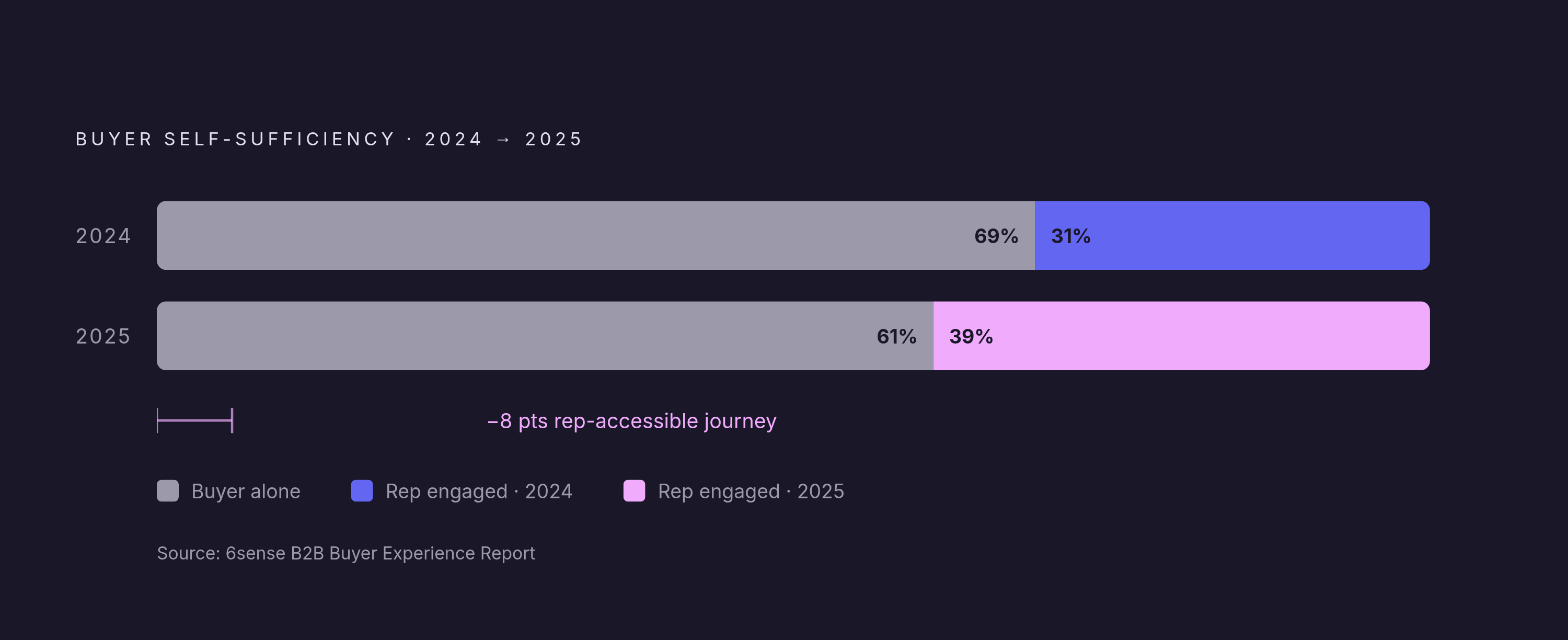
The buying journey once stopped when the sales conversation started. Buyers reach that point well before a rep ever spots the deal. According to the 6sense B2B Buyer Experience Report, buyers talk to a sales rep at roughly 61% of their buying journey, compared with 69% back in 2024. Buyers arrive further along, and they understand more by then, so the companies figuring out their response aren't buying extra sales tools. They're rebuilding enablement into a single linked system rather than somewhere content just sits unused.
Gartner's poll of 646 B2B buyers from August through September of 2025 sharpens this point: 67% said they wanted a fully rep-free buying experience, while 45% had already brought AI into their last deal. When a buyer finally engages, a rep who isn't prepared faces a conversation already influenced through an AI-generated brief, a competitor's analysis, or from a peer's input shared in a group chat. The space for a rep to shape the deal has gotten smaller, and it opens after it once did.
How a connected enablement system differs from a content library
Forrester puts unused sales content at 60% to 70%. Most say there's an overabundance of content and a shortage of curation. That reason gets it wrong. Reps skip content they can't find, so they guess at the right asset or reuse whatever closed deals last quarter. They struggle because the right asset can't be located when they require it, so they improvise or simply recycle whatever had traction the previous quarter. Relevance and Findability were the real bottleneck, and more content fixes nothing.
CSO Insights' Fifth Annual Sales Enablement Study reveals the result when an organization fixes that rather than making the problem bigger. Companies with a set sales content plan saw 27.1% better win rates and 18.1% better quota attainment than those without it. For forecasted opportunities, win rates were 49% when enablement was present and 42.5% when it wasn't, a gap too big to attribute to luck. That gap is too big to ignore.
A connected system ties together three pieces companies often split across teams and spreadsheets: content for the buyer’s stage, rep coaching, and call records that reveal what works. All three must constantly inform each other. In 2024, Forrester set this change in place by folding sales content with sales readiness tools under one category, revenue enablement platforms; by 2026, it expanded its coverage to more vendors. That growth signals the unified approach is no longer a differentiator but a basic requirement. A content library is about where files live. An enablement system picks how reps act on a call, and treating them as interchangeable is why 60-70% goes to waste.
How Apollo.io built growth on a unified intelligence-and-engagement motion
Apollo.io's results speak for themselves: revenue growth of 752%, #119 in the 2025 Deloitte Technology Fast 500, plus a valuation many times larger after its Series D. The strategy behind those numbers sounds simple but is tough to pull off: combine the prospecting side and the outreach workflow into one platform so reps stop jumping between tools.
That can look like a small design detail until you see how tool-switching drains the rep's day. By combining research in one place, Clay helped reps find leads dramatically quicker than jumping between separate apps. Outreach users saw research time drop by 90%. Clay and Outreach produced those numbers, not Apollo, yet they offer the right benchmark for outcomes when mid-task friction goes away.
The growth math is nearly automatic, but most revenue leaders still miss it when they treat tool consolidation like an IT call instead of a sales one. Every minute a rep saves by skipping the contact search or the back-and-forth between tabs turns into real talk time, and more talks with better-fit leads keep the pipeline full. Cutting the drag of moving between tools is its own enablement choice, one fast-growing teams plan instead of backing into later.
Gong's sales training approach and insights from actual customer interactions
In 2026, Gong topped a major milestone for annual recurring revenue, up 55% year over year, then put that lift into its platform push, Mission Andromeda, with Gong Enable, Account Console, and AI Call Reviewer for deal work in one view. Transcripts of calls give a much stronger base for coaching than a manager's recall of how it played out, and that choice powers the whole effort.
Experian increased win rates by 25% using AI insights. Iron Mountain cut new-hire ramp time by three months using sales enablement tools. One outcome involves deal conversion while the other covers productivity time-to, but both go back to the same place: transcripts and trends drawn from real calls, not ones that a sales manager half-remembers during a pipeline review.
McKinsey's logistics example proves this works at real volume. A company fed 80,000 sales conversations into an AI system, changed speech into written words, removed private details, put the records in order, then asked LLMs to find trends in the whole group. Over 12 weeks, conversion climbed 1.8% to 3.0%, and McKinsey estimated annual incremental revenue could reach $120 million if it worked company-wide. Doubling conversion from real-call extraction proves the point: instinct falls short of transcript facts, and companies that keep relying on their manager's take in pipeline review miss revenue they can't track.
The same thing repeats in all three cases. Data replaces guesswork. A sales manager doesn't have to intuit problems on calls, since the recordings reveal them, and the coaching after focuses on concrete issues rather than a vague feeling that reps should improve at objections.
Before the call, practice tools and AI roleplay shrink the readiness gap
Conversation intelligence shows what went bad after the call is over. Practice tools and roleplay build readiness before the call begins, and one isn't a stand-in for the other. When teams start Skipping practice while leaning into post-call review, they get the same point only after a deal is gone, a poor choice when both are within reach.
Many growth-stage B2B SaaS teams have adopted three-tool setups: a conversation intelligence platform like Gong or Chorus by ZoomInfo, a practice or roleplay tool such as Tough Tongue AI, Hyperbound, or Second Nature, and a content enablement platform. This setup is gaining traction as 2026 approaches, with many enablement leaders evaluating it now.
Gartner shows the payoff in its AI data. By 2029, Gartner expects AI-driven sales enablement to speed up sales stage velocity by 40%, and other Gartner research shows sellers working well with AI tools have a substantially better shot at making quota. That connection forms in the readiness layer, where reps practice before a real conversation. Declaring the tool ready in a kickoff and walking away won't cut it.
Highspot’s practice tools use roleplay tailored to buyer personas and real call scenarios, rather than generic scripts. Practice drawn from real calls carries over to conversations much more easily than rehearsal run on a generic script put together by someone who stopped taking calls ages ago.
Content governance is the day-to-day challenge most companies underestimate
Forrester’s finding that 60% to 70% of sales material goes unused highlights a challenge in content accessibility and relevance. The content is there, usually useful, yet reps can't get the right asset when they need it because no one handles updates or surfacing. Companies keep adding content marketers to fix this. What they really need is someone in charge of governance.
Highspot delivers a 20% deal size increase for customers like DocuSign, as reps use up-to-date, relevant content instead of outdated materials. In practice, Governance calls for tracking file changes, setting expiration so stale items quit surfacing, giving marketing ownership of fresh content, and using AI tools that hand a rep the right asset by buyer persona, deal stage, and sector instead of making them dig through a folder.
The vendor market is consolidating so fast that stability has to be part of the buying choice. Gartner’s November 2025 Revenue Enablement Platforms Magic Quadrant placed Highspot, Seismic, Showpad, Allego, SalesHood, and Bigtincan in the Leaders quadrant, and that list moved fast. A merger on February 12, 2026 combined those Leaders into one firm, now valued at approximately $6 billion. Another merger, this one in October 2025, plus one more before year's end, pile extra churn onto it; that churn shows up down the road as roadmap mess or renewal fee hikes for buyers who committed before the deal was done.
Those deals cost plenty from the start. Vendr's buying records show these platforms typically cost $45,000 to over $100,000 annually, with Mindtickle close to $92,000 and Highspot at $91,460. At that cost, a buyer choosing a vendor that won't last is making a serious error. Vendor staying power should be a top priority, well before feature comparisons.
How fast-growing businesses track enablement so leadership can see it
Most enablement teams measure what matters least, because those metrics are the easiest to make. Content uploads, completions, and meetings held seem like forward motion on a deck, but they give a CRO zero proof of real shifts out with reps. Leadership spots the gap later on, often at planning time, and by then enablement can only point to a list of what it did.
Combined studies spanning 2024 through 2026 comparing AI-enabled B2B sales groups against slower adopters showed a 17 percentage point revenue divide, about 28 percentage points better forecast accuracy, and nearly two hours and fifteen minutes restored to each seller's day. Leadership keeps its eye on numbers like these, so any enablement team hoping to hold onto its budget has to leave its mark somewhere in the shift. A 2025 research report from IBM showed salespeople with AI-driven pipeline and enablement platforms projected 25% higher revenue. The real measurement asks if reps behave differently when they're back with a buyer. Do they behave differently when they're back with a buyer?
Salesforce's State of Sales report polled 4,050 sales reps from August through September of 2025 and showed 87% of sales teams already run AI. With AI that widespread, it stopped setting teams apart a while back. The best performers are set apart when AI shifts how rep behavior separates them. A measurement worth putting together pairs content consumption with deal stage, links coaching to hitting quota by cohort, and watches ramp time for hires as a first read on whether the whole system holds. If done right, it gives CROs a dashboard they opens, not a scoreboard only enablement reviews.
The AI visibility layer most B2B enablement programs are missing
Look again at the stats from earlier: 67% of buyers like a no-rep research path, and 45% tapped AI during a recent buy. Those figures pose something most enablement programs have yet to consider: does the company appear if a buyer asks an AI system for suggestions before a person enters the picture?
Call this the Day One List issue. A buyer fires up an AI tool, asks who tops a category, and it lists a few companies. Only those companies get considered for the RFP. The other companies never get seen, even when their content is strong and their sales people are well-prepared. Answer Engine Optimization and Generative Engine Optimization fix this through structuring content and presence so AI will cite a business in its answers, acting as another pillar next to SEO.
For firms overseeing many customer accounts, checking which ones appear through AI-generated answers and confirming that presence stays over time is turning into a separate offering. Thrad and similar platforms set up the system for this, pushing ads into LLM chats and tying brands to AI publishers via an engine built for users ready to buy. Letterstory takes a similar path for reps, bringing together buyer-ready analytics and coaching on AI visibility inside one workspace so account teams can point to real numbers rather than a hunch.
Even with strong content and good coaching, a rep misses the deal when it’s off the buyer's list. AI presence kicks off what enablement tries to speed up, and leaving it to marketing misses how it shapes the deals enablement can chase.
What best-functioning enablement programs share
This isn't about choosing the right tools. Companies chasing one all-in-one platform to solve enablement are looking in the wrong place: the strongest programs share a structural foundation, with content and measurement running through the same motion under teams that communicate often.
Cross-functional ownership comes through in Shared dashboards plus a shared view of what strong looks like for marketing, sales, enablement, and revenue. That 49% to 42.5% CSO Insights figure shows just how much joint responsibility helps results. The system has to work as a cycle, not something with fixed deadlines: coaching gets fed by conversation intelligence, coaching finds gaps that turn into content asks, and results come back so teams can refine messaging. It keeps itself current rather than holding out for the quarterly reset.
Enablement teams that make it through budget reviews link what they built directly to shifts in a rep's behavior and the revenue those shifts produced. Tracking reps' tasks won't hold up under that scrutiny. Results carry the weight, and the top-performing programs heading into 2026 now count AI visibility among the metrics they own, framing a brand's appearance in AI-generated answers as an enablement responsibility instead of leaving it solely to marketing.
Learning should lead into content, content into measurement, with the whole system made to account for where the buyer's journey starts before a rep gets a call booked. The rest is decoration on that one issue.