Ghostwriting Sales Thought Leadership for Executives
How ghostwriting lets executives build sales pipeline through authentic LinkedIn thought leadership.

Ghostwriting sales thought leadership means pulling an executive's actual perspective, the stuff they'd say over drinks after a conference, and shaping it into content that moves real buyers through a real pipeline. Thought leadership used to sit in the "nice to have" bucket, filed somewhere next to the company holiday card. That bucket doesn't exist anymore, and the reason why is worth unpacking before we get into the mechanics of how the work actually gets done.
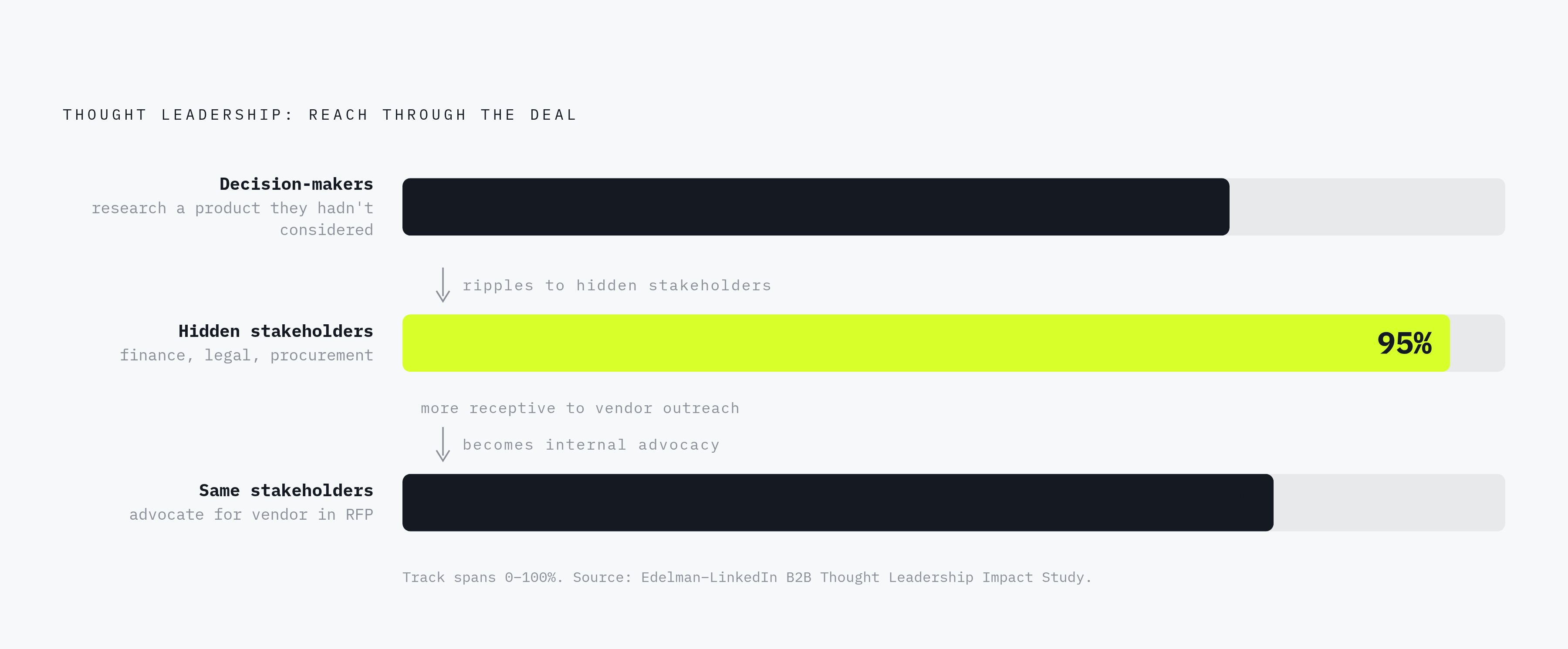
Start with the buyer, since that's who this is actually for. Most business buyers, roughly 95% of them, aren't shopping at any given moment. They're not filling out RFPs or taking sales calls; they're living their lives, blissfully unaware your solution exists. Thought leadership is the only scalable way to reach someone before they know they need you. Edelman and LinkedIn found in 2024 that 75% of decision-makers say a piece of thought leadership led them to research a product they hadn't previously considered. That's pipeline, quietly forming months before anyone touches a CRM.
But here's the wrinkle nobody talks about at the sales kickoff: the buyers you can see on a call aren't the only ones reading. A 2025 Edelman-LinkedIn study found that 95% of "hidden" stakeholders, meaning finance, legal, procurement, the people who never show up on a Zoom but can absolutely sink a deal in week four, say strong thought leadership makes them more receptive to vendor outreach. Seventy-nine percent say it makes them more likely to advocate for that vendor during an RFP. So the executive's LinkedIn post isn't just reaching the VP who took the demo. It's reaching the accounts payable person who's going to ask an uncomfortable question nobody prepared for.
The downstream math keeps compounding. About 60% of decision-makers say good thought leadership makes them more willing to pay a premium, and 70% of C-suite executives say it's led them to reconsider a vendor they were already using, per Edelman-LinkedIn 2024 research. If a published voice can talk a Fortune 500 buyer into switching vendors mid-relationship, treating it as a marketing afterthought seems like a strange call. An executive's voice, published consistently and well, isn't adjacent to the sales process. It's part of it.
Why LinkedIn is the primary surface and why personal voice beats the company page
LinkedIn has roughly 65 million decision-makers on it, and about 10 million of those are C-level. No other platform gets close to that concentration of people who can actually sign a contract. If you want to reach buyers where they already spend their time scrolling, LinkedIn is the room, and everyone else is standing outside it.
Personal accounts beat company pages, and not by a little. CEO posts pull about 7 times more impressions and 4 times more engagement than the same content posted from the corporate page. C-suite content broadly gets roughly 5 times more views and engagement than posts from other employees, according to 2025 Edelman-LinkedIn data. People respond to a named person with a real opinion on supply chain risk. They scroll past the logo.
Why does this matter before a deal even starts? About 67% of decision-makers research an executive before a first meeting. Find three posts from 2019 and a profile photo from a company holiday party, and that's not a neutral outcome. That's a missed impression, sitting there in plain view, doing quiet damage.
One more complication, and it's a real one: roughly 40% of B2B buyers now start vendor research with AI tools instead of a search bar. Content needs enough structure that these tools can parse and cite it, not just enough polish that a human enjoys reading it. LinkedIn is still the primary surface. It's no longer the only thing measuring you. Bylined articles and trade press pieces still earn their keep, mostly as amplifiers for whatever's already working on the executive's own feed.
Why executives don't write this themselves, and why ghostwriting became standard practice
Executives don't produce their own thought leadership because it takes a different skill and a chunk of time most of them don't have lying around. A CEO running a large P&L does not have four spare hours a week for research, drafting, and revision. That cognitive load competes directly with the job they're actually paid to do, and the job usually wins that fight.
The numbers back this up without much ambiguity. About 61% of C-suite executives at companies with more than 500 employees use some form of writing support for what they publish, per 2025 Content Marketing Institute data. Among Fortune 500 CEOs with active LinkedIn presences, that climbs closer to 80%. The LinkedIn ghostwriting market has grown roughly threefold since 2024, and an estimated 15 to 20% of funded startup founders now use some version of this support too, according to available market estimates. This is standard operating procedure at this point, not some fringe workaround.
None of this is new, if you think about it for more than a second. Executives have used speechwriters and co-authors for decades. Nobody assumed top executives personally drafted every word of their public communications alone. LinkedIn and AI-powered search just opened new surfaces that demand the same discipline speechwriting always required.
The ethical question deserves one honest sentence: what matters isn't who typed the words, it's whether the position genuinely belongs to the executive. Done badly, ghostwriting produces the bland, committee-flavored "thought leadership" readers scroll past without a flicker of recognition. Done well, it demands more process discipline than most internal teams expect walking in the door.
What voice capture actually involves, and why it's the step everyone skips
Voice capture is the unglamorous, unskippable foundation underneath all of this, and it's exactly the part most programs cut corners on because it doesn't look like "real work" from the outside. It's a structured process of recording how an executive thinks, argues, and lands on conclusions, and it goes well past simply cataloging their opinions. Anyone can ask an executive what they believe about AI in procurement. Voice capture asks how they got there, and what they'd say to the person in the room who disagreed with them.
In practice that's usually two or three recorded interviews across the first couple of weeks, covering core positions, recurring themes, and communication quirks, paired with a review of existing material: emails, old talks, prior posts, anything showing authentic patterns rather than performed ones. A good interviewer in these sessions is listening for more than stated beliefs. They're listening for the analogy the executive reaches for without thinking about it, the claim they instinctively push back on, the phrase that shows up three separate times across three separate conversations without anyone planning it that way.
Skip this step and the damage shows up fast. FT Longitude Insights found that 73% of decision-makers say weak thought leadership can actively hurt a company's reputation, and generic, voiceless content is exactly the kind that earns that reaction. It reads like it was written by nobody in particular. Functionally, it was.
Voice capture does one more quiet thing worth naming: it surfaces the three to five themes an executive can credibly own. Skip that groundwork and the content calendar defaults to whatever's trending on LinkedIn that week, which is how a company ends up with fourteen posts about "the future of AI" and zero posts that sound like an actual person with a specific job wrote them. Voice capture isn't a box checked once at the start, either. It's the foundation the calibration process, which we'll get to next, keeps circling back to.
How ongoing calibration keeps the content commercially current
An executive's thinking in March isn't their thinking in September. The market moves, deals close or fall apart, positions sharpen or go soft in response to something a prospect said last Tuesday. Calibration is the mechanism that keeps published content tracking that drift, instead of freezing into something that sounded sharp in the spring and reads faintly stale by fall.
The mechanics are almost boringly simple. A 30 to 45 minute working conversation every two weeks, built around what the executive has actually noticed lately: a new question buyers keep asking, a client situation that punched a hole in an assumption they'd held for years, a competitor's claim that struck them as worth writing down. Traditional ghostwriting setups can require 3 to 5 hours of executive time a week between interviews and revisions. Calibration compresses that without losing the accuracy that makes the content worth publishing in the first place.
By roughly the two-month mark, a program running well produces drafts the executive reads and recognizes as their own, without a heavy edit. That's calibration data piling up into something close to a working model of how this specific person thinks.
Worth being precise about what calibration is not. It's not a brainstorming session, and it's not an approval gate where the executive rubber-stamps drafts. It's intelligence gathering, plain and simple, feeding straight into the next drafting cycle. And it does double duty commercially, because calibration is often where a ghostwriter learns what's actually happening in live deals: the objection that keeps resurfacing, the question prospects keep asking in slightly different words each time. That's the thread tying content back to real pipeline, instead of letting it float off as "thought leadership for its own sake."
How one executive interview turns into a stack of different assets
One well-run interview, maybe 45 minutes, can produce a genuinely wide spread: a couple of short LinkedIn posts, a longer newsletter piece, a video script, a line of event commentary, a repurposed thread somewhere else entirely. A good insight earns more than one format. That's not padding; that's just matching the idea to where people actually consume it.
Different formats serve different moments in a buyer's day, and that's really the whole logic here. A short post works when someone's on a train with eleven seconds to spare between stops. A newsletter works once someone's curious enough to click through. Video works for people who'd rather listen than read, and there are more of those people than most marketers want to admit. Not every idea deserves the long-form treatment either; a sharp, specific observation in three sentences often beats a thousand-word "hot take" that says nothing anyone couldn't have guessed on their own.
Specificity is the tell, honestly. Vague thought leadership signals that someone got assigned a posting quota. A specific observation, the kind that could only come from someone who was actually in the room when a deal went sideways, signals real expertise in a way generic commentary never manages.
Once voice capture and calibration are actually humming, the bottleneck stops being volume. There's usually plenty of raw material sitting in the transcripts already. The real constraint becomes editorial judgment: which of these ten observations deserves the executive's name on it, and in what order they should go out the door. That's a human call, not a production line.
What separates content that moves buyers from content that just fills a calendar
FT Longitude Insights found 78% of decision-makers say genuinely intelligent thought leadership increases trust and makes them more likely to engage with a vendor. The same research found 73% say poor-quality content can actively harm a company's reputation. That gap is the whole ballgame: the difference between building trust and quietly eroding it, one bland post at a time.
Here's the editorial test that actually separates the two, and it's simpler than it sounds. Could this piece have been published, word for word, by any competitor in the category? If yes, it's noise, however polished it looks on the page. If the position could only credibly come from this specific executive, with their specific track record and their specific scars from specific deals, that's signal. Strategy-first thought leadership traces every piece back to something commercial, a deal stage, a recurring objection, a competitive question surfacing repeatedly in calibration calls, rather than whatever's trending in the trade newsletter that week.
The failure patterns are easy to spot once you know what to look for. Content that hedges every claim so hard it ends up saying nothing at all. Posts that just restate an industry report's findings without a single original thought layered on top. Pieces that quietly promote the company instead of showing how the executive actually thinks. All three read as filler, because they are filler, dressed up in a suit.
Buyers don't share content that hands them back what they already knew. They share content that hands them a frame they didn't have five minutes earlier. That's the actual trust mechanism at work, and it's what moves a relationship forward before a sales call ever gets scheduled. This also happens to be the one part of the process AI tools genuinely struggle with. Software can draft fast and vary the format all day long. It can't tell you which observation is genuinely interesting to a skeptical buyer and which one is filler wearing a confident tone of voice. That judgment call stays stubbornly human.
Building the internal process that keeps a ghostwriting program alive past quarter one
Ownership varies by company size, and there's no single right answer here. In most B2B organizations, marketing ends up ghostwriting for the CEO, the CMO, or the VP of Sales, since they sit closest to the commercial motive anyway. At larger companies, corporate communications sometimes takes it over when brand alignment needs tighter control. Plenty of teams bring in outside writers or agencies simply because the internal bandwidth, or the specific B2B editorial chops, isn't there yet.
Whoever owns it, the executive still has to show up with a few things: recurring access for that 30 to 45 minute calibration call, time to actually review drafts, and, maybe hardest of all, a willingness to hand over half-formed reactions instead of polished, PR-safe talking points. Raw material beats sanitized opinion every time. A writer can shape a messy observation into something sharp; there's nothing to shape from a sentence that's already been overworked into blandness by three rounds of internal review.
Marketing's job on the other side is to own the editorial calendar and tie it to the actual sales cycle, keep the thematic pillars lined up with commercial positioning, and build the feedback loop connecting content performance back to pipeline signals. Skip that loop and nobody ever finds out whether any of this worked. That's its own kind of quiet failure.
AI-assisted tools have a real role here, and it's worth naming precisely: drafting speed, format variation, first-pass structure. Voice capture and editorial judgment stay harder to hand off, since both require an actual human paying attention to how one specific executive thinks and what one specific buyer needs to hear next. A platform that pairs AI-powered drafting with a strategy-first workflow, baking editorial frameworks directly into production instead of bolting them on after the fact, can shrink the gap between interview and published post without cutting the voice work that makes any of it believable. Letterstory is one platform built around that idea, folding structured voice capture into the production process itself rather than treating it as a separate step everyone quietly skips.
The real sustainability test is simple, if a little unforgiving: a program that demands heavy weekly effort from the executive tends to collapse by the end of the first quarter, usually right around the moment the executive gets pulled into something more urgent. The goal is a system that runs on minimal executive time once it's calibrated, with the writer carrying the production weight.
What a realistic budget looks like, and how to tell if it's working
Costs vary a lot depending on who's doing the writing. Freelancers tend to charge anywhere from a few hundred dollars per LinkedIn post, or a few hundred to a couple of thousand dollars monthly on retainer. Agencies run higher, with entry-tier retainers typically in the low thousands a month, climbing to well into five figures or more at the premium end. Public company CEOs who need media-grade editorial review and compliance sign-off can push into very significant five-figure sums a month, which sounds like a lot until you price out what one mishandled quote costs a public company in a bad news cycle.
B2B marketers increased thought leadership budgets by 53% in 2024. That's not a fluke; it's a sign the category is finally getting measured with actual return expectations attached, instead of a vague sense that the CEO should probably post more often.
Which raises the obvious next question: measured against what, exactly? Impressions and follower counts look nice in a monthly slide but mean almost nothing commercially on their own. The real signals look more like inbound connection requests from people who match the target-account list, deal conversations where a prospect brings up something the executive posted three weeks earlier, buyer research that a specific piece of content visibly triggered. Gartner analysis cited in 2025 Edelman-LinkedIn research found companies with strong thought leadership programs see sales cycles run about 23% shorter. That's the number that belongs on a scorecard somewhere, not impressions.
The build-versus-buy question comes down to an honest read on internal capability. Building in-house costs less upfront but takes longer to ramp and needs real ongoing management to stay on track. Going external costs more but gets voice calibration and editorial judgment moving faster, assuming the partner has actually done this before and isn't just good at scheduling posts. The deciding factor isn't budget so much as whether the internal team has genuine B2B editorial instincts or just the capacity to fill a page with words. Frame the whole thing as sales infrastructure rather than a content line item, and the evaluation gets a lot easier to make.