GROW Model Application in Sales Coaching
Managers using GROW often skip its core principle: surfacing what reps already know.
GROW was developed in the 1980s by Sir John Whitmore and Graham Alexander, along with Alan Fine, and reached a mainstream audience through Whitmore's 1992 book, Coaching for Performance. The intellectual roots go back further, to Timothy Gallwey's Inner Game method, which argued that performance is most often blocked by internal interference rather than missing knowledge. The performer already has more capability than their results reflect. The coach's job is not to fill a gap. It is to remove obstruction.
That origin is the thing most managers skip over, and skipping it is why so many GROW sessions quietly turn into something else. GROW was not designed to transmit expertise from manager to rep. It was designed to surface what the rep already knows and figure out what is keeping them from using it. The four stages: Goal, an articulation of what the rep wants to achieve; Reality, an honest look at where things actually stand; Options, a genuine exploration of what paths exist; and Will, a specific committed action the rep owns and can be held to.
The sequence is doing real work. You cannot build a meaningful action plan without a real goal to build toward. You cannot evaluate options honestly without a Reality check that neither party lets the other soften. Skipping stages is precisely how sessions stay shallow, and shallow sessions are what reps describe when they say they don't feel coached. The whole design is deliberately non-prescriptive: the coach asks, the rep generates. That is not a design flaw. It is the reason reps eventually learn to solve problems when no one is watching, which is, ultimately, the only outcome worth chasing.
Setting a Goal That a Sales Rep Will Actually Own
There are two legitimate categories of goals in a GROW session. Outcome goals point to a measurable result: hitting a specific percentage of quota, adding a defined number of qualified opportunities by a certain date. Skill goals point to a behavioral shift: better discovery questions, a tighter narrative in a late-stage proposal. Both are valid, and they lead to substantially different conversations. The manager's first job at this stage is helping the rep identify which type is actually relevant right now, because reps often arrive convinced they need one when they need the other.
The more insidious failure at the Goal stage is not vagueness, though vagueness is common enough. It is when the goal is clear but wrong for this moment, and neither person says so. A rep says they want to improve pipeline coverage when the real constraint is that their demo-to-proposal conversion rate is notably low. A question like "if you could fix one thing about how your deals are moving right now, what would it be?" is diagnostic, separating the stated priority from the actual one.
The goal has to belong to the rep. A goal handed down by the manager is a directive, not a GROW goal. Directives have their place, but they produce compliance, not commitment, and compliance does not compound over time. Specificity is what creates ownership: "improve my pipeline" gives the rep nowhere to stand, while "add three qualified enterprise opportunities before the end of Q2" gives them something they can either achieve or explain. That specificity is also what makes the Will stage functional later, which is reason enough to resist accepting the first answer and moving on.
How to Run the Reality Stage Without Letting the Rep Off the Hook
Salespeople are professionally optimistic. It serves them in the role and works against them in a coaching session. The Reality stage is where that optimism has to meet actual data, gently but without giving ground. The coach's job here is not confrontation. It is asking questions that surface what the rep is rationalizing past: "What does your pipeline data actually show?" rather than "Why are your numbers down?" The first question invites self-diagnosis. The second assigns blame before the rep has spoken, and you will spend the rest of the session managing their defensiveness instead of their development.
Grounding Reality in evidence is not optional. CRM data, call recordings, pipeline metrics, win-loss patterns: these are the evidentiary base, not impressions from the manager's memory of how the last few weeks have gone. A data-backed opener can be direct without being punitive. If the evidence shows that most of a rep's pipeline has exceeded the threshold for a stalled-deal KPI, surfacing that number and asking what they make of it creates a concrete starting point no one can dismiss as opinion.
The cognitive traps that corrupt this stage are well-documented. Blind spots, overconfidence in one's own read of a situation, the tendency to recall confirming evidence and quietly discount the rest: all of these distort a rep's self-diagnosis when the coach takes their account at face value. Three well-chosen questions that move from observable behavior to underlying pattern is a reliable structure. Too few and you miss the root cause. Too many and the rep shuts down, and you have spent the trust the rest of the session needs.
Using the Options Stage to Generate Solutions the Rep Commits To, Not Solutions the Manager Prescribes
The letter O in GROW gets interpreted in different ways across different versions of the model: Obstacles, Options, Opportunities. A well-run session covers all three, starting with what is actually blocking progress before expanding to what paths exist. The sequencing matters because surfacing obstacles first keeps the rep from proposing a solution that would work beautifully if the original problem were not still sitting there. Managers see this constantly: a rep builds a whole plan around an assumption that has already been invalidated, and because no one named the obstacle, the plan goes nowhere.
The non-directive default at this stage is the most misunderstood principle in GROW. When a manager who has spent fifteen years in sales sits across from a struggling rep, the instinct is to hand them the answer. That instinct is natural. It is also counterproductive in a way that compounds quietly: the rep who receives the answer never builds the pattern recognition to derive it next time, and next time will come. The questions that move this stage forward are things like "what have you tried so far?" and "what would you do if that option weren't available?" These build the rep's capacity to think through problems without a manager present, which is the only version of development that actually scales.
When a rep genuinely has nothing to offer, the manager can introduce possibilities, but the conversation returns immediately to the rep: of the options now on the table, which feels most actionable? That return of ownership through a moment where the manager had to be directive is what preserves the whole structure. The goal of this stage is not an exhaustive list of possibilities. It is one or two paths with enough traction that the Will stage has something real to anchor to.
Turning the Will Stage Into a Commitment That Survives the Next Two Weeks
The Will stage is where most GROW sessions quietly dissolve. The session ends with something like "I'll work on my discovery calls," and both parties leave feeling like something happened. Nothing happened. A commitment that survives looks different: "Before my Thursday call with Apex, I will prepare three open-ended problem questions and send them to you by Wednesday for review." Every element of that sentence is structural. Remove any one of them and the commitment becomes optional.
A practical diagnostic that actually works: ask the rep to rate their commitment to the action on a scale of one to ten. Below eight means the action needs revision, not encouragement. A low rating usually means the action is either too large to feel real or too disconnected from something the rep actually cares about completing. The fix is asking what would need to change for the number to move up, then adjusting the commitment accordingly.
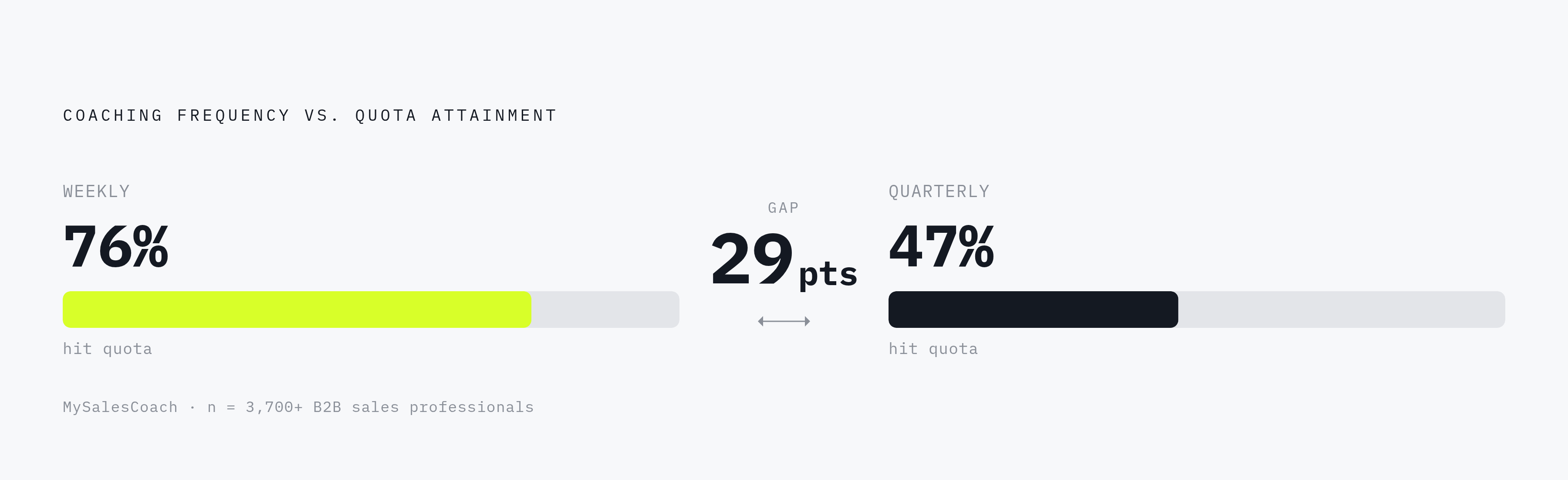
Record the action plan somewhere it can be inspected at the next session: a CRM activity record, a sales win plan entry, any system the team actually uses rather than ignores. The research from MySalesCoach's study of more than 3,700 B2B sales professionals is direct on frequency: 76% of reps coached weekly hit quota, compared to 47% of reps coached quarterly. That 29-point gap is driven substantially by whether the Will from one session becomes the Reality of the next. Scheduling the follow-up review before the current session ends is the mechanism that closes the loop.
Applying GROW to Deal Coaching Versus Pipeline Reviews
Deal coaching is the most natural fit for GROW because the four stages map directly onto a live opportunity. The Goal is the outcome needed from this specific deal. The Reality is an honest read of where the deal stands in the buyer's actual process, not where the CRM says it should be based on a stage someone updated three weeks ago. The Options are the concrete levers available to move it. The Will is what the rep commits to before the next meaningful touch. When both parties come prepared with deal data, the session can run in fifteen minutes and still accomplish something real.
Deal coaching can also be retrospective, and most managers never think to use it this way. A post-mortem on a lost deal is a legitimate GROW session. The Goal shifts from "win this deal" to "understand what we would do differently," and the conversation moves through the same four stages with past performance as the material. A Reality assessment of a loss, run without defensiveness, builds the pattern library that makes the Options stage richer in future live deals.
Pipeline reviews are a different conversation entirely, and conflating them with coaching is one of the more reliable ways to undermine both. A pipeline review inspects quantity and coverage: how many qualified opportunities exist, at what stage, with what expected close date. It is largely inspective. A coaching session develops the rep. Running them simultaneously means neither gets the attention it requires, and the pull to slide from one into the other during a single meeting is persistent, understandable, and ultimately costly. Keeping them separate is a structural decision, not a scheduling preference.
GROW also applies to mindset challenges, which gets underappreciated. A rep who has developed a pattern of discounting too early to close deals is not facing a knowledge problem. The Reality stage in that conversation is where the coach surfaces the behavioral pattern carefully, without making the rep feel indicted. The structure is the same. The calibration of questioning has to account for what the rep can actually hear in that particular moment.
The Questioning Habits That Make GROW Work and the Mistakes That Make It Feel Like an Interrogation
The functional discipline of GROW is asking open-ended questions that begin with "what," "how," or "why" and then actually listening to the answer. Closed questions that invite yes or no collapse the conversation. They communicate, implicitly, that the manager already has the answer and is simply waiting for the rep to arrive at it. That signal shuts down reflective thinking fast.
The most common technical failure among managers who nominally use GROW is asking questions while processing the next question rather than genuinely hearing the current answer. Reps detect it even when they cannot name it, and their willingness to disclose real information drops accordingly. The pause after a question, the silence that gives the rep space to actually think, is not dead air. It is where the substantive material surfaces. A manager comfortable with ten seconds of silence after a hard question will consistently pull more useful information than one who rushes to fill it.
The advice trap is the other dominant failure. Experienced sales managers have seen the problem in front of them dozens of times and know what works. The instinct to share that knowledge is not wrong in itself, but when it arrives before the rep has had the chance to derive the answer independently, it forecloses the development that justified the session. Recency also matters more than most managers account for: coaching delivered close in time to a relevant call or event produces better behavioral improvement than delayed feedback, because the Reality and Options stages can be grounded in something the rep vividly remembers. That is a quality variable, not a scheduling detail.
Where GROW Falls Short and What to Do About Its Documented Limitations
GROW is a conversation structure. Not a coaching system. That distinction gets obscured in how the model is usually presented, and the confusion has real consequences. The framework does not tell you how to diagnose which behaviors to prioritize, how to use performance data to set the session agenda, or how to build a development program that compounds across months. A manager can run four consecutive GROW sessions on four disconnected topics and produce no meaningful growth whatsoever.
The model's reliance on the rep's self-awareness is its most significant functional limitation. A rep who does not know what they do not know cannot self-diagnose in the Reality stage with any useful accuracy. The coach compensates by bringing external evidence: call recordings, deal data, peer comparisons. Without that data, a non-directive Reality stage with a rep who has significant blind spots produces a polished rationalization rather than an honest assessment.
With less experienced reps, the Options stage breaks down for a related reason. Someone who has run thirty discovery calls does not yet have the pattern library to generate meaningful alternatives independently. The non-directive default becomes progressively less effective as experience decreases, and the manager has to introduce structure without abandoning the principle that the rep must own the path forward. That balance is harder to strike in practice than the model's advocates typically acknowledge.
When performance issues are acute and time is short, GROW is the wrong tool. It is a coaching model, not a performance management intervention. Using it as a substitute for a direct, documented performance conversation creates confusion for both parties. Other models address some of these gaps: OSKAR handles longer-term outcome tracking more cleanly; CLEAR works better when the rep primarily needs to feel heard before they can engage analytically. The research consistently points to the same practical conclusion: the specific model matters far less than choosing one and running it consistently, every week, with real deal evidence in the room.
What Consistent GROW Coaching Actually Produces in Quota Attainment
The numbers are consistent enough across enough sources that arguing against structured coaching in sales has become a difficult position to hold. Structured coaching programs are associated with a 28% higher win rate. Formal coaching processes correlate with quota attainment of 91%, compared to 85% for less structured approaches. Research from CSO Insights points to roughly an 8% annual revenue increase from real-time, deal-specific coaching: exactly the kind of focused, single-deal GROW conversation described throughout this piece.
The frequency finding is the most operationally useful data point in the literature. Moving a twenty-five-person team from quarterly coaching to weekly coaching is associated, per the MySalesCoach dataset of more than 3,700 reps, with approximately £3.6 million in incremental revenue coverage annually at a £500,000 quota per rep. Most managers are making the frequency decision by default rather than by design, which means they are leaving that number on the table without realizing it.
The data also clarifies the distinction between coaching and training. The productivity improvement attributed to coaching significantly exceeds the improvement attributed to training alone. The implication is not that training is irrelevant but that knowledge transfer is not the primary bottleneck. Behavior change is. And behavior change requires repeated, structured, accountable conversations over time, not a quarterly skills workshop followed by three months of silence.
Fifty-seven percent of chief sales officers, in Gartner's Sales Transformation Survey 2024, name manager coaching, improved tools, or upskilling among their top three productivity priorities. Executive intent is not the gap. Execution is. The framework itself is not the hard part; any experienced sales manager can learn the four stages in an afternoon. What separates teams that see the numbers from teams that simply know the acronym is the discipline of running it weekly, recording the commitments that come out of the Will stage, and bringing those commitments back into the room at the next session as the starting point for Reality — the same logic, incidentally, that applies to content strategy: Letterstory, for one, is built on the premise that frameworks without consistent execution produce nothing.