Pipeline Review Cadences That Improve Deal Velocity
Deals closing in 45 days win at 68%, but stale pipeline activity masks real capacity gaps.

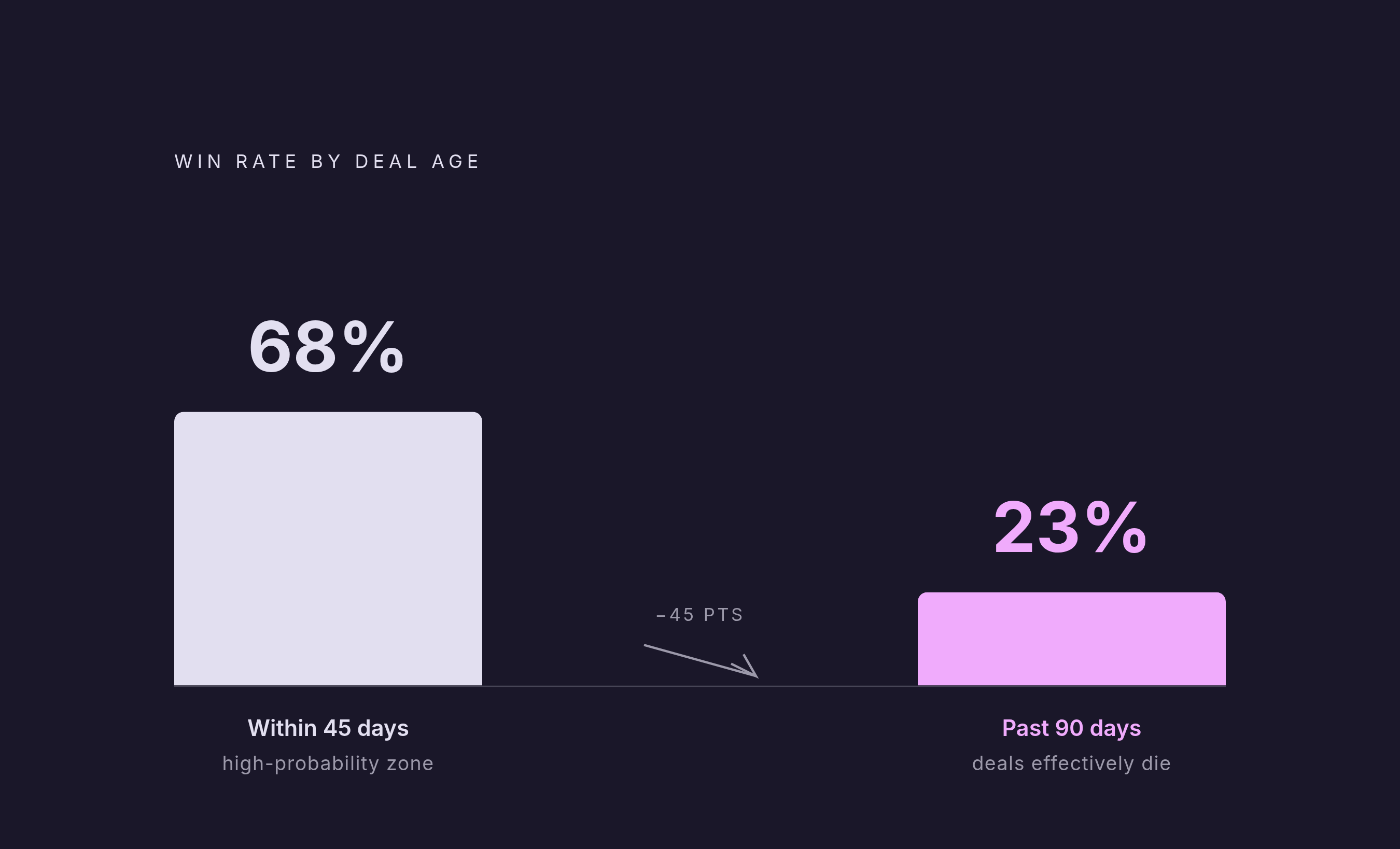
Here is what the data actually shows, and it is uncomfortable if you run a sales team. Deals closing within 45 days win at roughly 68%. Push past 90 days and that figure craters to 23%. The window in which a deal closes at high probability is not just finite, it is shorter than most pipelines honestly reflect.
And that window keeps shrinking. Sales cycles have stretched roughly 22% since 2022, not because reps got worse, but because B2B buying now involves six to ten decision-makers, each arriving with their own research, their own objections, their own approval gates. More stakeholders at more stages creates more surface area for things to stall. Most review cadences were built for a simpler environment, 2018 or 2019, when you had two or three contacts and a reasonably predictable sequence. That mismatch is where quarters go to die.
The performance gap between top and bottom performers is worth examining plainly. It is not primarily about talent. Top performers qualify harder, multi-thread earlier, and maintain enough activity that deals do not go dormant between touches. That is a discipline and systems story. You can fix systems.
There is also a pipeline math problem that rarely surfaces in reviews. If 25% of your pipeline has had no stage change in 30 days, a nominal 4x coverage ratio is functionally something like 3x. At median win rates, 3x is right at the floor of what you need to hit target, with no cushion for the deals that slip at the last moment, and there are always deals that slip at the last moment. Stale deals do not vanish from dashboards. They sit there, inflating the number, contributing nothing to the quarter, and everyone tacitly agrees to avoid talking about them until it is too late.
These are not problems that better CRM hygiene resolves on its own. They are problems a structured, intentional review cadence is designed to catch before they compound.
Note: The win-rate-by-close-window figures (68% within 45 days, 23% past 90 days) and the 22% cycle-length increase since 2022 cited in this section require explicit sourcing before publication. Readers should be able to verify these claims independently.
What Most Pipeline Reviews Actually Get Wrong Before the Meeting Even Starts
The standard prescription is "review your pipeline more often." That advice misidentifies the problem. Most teams already meet often enough. The failure is architectural.
The typical pipeline review tries to do three incompatible things inside a single 45-minute session: rep-level deal coaching, aggregate pipeline health inspection, and data-quality auditing. Each of those jobs has a different owner, a different time horizon, and a different kind of decision it should produce. Stack all three into one meeting and each gets roughly fifteen rushed minutes. Reps sit through leadership's aggregate conversation. Leadership sits through individual deal minutiae that does not concern them. Nobody leaves with what they actually needed.
Only 7% of companies achieve 90% or better forecast accuracy, according to Gartner. That chronic miss is partly a meeting design problem, not just a forecasting methodology problem. Readers should consult the specific Gartner report for full methodology and context.
The second structural failure is the absence of pre-work requirements. When participants arrive without having pulled deals by stage, flagged no-activity opportunities, or identified slippage from the prior period, the meeting becomes discovery rather than decision-making. Time that should go to intervention goes to orientation. Fifteen minutes reconstructing where a deal stands is fifteen minutes that does not go toward moving it.
Splitting the overloaded single meeting into distinct conversations, each with a clear owner, a clear purpose, and a pre-work requirement that actually makes the session worth attending, is the architectural fix. Not complicated. Just deliberately neglected.
A Four-Level Cadence Architecture Matched to Decision Type and Audience
Level 1: Weekly 1:1 Deal Review
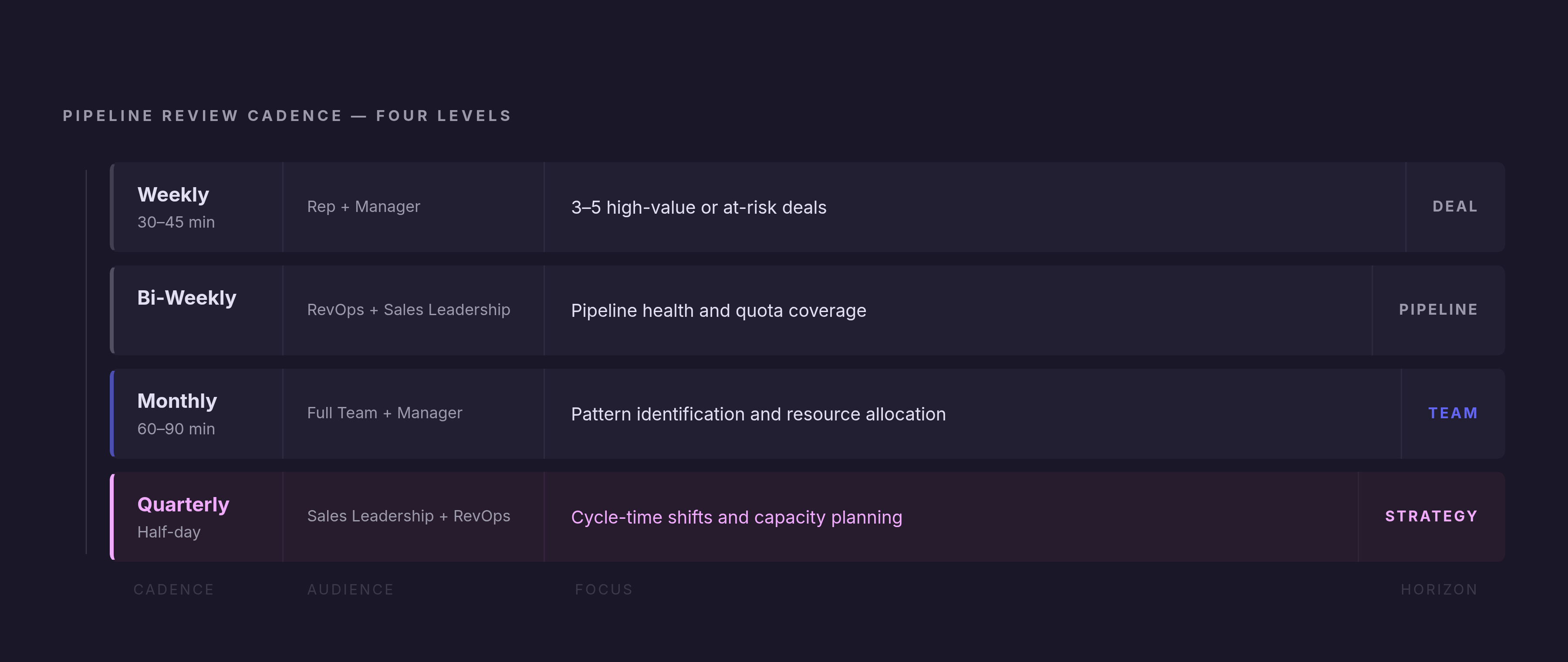
This is a 30-to-45-minute conversation between rep and manager. The focus is intentionally narrow: three to five high-value or at-risk deals where coaching or a specific intervention can actually change the outcome in the next two weeks. Not all deals. Not a status tour of the entire pipeline. The specific deals where the next two weeks matter.
Consistency is more important than frequency. A weekly review that both parties prepare for and trust outperforms a daily check-in that feels like surveillance. For experienced reps running shorter cycles with consistent performance, bi-weekly is defensible, but it requires a compensating mechanism: CRM-triggered alerts or async pipeline updates in off weeks, so stalls get caught before they compound between sessions. Bi-weekly is a calibrated adjustment, not a default.
Level 2: Bi-Weekly Pipeline Health Review
This conversation belongs to RevOps and sales leadership. The focus is structural: is coverage holding against quota, is velocity trending in the right direction, where is the pipeline thin two or three quarters out. Individual deals do not belong in this room, and that boundary matters more than it sounds. When individual deals creep into a structural health review, the conversation collapses back into the overloaded single-meeting problem you were trying to escape.
The coverage red-flag threshold is specific. When pipeline value slips meaningfully below three to four times quota, that is an operating problem, not a coaching problem. It needs a different fix than pushing one rep harder on one deal.
Level 3: Monthly Team Review
A 60-to-90-minute session with the full sales team and their manager. Cross-team visibility, pattern identification, and resource allocation are the agenda. Two or three deals get examined, either because collective input would genuinely help or because they illustrate something instructive for the group. This is not an individual performance review. It is a learning and alignment session, and the distinction matters for how people show up to it.
Level 4: Quarterly Executive Review
A half-day investment by sales leadership and RevOps. The focus is cycle-time shifts, structural bottlenecks, and capacity planning. These are the trends that are invisible from the weekly vantage point. They require distance and aggregated data before they become legible. Gartner has projected that roughly three-quarters of high-growth B2B companies will operate a formal RevOps function by the end of 2026; readers should consult the specific Gartner report for the methodology behind this projection.
A practical frequency rule: weekly is the right default for B2B SaaS teams with 60-to-90-day cycles. Longer cycles or smaller teams can sustain bi-weekly without losing visibility, provided coverage tracking is automated between sessions.
The Deal Signals and Risk Flags Each Review Must Surface
Every review tier has three non-negotiable purposes: validate that deal progression is based on real buyer actions rather than rep optimism, identify risks early enough to do something about them, and produce action items with named owners and explicit deadlines. A review that does not accomplish all three is a status meeting in a pipeline review's clothing.
Prioritization determines where session time actually goes. Focus on deals closest to close that need a specific push, deals that have stalled for 14-plus days, deals where the rep cannot articulate a clear next step, and new high-value deals that need a real strategy from the start. Everything else can genuinely wait.
Four risk flags deserve to be named explicitly in every review. No activity logged in 14 or more days is the first, because a deal that has gone quiet is rarely just taking its time. Single-threaded engagement with a non-economic buyer is the second; one contact who cannot write a check is not a deal, it is a relationship. Budget described as "definitely allocated" without knowing the amount or the approval process is the third; vague budget confidence is often a lag indicator of a deal that will slip. Next steps defined by vague timeframes rather than specific actions is the fourth, because "we'll reconnect next week" is not a next step, it is a placeholder.
The stale-deal rule deserves a hard line. If a deal has been in its current stage for more than twice the historical average for that stage, it should not count toward coverage, should not feed velocity calculations, and should not appear in the forecast. Including it distorts every number downstream, and those distortions are how teams convince themselves they are on track until the quarter ends and they are not.
Pipeline reviews and forecast reviews are not the same conversation. Pipeline is about how to move deals. Forecast is about what will land. Keeping them separate keeps the coaching sharper and the number more honest.
On coaching mechanics: pick one theme per session, reference a specific deal or call where the gap actually appeared, and agree on one concrete change before the next review. Three feedback points get forgotten before the parking lot. One has a chance.
How Coverage Ratios and Velocity Benchmarks Give Reviews a Factual Baseline
Coverage targets are win-rate dependent, not universal, and that distinction gets papered over in most organizations. A 25% win rate requires 4x coverage. A 33% win rate requires 3x. Below 3x at median win rates means relying on nearly every deal to close, which does not happen. The standard 3-to-4x rule is calibrated for mid-market. Enterprise and upper mid-market segments need 5-to-7x, because win rates are lower and cycles are longer and there is simply less room for error.
Segment variation matters more than most cadence designs account for. SaaS and tech businesses average cycles around 67 days at roughly 22% win rates. Manufacturing averages cycles over 120 days at win rates below 20%. These figures are drawn from HubSpot's 2024 State of Sales report; readers should consult that report directly to verify the numbers and understand the methodology. A team running SaaS cadences on a manufacturing pipeline will systematically under-review, and the problem will not surface until the quarter is already lost. The review frequency, the coverage threshold, and the stale-deal definition all need to be calibrated to the actual cycle length of the segment being managed. HubSpot's 2024 State of Sales reports an average B2B win rate of approximately 21%, which means most teams are operating closer to the 4x coverage floor than they realize, with less margin than their pipeline reports suggest.
Use these benchmarks for calibration, not as targets. When a review surfaces a coverage ratio or velocity trend, the question is whether it sits above or below the baseline appropriate for that specific segment and cycle length. Four metrics should travel together in every review: volume, value, coverage, and velocity. Tracked together, they prevent the common failure of optimizing one number while another quietly deteriorates.
Building Accountability Into the Cadence So Decisions Made in Reviews Actually Stick
Here is how it usually goes. Manager and rep agree on specific next actions. Both leave the room with genuine intention. The week fills up, an inbound opportunity lands, a customer escalation surfaces, the usual. The following review starts from scratch with no reference to what was committed.
The fix is an agenda structure. The opening block of every weekly review checks last session's action items before new deals are touched. Not as a performance evaluation; as a factual accounting of what was committed and what happened. That single structural change does more for actual follow-through than any values conversation about ownership or accountability.
Async supplements between sessions do real work here. CRM-triggered alerts and Slack updates on stalled deals maintain visibility without adding meetings. They also make in-session time more productive, because participants arrive with current information rather than spending the first ten minutes reconstructing reality from memory.
A pipeline review without action items attached to owners and deadlines is a status meeting. If the situation in the deals you reviewed is identical at the following session, the review did not function as a review. You narrated the pipeline. You did not change it.