How SaaS Companies Actually Use Content to Drive Signups
Top performers drive 11% signup rates by matching content to buyer intent, not just traffic.

How the funnel looks when content does its job
Content marketing grows SaaS only when it delivers signups, not just traffic. Most firms still shape content around visits and collecting addresses, while that mismatch between the numbers tracked and the money earned is the industry's biggest letdown. Software shares declined in 2026, customers are merging suppliers, and any content investment has to pay back on a tighter timeline.
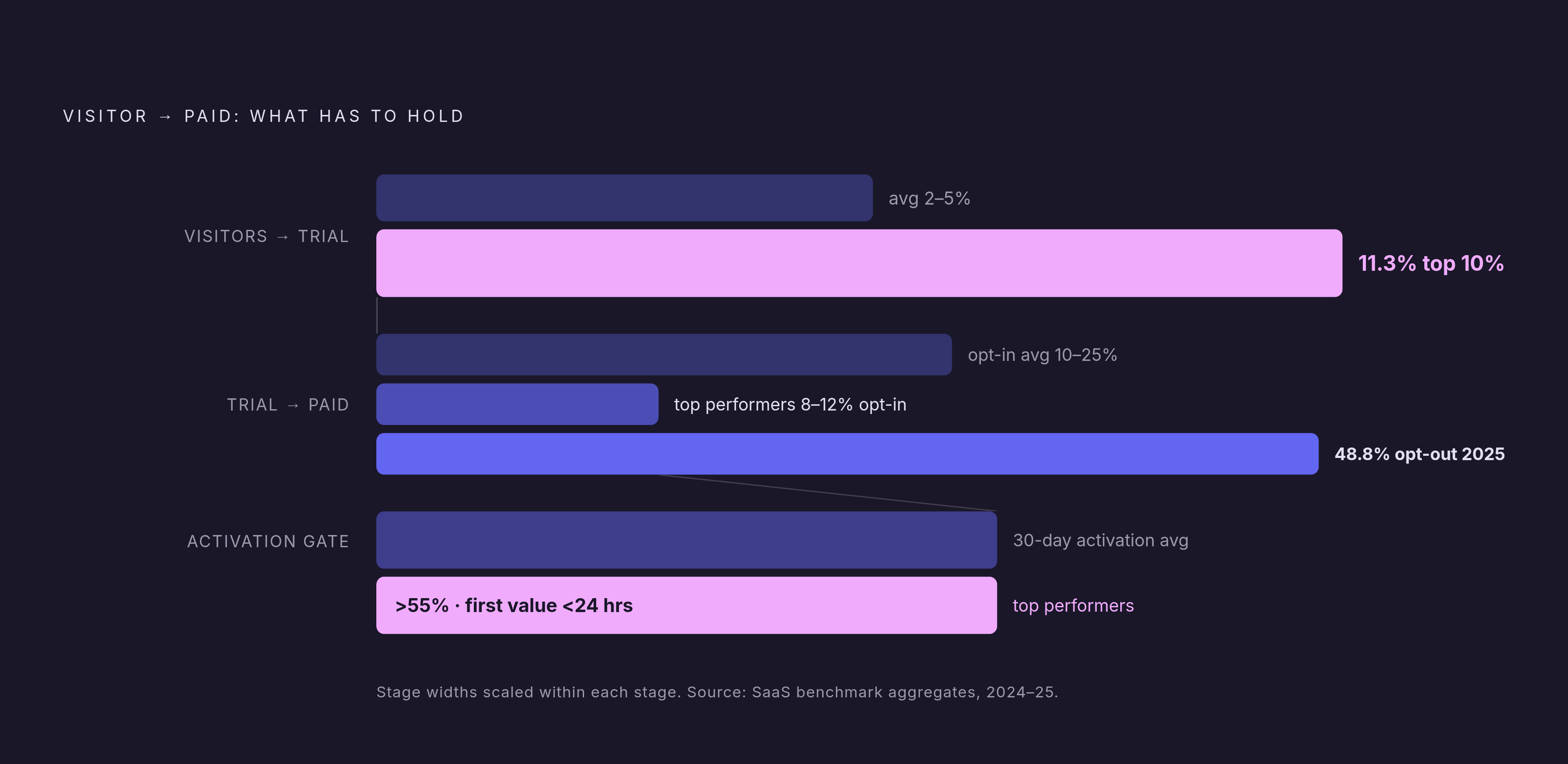
Then, let's get concrete with actual figures. About 2% to 5% of visitors sign up for a trial, and from that group 10% to 25% convert to paid after the free trial (or 2% to 5% under freemium). In a group of companies studied, 8% of free users go paid at the midpoint, which feels small until you check what the leaders do differently.
Averages miss what’s really happening here. The top 10% of performers across roughly 2,900 SaaS websites spanning 14 verticals see signup rates of 11.3%, way above the middle. Looking at over 800 companies, the High Alpha 2025 SaaS Benchmarks Report found top performers land free-to-paid conversion at 8% to 12%, deliver first value inside 24 hours, and push 30-day activation past 55%. All three of those figures are linked: when a brand drives a new user to value quickly, more of them end up activated, and solid activation keeps the conversion rate from dropping off a month later. Signups can climb while time-to-value lags, the funnel looks solid on a dashboard even as weak activation starves the company, since slow time-to-value lowers activation, and weak activation is what makes the conversion rate decay within a month.
How the topic brings in buyers instead of browsers
Not all visitors act the same once they hit a page, but most content teams still plan as if they do. A buyer entering “best [category] software” is comparing products today, ready to pay. A visitor looking at a how-to page might be years out from buying, or might never purchase. Giving both visitors the same weight is the most frequent budgeting error in this category, and that's how content work loses money with nobody noticing it on a spreadsheet.
Comparison content lands right before the buying choice, and the numbers make it obvious. A single head-to-head post on Arcade's blog brought in 302 signups over a month and a half, since it met the buyer mid-decision, weighing specific options against one another. Research from one digital marketing analysis found "best X" listicles represent 43.8% of every page format named by ChatGPT. It ranks in traditional search and AI-generated results, a pairing so unusual that teams should reorder their calendars around it.
Around 83% of B2B buyers conduct self-research before speaking to sales, and a significant share devote weeks or months to it. Content that reaches a buyer at that moment, matching where they are in their purchase journey, is when the signup decision gets made. Content that misses that moment, even when well-written, usually increases a business's page count, and that's it. Volume alone won't cut it: content calendars that skip intent-matching just pad page counts.
Content formats that let buyers evaluate the product without a sales call
According to what the 6sense B2B Buyer Experience Report found, buyers do about 70% of their research before contacting any vendor, and 81% lock in a shortlist before sales even shows up. That data rewires what content has to deliver. Content does the job a sales rep once did on a first call, and a plan still aimed only at early-stage reach is answering a question from ten years ago.
Static product pages and screenshots can't do that work, and teams still backing them optimize for a buyer phase with far less volume now. Quantum Metric saw conversion rate jump 2X and engagement climb 5X once static product pages gave way to interactive product demos visitors could click through themselves. Zapier noticed the same thing later: sharing live tours rather than PDFs raised scheduled meetings by 70%, since the app did what once meant setting up another chat.
Buyers increasingly prefer to evaluate products without friction, seeing the product itself rather than navigating a meeting, payment screen, or trial gate. They're after the product itself. Storylane's demo events lifted both signups and brand recognition right away, fitting the larger pattern. When a decision removes friction between interest and trying the product, it works. Any move that throws a gatekeeper in the path usually falls flat.
Using original data and proprietary research to become the source AI systems cite
Original research earns belief in a way recycled content can’t. Proprietary research delivers ROI for 88% of B2B SaaS marketers, and 64% say data-driven content converts at a faster rate than content built from secondhand sources.
HR Datahub shows this dynamic in action. After updating one blog post with original data, it climbed from 35 to 1 in search rankings over four weeks, began drawing citations in AI tools, and lifted webinar signups by 200%. Original data doesn’t go away when paraphrased like a personal take does. When an AI summarizes a topic, it often cites the original research, as the data carries more weight than the surrounding prose. All the other posts in the category wind up citing and linking to the original, so the SEO gains compound rather than fade.
That compounding counts because of where those prospects end up in the funnel. SEO-derived prospects move from MQL to SQL 51% of the time, versus 26% from ads. Solid, well-backed material doesn't only show up higher in search, it pulls in a stronger kind of buyer, someone sold on the numbers before a rep ever talks to them. Anyone treating "content marketing" and "lead generation" as separate budget lines is missing that they're the same line, measured at different points.
Free tools as a signup channel that outperforms most content
Ahrefs offers the clearest example of this approach. Ahrefs gives away backlink checks, traffic checks, and writing utilities that support the paid product while standing on their own, attracting significant search traffic.
The idea is plain when you notice it: the free tool delivers product experience directly, without talking about it. A CTA has no gap to fill, because the tool itself already serves as signup, or near enough that the final step is trivial. A how-to piece on reviewing backlinks manually only creates a visitor. A free tool turns visitors into users, and that gap in results is the entire case for making one rather than another article.
This tactic isn’t right for all SaaS category cases, and denial leads teams to sink developer effort into a tool people ignore. Not every product can have a slice pulled out and handed off without hurting what the paid version sells. But when the product can turn a calculator, grader, or checker into standalone use, it wins against a same-search-query informational blog post because people are already at work.
The CTA and page design decisions that turn a reading session into a signup
CXL Institute examined about 2,900 SaaS sites and found what puts the best 10% ahead: screens appearing in under 2 seconds, a clip visible immediately, one clear CTA, and trust signals using real company marks over plain quotes. On its own, each trait raised conversion by a modest handful of points. Each one seems modest by itself. Stacked, they form the gap between a standard page and one that's top-decile.
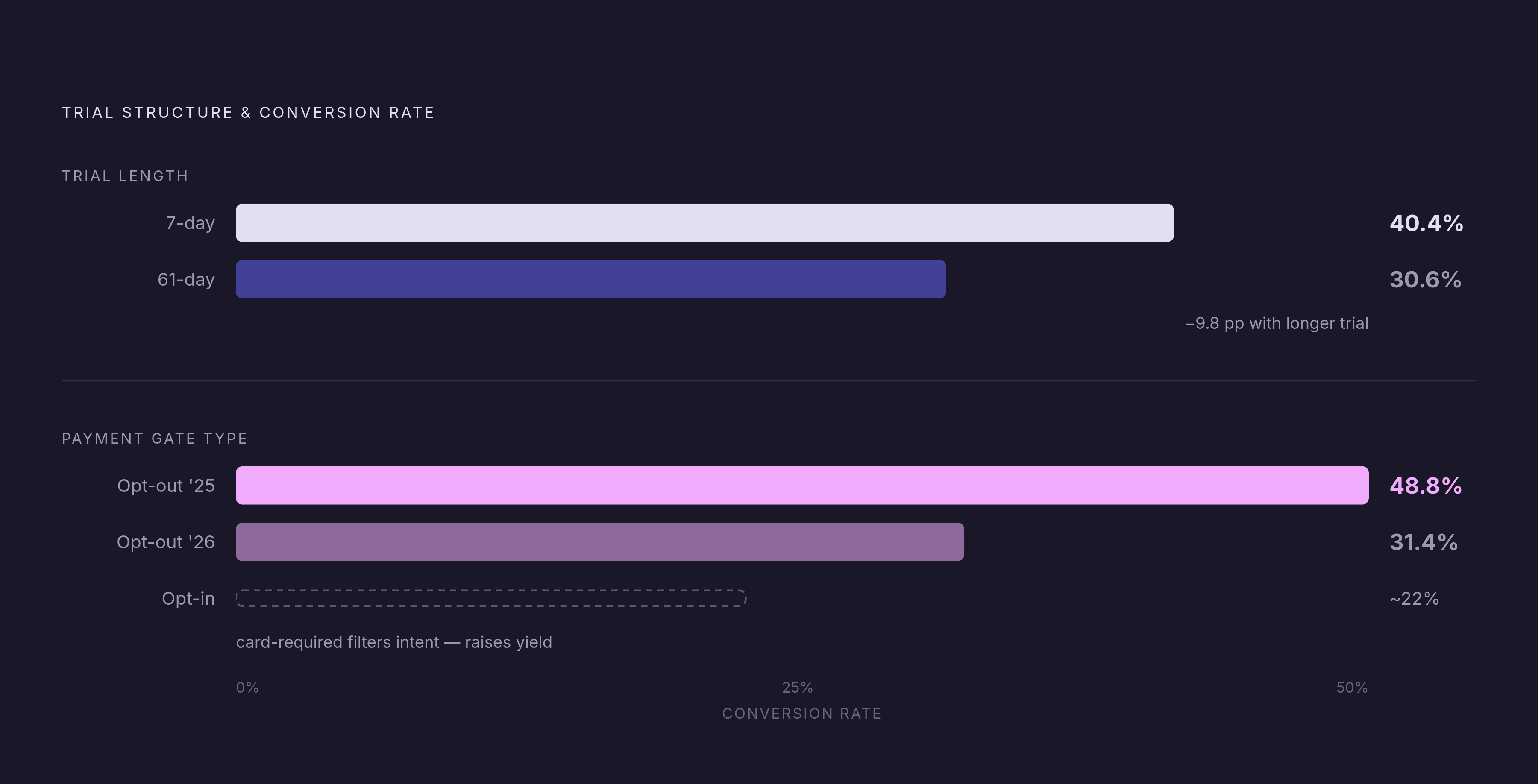
Trial length is really a disguised CTA decision, and most teams read its impact wrong. Seven-day trials convert 40.4% of people, but after 61 days that figure is just 30.6%. Urgency is built directly into how long the trial itself runs. You design urgency directly into the trial length itself.
The instinct to dodge friction around credit card entry is a mistake, and opt-out trials back that up. Opt-out trials, which require a card upfront, averaged 48.8% conversion in 2025 and 31.4% in 2026, significantly higher than opt-in trials from comparable traffic. Asking for a card filters out browsers before the funnel, so the top shrinks, but those visitors convert at a rate high enough to make up the difference. Chasing signup volume instead of holding the card requirement targets the wrong metric.
How the first 48 hours post-signup decide whether content ROI holds up
SaaS teams spend big to get a signup, then go silent right when its value gets set. The first 48 hours closes the gap between what a dashboard shows and money in the door. Content teams working the funnel have almost no visibility into this stretch. Most content reporting is a dashboard full of made-up numbers.
Top-decile self-serve companies combine four things: a single "aha moment" a new user can reach in under 10 minutes, lifecycle emails triggered by product activation rather than fired off on a calendar schedule, in-product upgrade prompts that appear right when a free-tier user hits a usage wall, and sales outreach reserved for accounts that cross a defined product-qualified lead threshold rather than every signup indiscriminately. The High Alpha report's metrics, sub-24-hour time reaching first value plus 30-day activation topping 55% for top performers, sit downstream of that sort of first-48-hour design. All of it is on purpose.
Attribution breaks down quickly once activation is in play, and that's where most content reporting falls apart. For example, one source may drive high trial signups but low paid conversions, while another achieves the opposite, yet both can appear similar in basic reporting. Signup volume becomes a misleading scoreboard when activation data isn't there. When they count only trial starts, they show part of a metric as the full story.
How AI search shifts where buyers find software and which content gets seen there
Gartner projected a 25% drop in traditional search engine volume by 2026, and halfway through that period the prediction had mostly come true. Search isn't where buyers head first anymore when weighing software, and content built to climb the results page is hitting a shrinking target.
Looking at an analysis spanning many keywords, click-through numbers for the top page ranking first slide as much as 58%, falling from 7.3% to just 1.6% wherever Google's AI Overviews show up. Zero-click shows it another way: in May 2024, 56% of news-related Google searches ended without clicks, rising to 69% by May 2025, a 13 percentage point increase.
Buyers are doing this differently right from the start. Roughly 35% of US shoppers turn to AI when looking into a product purchase, while 13.6% stick with traditional search for that same job. Buyers have a shortlist built before they start a search engine, so content that optimizes only for the results page is optimizing toward something that rarely occurs now.
How GEO and AEO work for SaaS content teams
Content teams are adapting to two acronyms that address distinct challenges, not the same issue under different labels. For Generative Engine Optimization, or GEO, structuring content and web signals gets ChatGPT, Perplexity, Claude, and Google AI Overviews to cite an organization by name for the right prompt. It’s not so much about building backlinks as about being seen, in plenty of places online, as a credible voice on the topic.
Engine Optimization (AEO), narrower and more rule-based, means structuring content so search systems can place it directly in a snippet, knowledge box, or generative response without someone clicking through. One source breaks GEO's efforts into about 80% strategic work (like positioning and brand authority) versus just 20% technical tasks. Most of it lines up with the content-and-brand-building SaaS marketers already do. People marketing GEO through schema markup alone deliver the 20% while skipping the positioning that earns citations.
Traditional SEO still matters, and teams that abandon it for GEO alone risk missing key opportunities. Google's AI Overviews often cite pages ranking in the top organic results. Ranking by old-fashioned methods still counts, but the best spot can now sit past top of page one. The playing field has expanded, and even lower-ranking pages can appear in AI-generated responses.