How to Build a Content Marketing Strategy From Scratch
Document your audience, goals, and AI visibility to build content that converts.

Most companies lack a content strategy. They have a blog updated only when it crosses someone's mind, a posting schedule with too many gaps, plus a newsletter that silently vanished from inboxes eight months earlier. It’s posting on hope, with the same result every round: someone or a CFO wondering why content spend created no traceable lead. CoSchedule's study shows marketers who put their strategy on paper hit 313% better odds of winning, a figure that matters not for the paperwork but for the choices documentation demands before anything gets made. A strategy is the foundation: who reads it, why it matters, and what pipeline it fills. The work gets built from this layer, and by skipping its core call, the schedule becomes guesswork with a deadline.
The environment content has to compete in now
Google's no longer the opening move, and a vendor's page isn't the finish line. They have a ChatGPT conversation, hear what people suggest in Slack, and reach the homepage of a brand only after they've nearly chosen. A Google Analytics dashboard built for that funnel can't capture the gap, since the path is gone.
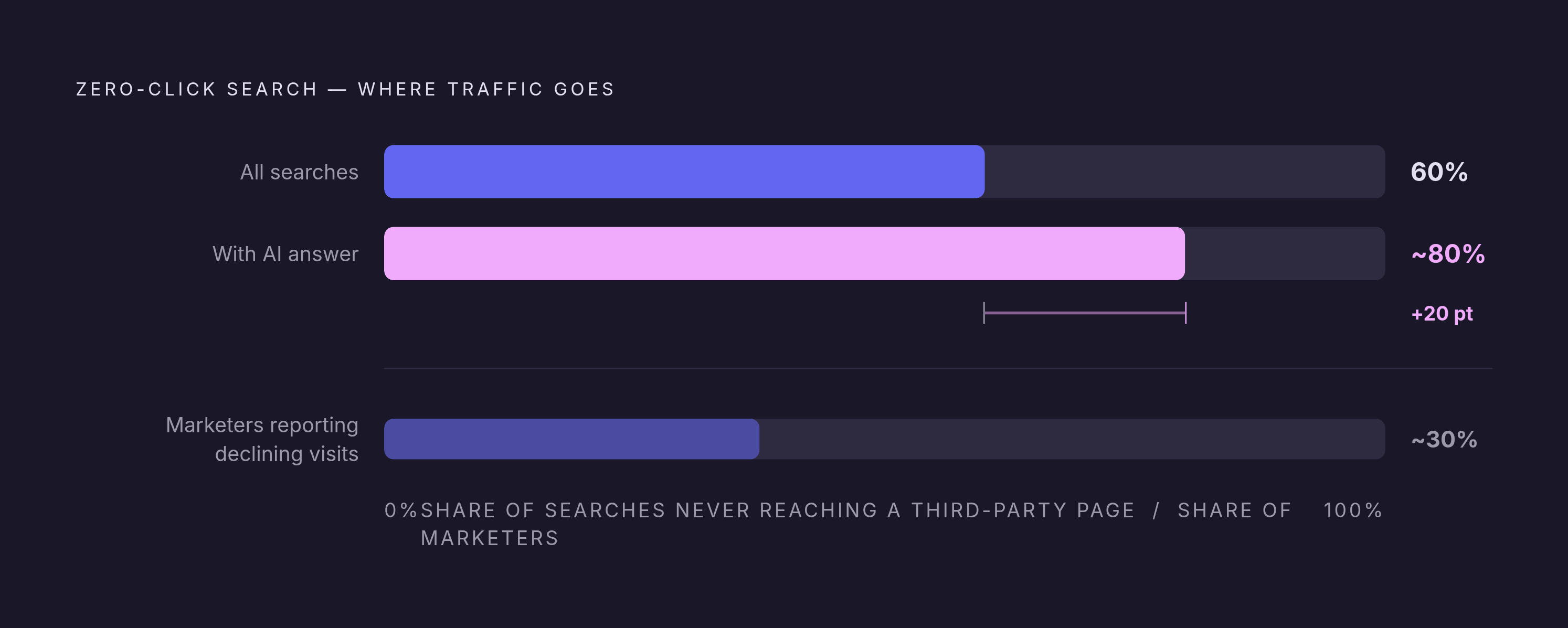
Zero-click had already cut into the dashboard before generative answers showed up. Over 60% of searches on Google never lead to a third-party page, and that share climbs near 80% whenever an AI-generated block shows up. About 30% of marketers see declining search visits as research moves from ranked links straight into AI tools.
Organic isn't over yet, though. It still brings in 53% of all trackable website traffic for B2B marketers, making it the top route for most. The terrain under it is different. Before, the surface was just a ranked list of 10 links. The surface today has a ranked list, a synthesized reply, and a citation list inside one conversation view, so any strategy built to capture just the ranked list means optimizing for a shrinking portion. Most teams still treat the AI box as a curiosity rather than the battleground, and that's the priciest miscalculation out there.
Setting goals that survive a budget review
Marketing teams now hear the same thing from executives: how does the company appear inside ChatGPT? A strategy based only on visits and keyword rankings can't address that, and that gap is where content marketing gets cut. No one defends a figure they don't have.
SMART, measurable, time-bound, attainable, and relevant, brings the tough issues up early: who the content is really for, the pipeline value it's supposed to create, how to tell in six months if it worked. "Get more traffic" fails every part of that test. "Increase organic blog traffic by 25% in six months through keyword-focused articles targeting mid-funnel buyer questions" passes, because it names a number, a mechanism, and a deadline.
Targets must state the visibility surface they compete on and the volume they expect. Ranking is just one surface. AI citation, the number of times a company is cited within an AI-generated response, is another. How often a brand appears in AI answers compared to rivals is a third. Choosing only one leaves a strategy built for a web that’s no longer there.
Audience research that goes beyond demographics
Customers handle about 80% of the buying process on their own timeline, without talking to a salesperson or answering to anyone's direction. Content carries that self-guided stretch. It's no sideshow to the sales conversation. Through most of the cycle, that conversation is all they're having.
People want to find things themselves, and that isn't going away. About 70% of buyers want to find out about a business through articles instead of ads, which shows a lasting change in how vendors get sized up, not a phase that reverses when budgets tighten.
Demographics account for none of it. To understand a buyer, dig into sales call recordings, help requests, and the online spaces the audience spends their day, all mined for the needs and wants recurring in their own words. Tools such as Brandwatch or Hootsuite, paired with behavioral reports from Google Analytics, fill in the rest: which formats get consumed, which platforms pull weight, and which sit unused.
Keyword and intent research for a unified search and AI visibility surface
Keyword research answers one thing: how many people type this phrase. Intent research takes a different angle: what need are they really working through, and where in the buying process are they when they run that search. Don't hand the team a volume-sorted spreadsheet. It should look like a topic map where every cluster carries a pipeline score, giving the content team a clear read on which ones pay back the effort and which ones only pull visits.
Segmenting intent helps because each point calls for a different task. Informational queries live in awareness and look for learning. Navigational queries fall in the evaluation stage, seeking head-to-head comparisons. Transactional queries sit where choices are made and need evidence. One format and call for all of them wastes two out of every three.
The AEO layer is a research space that barely showed up a few years back and is too important to skip today. A benchmark covering ChatGPT, Google's AI Overviews, Gemini, Copilot, and Perplexity tells where a company is cited, where it's not, and who is occupying that spot. That kind of diagnosis is what makes generative engine optimization a concrete list of tasks instead of just a buzzword.
In many current questions, close to 30% of sites mentioned in AI Overviews were not on the regular search page shown with that reply. Showing up on page one still counts. That placement no longer guarantees a citation, and treating those two as equal can leave a company sure it’s being found when it isn’t.
Topic clusters and pillar content: building authority that accumulates
In the cluster model, content gets organized by a single pillar page on a wide topic, with narrower cluster entries that each address one subtopic and link to the pillar. This link structure shows topical depth, both to Google's ranking and to AI assembling citation lists.
The companies that do well over the long term with content don't need giant staffs or massive article volume. They built the cluster structure at the start and stuck with it past six months without abandoning it, so authority grew like a link structure should. It takes patience. Most groups walk away just as the structure begins to deliver results.
A pillar page does more than a standard blog, since it's built to take someone from the core issue through possible answers to the brand's own role, helping a buyer self-qualify before a sales call. The numbers prove it: firms putting out 16 or more articles monthly pull in far more visitors and prospects than those releasing zero to four. The cluster model gives that volume purpose rather than letting it go scattershot. Sixteen articles with no topic structure just create more mess.
Choosing formats and building a repurposing system
Match the format to the job. In-depth hub posts win AI mentions and keep search positions for years. Among visual formats, Short-form delivers the most. Newsletters grow an audience free from any platform's rules, which makes them among the more durable things a content team can own. Personal preference has nothing to do with it. Each format is built for a specific role, and choosing it for any other reason burns through the budget.
Repurposing creates leverage. A long-form pillar can turn into a brief video draft, a newsletter item, a LinkedIn note, plus an AI-extraction-ready structured FAQ, with every format drawing extra value from research already done once. Begin again from scratch each round, that's the pattern to fix.
AI tools belong here, but what they can do is narrower than marketing makes it sound. Digital Applied research says pairing AI-generated content with a person's review dropped bounces by 73%, but unedited AI content didn't help. AI is not what moves the numbers. The fix does it, and workflows that skip people are optimizing for volume instead of what makes someone stay on the page.
Optimizing content so AI systems cite it
Ranking on Google doesn't guarantee visibility inside ChatGPT anymore. Keeping the top snippet on a page doesn't guarantee showing up in Perplexity's citation list. They overlap on structured tags, plain answers, and authoritative sourcing, but it isn't a one-to-one match, so treating SEO the same as AI visibility for optimization means companies vanish where people actually look.
GEO, what generative engine optimization stands for, is about shaping content and looking after a brand's wider web footprint so AI tools pull it, sum it up properly, and show it when someone asks something. AEO is more focused: it shapes material so AI Overviews and similar boxes pull it in without anyone visiting the page.
By early 2026, no one term has won out. Practitioner talk treats GEO, AEO, AIO, LLMO, and AI SEO interchangeably, with no formal shared meaning to separate them. This is just about naming, not strategy. Use the word that fits the team and move forward rather than holding out for everyone to settle on language.
Distribution planned before the content is published
Most people in content marketing put all their time into making stuff, then treat distribution like an afterthought bolted on at the last minute. Ignoring the marketing side of content marketing is the most avoidable error in the field.
Allocate about equal effort and money to sharing content as to making it. Distribution is half the job, not a bonus round, and any plan that treats it as optional has already decided to underperform.
The places a company controls take priority because they aren't ruled by platform shifts: list sends, people already connected to it, and paths from busy site sections leading visitors to fresh pieces. Working with professionals from beyond the company quickly grows reach, as their audience’s confidence in the work can enhance credibility. Those expert-backed mentions from outside are what AI looks for when choosing what to cite. Distribution and AI visibility are one goal, worked in two different directions. Same goal, just worked from opposite sides.