Time Blocking for Sales Reps
Top performers protect 34% of their week for selling while average reps only manage 23%.

In 2025, 78% of sellers missed quota, up from 69% the year prior. It is not moving in a direction that implicates individual effort or raw sales acumen. Reps who are structurally blocked from selling cannot close what they never pitched. The pipeline will remain empty if prospecting hours get consumed by internal meetings and CRM entry before the day ever builds any momentum.
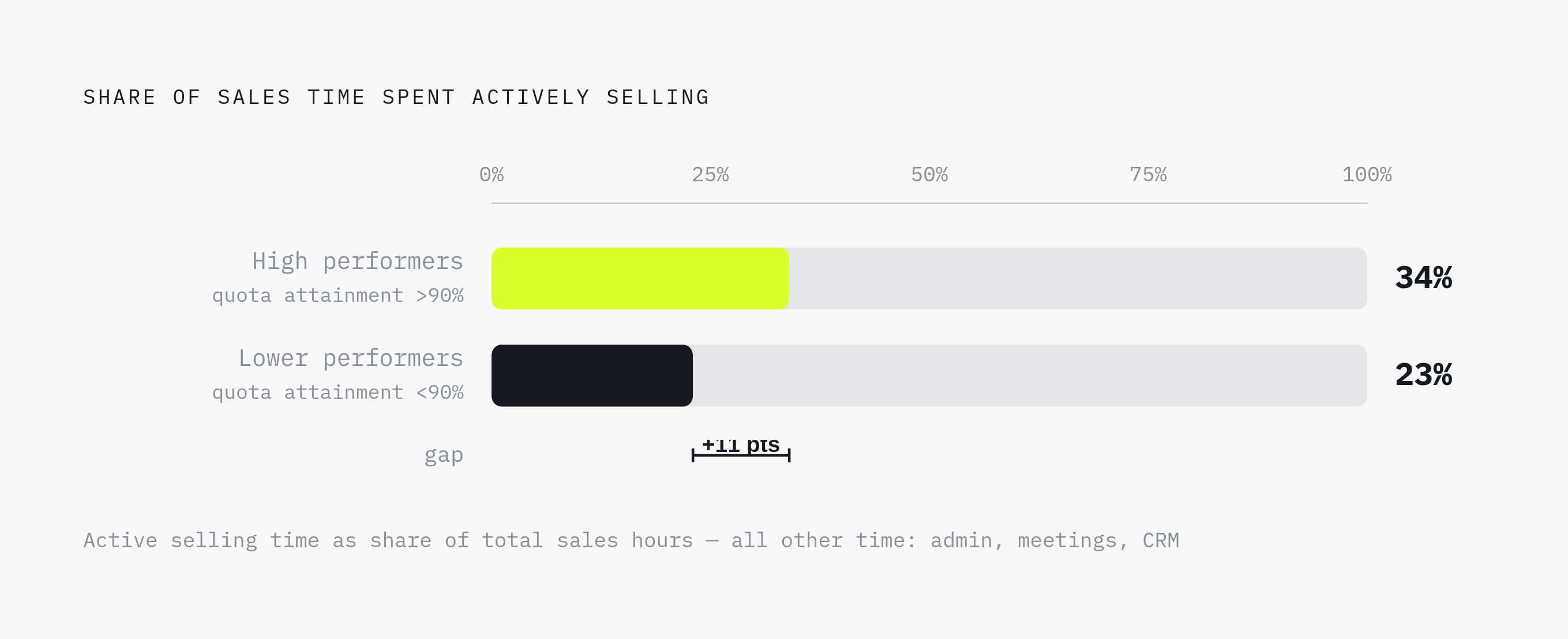
The time data at the top of the performance distribution tells the real story. Top performers spend between 35% and 40% of their week actively selling, against the 28% average. Forrester sharpens this further: organizations with quota attainment above 90% allocate roughly 34% of sales time to active selling, compared to 23% at lower-performing organizations. An 11-point gap that tracks almost exactly with whether teams hit their numbers.
Across a full year, a 7 to 12 percentage point advantage in selling time compounds to the equivalent of five to eight additional selling weeks for top performers. They are not grinding harder. They are protecting more hours for the activities that actually advance deals. The lever is calendar architecture — the difference between a river with defined banks and one that spreads thin across a floodplain: the same water moves faster and farther when it has somewhere to go.
What Time Blocking Actually Means in a Sales Context
Time blocking is the practice of scheduling the entire workday into dedicated slots for specific activity types: prospecting, follow-ups, demos, admin. The rep has already decided what each hour is for before the day begins, rather than reacting to whatever surfaces first.
The critical distinction from a standard to-do list is that tasks become appointments. They carry a fixed duration and a protected window. A Slack message cannot quietly devour a prospecting block the way it devours a loosely structured morning, because the block is already claimed. An unblocked calendar operates on the same logic as an open conference room: if it looks available, people will use it.
Cal Newport has written at length about what he calls deep work: single-task concentration in a protected window produces output that task-switching cannot replicate. In a sales context, the goal is not generic productivity. It is maximizing hours oriented toward buyers — the calls made, demos run, proposals advanced.
What time blocking is not: a rigid script that eliminates responsiveness. Urgent deal situations still get handled. The system creates a default, not a cage. Flexibility exists; it just has to displace something explicitly rather than erode everything passively. That distinction is exactly what most reps miss when they try this for the first time and decide it fails them.
Why Context Switching Is the Hidden Tax on Every Sales Day
There is no such thing as multitasking for the human brain. What reps experience as handling several things simultaneously is rapid task-switching, and it depletes cognitive energy faster while degrading the quality of each individual task. A mechanical constraint, not a philosophical argument.
The sales-specific version looks like this: a rep alternates a cold call block with CRM entry, returns to prospecting, then checks email. Each re-entry requires several minutes of reorientation before full operating capacity returns. Those minutes accumulate. By mid-morning, the day looks busy and the pipeline has barely moved.
A Gartner survey of over 1,000 sellers from September 2024 found that 72% feel overwhelmed by the number of tools they are expected to use, and those sellers are 45% less likely to hit quota. Sales teams average ten tools to close a deal. Without a structured calendar, each tool becomes a potential interrupt rather than an asset. The cognitive overhead has a direct quota consequence.
The correction is to group similar tasks into stacked blocks: all calls together, all CRM work together. This reduces the re-entry cost and lets reps build momentum within a task type rather than perpetually reorienting between them.
A Practical Structure for a Time-Blocked Sales Day
The governing principle comes from the "golden hours" framework: 8 AM to 3 PM represents peak buyer availability. All active prospecting and live conversations belong inside that window. Internal meetings belong elsewhere.
Within the morning block, sequencing by difficulty matters. Cold calls go first, when energy is highest and the friction is greatest. Cold email follows. A short spillover buffer closes the block. This sequencing prevents easier tasks from crowding out harder ones, which is the default failure mode of an unstructured morning. Most reps, given latitude, will find a reason to delay cold calls until the moment has passed. The structured sequence removes that option.
Inbox and Slack get three fixed check windows, roughly morning, midday, and mid-afternoon, with notifications off between them. Most deals can wait two hours for a response. The perception of urgency is usually false, and treating every notification as urgent is how prospecting hours evaporate without anyone noticing or authorizing it.
The afternoon block absorbs follow-up, proposal work, and pipeline management. These activities require less real-time energy and do not depend on catching a prospect live. They fit the natural energy curve of a sales day rather than fighting it. CRM entry and administrative work belong at the end of the day, or in whatever low-energy window the rep designates, where roughly eight hours of weekly admin gets contained rather than scattered through prime selling hours.
One tactical detail that gets overlooked: calling at five minutes before the hour or roughly 25 minutes after catches prospects between meetings. A rep who controls when the call block runs can engineer these windows deliberately rather than stumbling into them occasionally.
Inside the blocks, account prioritization follows a sensible allocation: the majority of selling time on Tier 1 accounts with strong fit and active buying signals, roughly a quarter on accounts with good fit but no current signals, the remainder on lower-priority accounts handled primarily through automated engagement. The exact proportions matter less than the underlying principle, which is avoiding uniform distribution of attention across accounts of unequal potential.
How Managers Can Protect the System Their Reps Build
Internal meetings consume 15% of the average rep's week. That makes them the single largest non-selling category after CRM entry, and it is a category that management controls almost entirely.
Some meetings are genuinely worthwhile. Deal reviews that surface genuine blind spots, coaching sessions with substantive feedback, pipeline inspections involving real analysis: these are worth the time. Standing syncs with no agenda and forecast reviews where reps read CRM data aloud to a manager are not. Whether a meeting generates insight that improves deal outcomes, or simply creates the appearance of oversight: most managers know the difference, and fewer act on it than should.
The manager's lever set is concrete. Audit and eliminate non-essential recurring meetings. Move updates that require no live discussion to asynchronous formats. Schedule all internal meetings in the afternoon, never during the prospecting window. These structural decisions produce larger productivity gains than coaching any individual rep on personal time management.
CRM simplification belongs in the same category. Removing fields that do not inform pipeline decisions directly reduces the 17% of the week currently absorbed by data entry. That is a systems decision, not a rep discipline problem, and treating it as the latter is one of the more expensive misattributions in sales management.
Research published in a 2025 ScienceDirect study examining B2B and B2C sales organizations found that managerial support, including structured feedback, mentoring, and regular check-ins, converts even high time pressure into performance-enhancing conditions rather than burnout. The manager's job is not to eliminate pressure. It is to ensure the environment converts pressure into output.
Where AI Fits Into a Time-Blocked Sales Workflow
AI's core role in a time-blocking system is not to replace the structure. It is to make each block more valuable by compressing the preparation required to enter it and the cleanup required to exit it.
Activity capture tools that log calls and emails to the CRM automatically drive a 30% to 50% reduction in CRM administration time. For a rep spending eight hours a week on admin, that reclaims several hours and returns them directly to selling blocks. Bain's 2025 analysis found that AI-assisted sales teams see meaningful productivity gains and significantly shorter deal cycles; the mechanism is exactly this compression of non-selling overhead. Bain estimates AI will roughly double the share of time sellers spend actively selling, from around 25% to near 50%, which would close most of the time gap documented in the quota attainment data.
Gartner's 2024 seller survey found that reps who effectively partner with AI tools are 3.7 times more likely to meet quota than those who rely on traditional approaches alone.
The practical implication: AI tools work best when the rep has already decided what each block is for. A rep who has blocked 90 minutes for outreach and uses AI to build and personalize that outreach is compounding the value of a protected hour. A rep without defined blocks is compounding the chaos instead.
This extends to the content that fills outreach blocks. Tools like Letterstory, which combine templated frameworks with rapid, on-brand content generation, let reps execute personalized outreach without the same context-switching cost that unstructured writing creates. The result is a more efficient and more consistent block.
Making Time Blocking a Repeatable Habit Rather Than a One-Week Experiment
The most common failure mode is predictable: a rep builds a well-considered calendar on Monday and abandons it by Wednesday when internal requests accumulate and the path of least resistance reasserts itself. This is not a discipline failure. It is a design failure. The system has to account for its own decay.
A weekly reset ritual addresses this directly. Fifteen to twenty minutes every Friday, or the following Monday morning, to review the upcoming week, confirm that selling blocks are intact, and reschedule anything displaced. Without that brief maintenance window, the calendar drifts, and once it drifts it rarely self-corrects.
Protecting blocks externally matters just as much. Marking prospecting windows as "busy" or "focus time" in shared calendars reduces the likelihood that colleagues or managers schedule over them. Visibility into availability invites scheduling unless the blocks are visibly claimed first.
The metric worth tracking is not hours worked. It is hours in front of buyers. Reps who monitor their actual selling percentage week over week build a feedback loop that calendar design alone cannot create. The number grounds the system in evidence rather than intention.
Pipeline effects from protected prospecting blocks do not surface in week one. They show up in the forecast two or three months later. Reps who abandon the system after two weeks, seeing no immediate results, tend to stop exactly when the lagging returns are about to arrive. That timing is common and costly.
Time blocking is not a productivity framework for the unusually disciplined. It is a structural decision to treat selling time as the scarce resource it actually is, and to require every other claim on a rep's day to earn its place. The reps and managers who internalize that tend to stop asking why their numbers are where they are.