LinkedIn Content Strategy for Individual Sales Reps
Publishing original content on LinkedIn gives sales reps a structural edge most competitors ignore.
Roughly 95% of B2B deals go to a vendor that already made the day-one shortlist, and that shortlist gets built during independent research, long before a sales rep gets a reply to their InMail. Gartner puts the share of buying decisions shaped before a rep is contacted at over 75%. Sit with that number for a second. The rest of this piece only makes sense once you accept that the sale is usually decided before you show up, and that LinkedIn, used well, is where a rep gets to show up early.
The performance gap between reps who publish and reps who don't
LinkedIn's own research on Social Selling Index scores found that reps who sell socially create 45% more opportunities and are 51% more likely to hit quota than peers with lower scores. Separately, 78% of social sellers outsell peers who skip social media entirely. HubSpot's Sales Trends Report found reps using social content in their role are 58% more likely to beat their goal. Three different studies, three different methodologies, same direction.
Only 1% of LinkedIn's monthly users share content weekly, and that sliver generates 9 billion impressions between them. Everyone's standing in the room. Almost nobody's talking.
80% of B2B leads sourced through social media come from LinkedIn specifically, not Twitter, not Facebook, not whatever the CMO is currently obsessed with this quarter. So the opportunity isn't just real, it's structural: so few reps publish that the ones who do compound their advantage every week they keep showing up. The question stops being whether to publish. It becomes how you build something sustainable enough not to fall apart by week three, which is where most of this piece is headed.
Why a personal profile beats a company page as a content channel
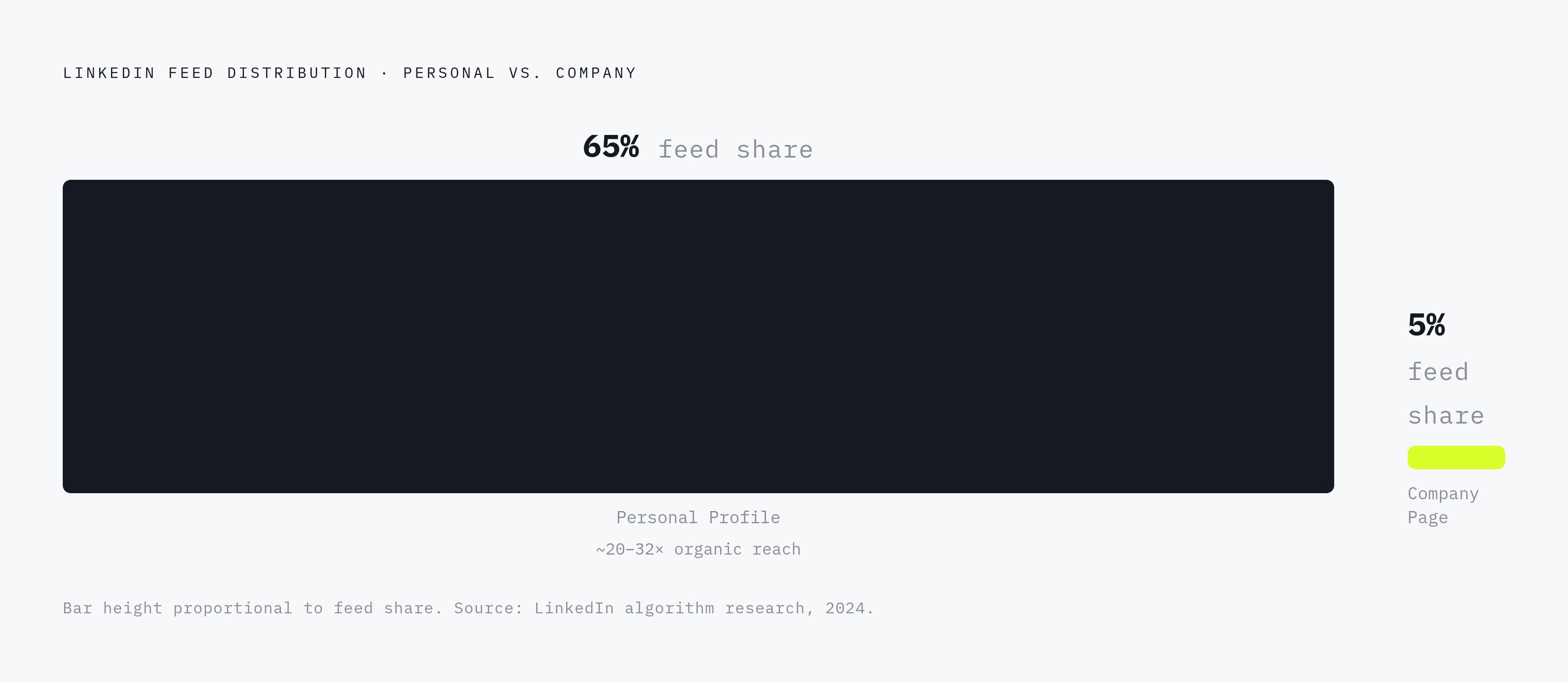
LinkedIn allocates roughly 65% of feed real estate to personal profiles. Company pages get about 5%. That's a structural decision baked into how the platform routes attention, and it means a company page's organic reach runs at something like 2 to 5% of what an individual profile gets for the same content, per LinkedIn and Edelman's research.
Why would a platform built for professional networking favor individuals over the companies that employ them? Buyers trust people, not logos. A VP of Marketing reading a post from "Acme Corp" processes it as an ad. The same VP reading a post from a specific person with a specific job and specific opinions processes it as a person talking. Trust does work that reach alone can't buy.
Reposting your company's content to your own feed doesn't capture any of that advantage. It just makes your profile look like an extension of the brand account, and the algorithm treats it accordingly. Original personal content is the thing that actually claims the 65%. Reps who get this have a structural edge over the ones still waiting for marketing to hand them a graphic to share.
Building a profile that earns reach before you post anything
Say you write the best post of your career. Sharp hook, real insight, a stat nobody else in your industry is talking about. Someone clicks through to your profile out of curiosity. The headline says "Account Executive at [Company]."
Nothing happens next. A vague headline gives a reader nothing to hold onto, and it undercuts the very post that got them there. Compare "Account Executive at Acme" against "B2B SaaS Marketing | Helping Startups Scale to 7 Figures." One's a job title. The other tells a buyer exactly what problem you solve and for whom, which is the only thing they came to find out.
Write the About section for the buyer, not for a recruiter who might poach you someday. What problems do you solve, for whom, and what do you understand about their world that a generalist wouldn't? The Featured section works best as a small portfolio, not a junk drawer. Anchor it to one or two pieces that show the exact kind of expertise you want to be known for, and resist the urge to pin everything you've ever written there.
Your Experience section isn't a résumé either, even though it looks like one. Treat it as a credibility signal, results-oriented language and buyer-facing impact, the kind of detail that makes someone think "this person has actually done the thing" rather than skim a bulleted list of responsibilities. And don't skip the photo and banner. They do first-impression work before a single word gets read, and a stretched stock-photo banner undoes a lot of good headline copy.
The profile is the landing page for every post you'll ever publish. A great post sent to a weak profile is a leaky bucket. The traffic shows up and drains right back out.
Choosing the content pillars a rep can actually sustain
ContentIn's GAP framework splits sustainable personal branding into Growth, Authority, and Personal content. For a sales rep, Authority content is your frameworks and how-tos, the stuff that builds credibility. Personal content is your stories and your stumbles, the stuff that builds trust. Growth content is engagement-oriented, community-building, the stuff that keeps you in proximity to pipeline.
Would you rather be the rep who posts general sales advice to everyone, or the rep known for solving one narrow, painful problem for one specific kind of buyer? LinkedIn's current algorithm rewards the second option. Specificity beats breadth; depth in one lane builds authority faster than a wide, shallow spread across many.
Failure posts tend to outperform highlight reels, and it's worth asking why. A post about a deal you lost, and what you learned losing it, signals something a win never can, that you're honest, self-aware, and worth trusting with someone's actual problem. Vulnerability paired with a lesson reads as credibility, not weakness, no matter how counterintuitive that feels the first time you hit publish.
One more thing before you lock in your pillars: don't pitch. LinkedIn's algorithm cuts distribution by up to 70% when it detects promotional language, so explicit selling isn't just tacky, it gets punished algorithmically. Authority and education are the vehicle. The pitch comes later, somewhere else entirely.
A practical starting point: name three topics your ideal buyer genuinely cares about that you're genuinely qualified to speak on. That's the whole exercise. Everything about format and frequency downstream only works if this part is right. Skip it, and your cadence just produces noise with good production values.
How the 2025 algorithm actually decides who sees a post
Something shifted in 2025 that a lot of reps still haven't caught up to. LinkedIn moved from a Social Graph model, which distributed content mainly to your existing connections, to an Interest Graph model, which distributes content to people interested in the topic whether or not they've ever heard of you. That's a genuinely big deal: a rep with 800 connections can reach a buyer they've never met, as long as the content matches that buyer's demonstrated interests.
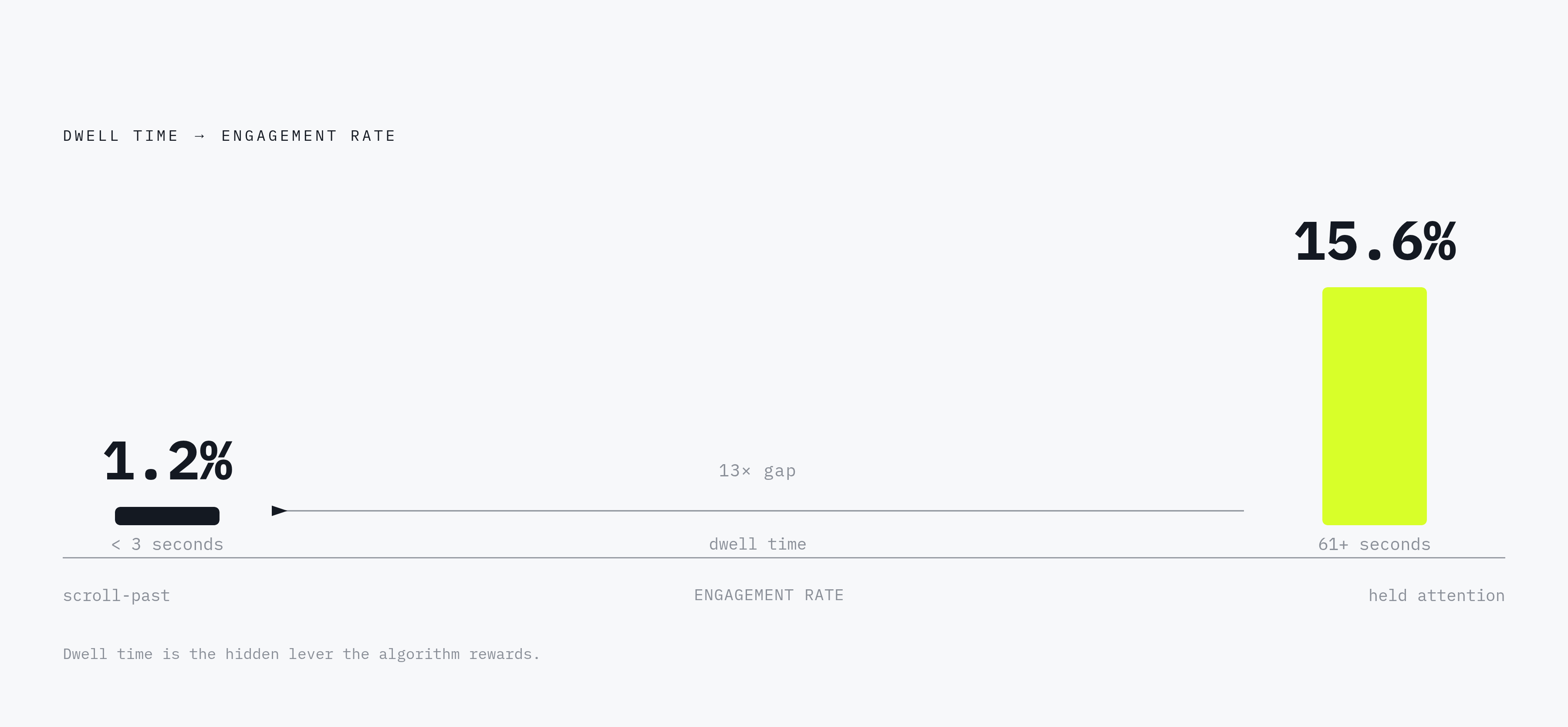
Dwell time is the metric doing the quiet work underneath all of this. Posts that hold a reader's attention for 61 seconds or more see engagement rates around 15.6%. Posts scrolled past in under 3 seconds sit at about 1.2%. That's roughly a 13x gap, which means your hook and formatting aren't decoration, they're the mechanism by which the algorithm decides whether you're worth showing to more people.
Comments carry roughly double the algorithmic weight of a like, but only substantive ones. "Great post!" doesn't move anything. If you've been chasing likes as your success metric, that's worth rethinking. The first 60 to 90 minutes after you post, the golden hour, predicts whether a post breaks out or quietly dies. Post and immediately close the laptop, and you're leaving the algorithm's most sensitive window unattended.
One update from mid-2025 is genuinely good news for anyone worried about keeping up a daily grind: LinkedIn now resurfaces posts two to three weeks old if they match a user's interests. Evergreen content has longer legs than it used to. On the penalty side, external links in the post body reduce initial distribution, so the link belongs in the first comment instead. Engagement pods get actively suppressed now, and promotional language still costs that same 70% distribution hit. The algorithm is trying to reward things that look like genuine expertise and punish things that look like manipulation. Mostly, it succeeds.
Which content formats to lead with and when to rotate
Socialinsider looked at 1.3 million LinkedIn posts in 2025 and found multi-image posts led engagement at 6.60%, with native documents (carousels, PDFs) close behind at 5.85%, and video at 5.60%. Text-only still works, but formats that make someone stop scrolling and interact with the post itself tend to win.
Documents deserve a second look because of a gap sitting in plain sight: they generate 39% more reach and 30% more engagement than the average post, yet only 4.88% of profiles post them regularly. Documents also account for 12.92% of all saved posts on LinkedIn, about 2.6 times their share of total content, and saves feed directly into how far the algorithm pushes something afterward.
Format choice isn't one-size-fits-all, and this is where a lot of advice online gets it backwards. For profiles with a smaller following, plain image posts outperform everything else. Carousels and documents only show their real advantage once you have a much larger following. So if you're starting out and copying the carousel strategy of someone with a massive following, you're optimizing for an audience size you don't have yet. Start with images and text. Earn the audience. Then graduate.
If you build carousels, keep them short. A five-slide carousel people finish beats a fifteen-slide carousel where most viewers bail by slide four, because completion rate matters more than length. Short-form video under 60 seconds gets 53% more engagement than longer video, worth testing if you're comfortable on camera, not worth the production headache if your carousels and text posts are already doing the job.
Accounts that rotate across formats see 37% more follower growth and 28% more consistent visibility than accounts stuck on one format. A word of caution on AI: audiences in 2025 got sharp at spotting templated output from a mile away. Use it to draft structure if you want, but rewrite in your own voice, with your own numbers and your own war stories. Anything that reads like it came out of a content factory should get cut before it goes near publish.
Building a posting cadence that doesn't collapse after two weeks
Four to five posts a week is the sweet spot, according to data from meet-lea.com, both for engagement rate and for that 28% consistency bump from rotating formats. Only about 4 to 5% of profiles actually post that often. Meanwhile 80% of LinkedIn profiles post just once a week, which means moving to three or four quality posts weekly already puts you ahead of most of the platform.
So how do you hit four or five posts a week without your job performance quietly cratering? Batch creation. One hour a week drafting multiple posts beats daily ad-hoc scrambling, mostly because it kills the decision fatigue that actually kills most content calendars around week two. Nobody quits posting because they run out of ideas. They quit because deciding what to post, every single day, from a blank page, is exhausting in a way batching just isn't.
Your sales calls are a rich source of material sitting right under your nose, if you'd just notice it. A question a prospect asked that surprised you. A misconception you corrected for the third time this month. A framework that actually landed on a discovery call. These need no research, because you lived them an hour ago, and they read as authentic because they are.
Timing matters too: Tuesday through Thursday, 9 to 11 AM in your buyer's timezone, with you actively online to engage right after, so you're not sleeping through the golden hour. And here's a stat worth remembering: leaving a substantive comment on a target account's post increases the odds your next post shows up in that person's feed by 70%. Engagement isn't separate from your cadence. It's half of it.
Consistency compounds and bursts don't. A rep who posts three times a week for six months straight beats a rep who posts daily for three weeks and burns out.
Turning post engagement into pipeline conversations without breaking the algorithm
Most reps get this step wrong in one of two directions. Either they DM every commenter with a pitch inside of five minutes, or they never make the leap from content to conversation at all and just collect likes forever, like it's a hobby instead of a job.
Someone who leaves a real comment, follows you after a carousel, or saves your document has told you something. They've self-identified as interested, which makes them warmer than anyone on a cold list you bought or scraped. When you send a connection request, reference the specific post or comment that brought you there. It signals a real person paying attention, not automation, and it noticeably improves your acceptance rate.
Once connected, add value before you ask for anything. Share something relevant to what they commented on. Ask a question that continues the conversation they already started with you. The same rule that cuts your post's reach by up to 70% for sounding promotional applies just as harshly to DMs; open with a pitch and your reply rates will suffer for it.
Keep a simple log of who's engaging: company, role, what they interacted with. Work that list into your CRM as warm leads sitting alongside your traditional pipeline, because that's functionally what they are. Here's the return cold outreach structurally can't produce: reps who publish consistently start getting direct inbound messages from buyers who found them through search or the Interest Graph, without a single cold email sent. That's six sections of groundwork finally paying rent.
Once you've settled on your Authority, Personal, and Growth pillars, the real challenge becomes staying consistent while still carrying a full pipeline of calls and deals. This is where a service like Letterstory earns its keep; it's built to handle the writing and editorial lift across those pillars, so the actual selling, the comments and DMs and calls, stays in the rep's hands where it belongs.
Measuring what matters so the system improves over time
Impressions and likes tell you about reach and general sentiment. They don't tell you much about pipeline. What predicts pipeline is profile views following a post, connection requests from people at your target accounts, and DMs that reference something specific you wrote. Watching only the impression count means watching the wrong dashboard.
LinkedIn's native analytics show post-level performance, and comment rate and save rate are worth tracking closely, since high saves mean the content was reference-worthy enough that someone wanted to find it again later, which also happens to feed the algorithm's distribution decisions.
Before you panic and blame your content for a slow week, consider what a dip actually means. Researcher Richard van der Blom documented algorithm shifts in 2025 that dropped views by 50%, engagement by 25%, and follower growth by 59% across the platform, affecting everyone, not just you. A slump isn't automatically a content failure. Compare against your own baseline, look at relative performance across formats, and hold off on concluding your instincts are broken.
LinkedIn's Social Selling Index gives you a rougher but useful compass, scoring four dimensions: professional brand, finding the right people, engaging with insights, and building relationships. Tracking it monthly gives you a structured way to see which part of the system is actually lagging, instead of guessing.
Set a monthly review habit. Which post got the most saves? Which format drove the most profile views? Which piece of content came right before a wave of connection requests from your target accounts? Those three questions should shape next month's pillars, not last year's assumptions.
Your second quarter of consistent publishing will outperform your first, and not purely because you got better at writing hooks. The Interest Graph is learning your topic authority in the background the whole time, quietly extending your reach a little further with every post that proves you know what you're talking about. It's a strange kind of patience to ask a salesperson to have. It also happens to be the one cold outreach never figured out how to reward.