Personalized Outreach Content at Scale
Doubling reply rates requires signal-stacking, not just adding first names.

Between 86% and 90% of all sales emails include zero personalization beyond a first name. Meanwhile, highly personalized outreach achieves roughly double the reply rate of generic sends, per Sopro's 2026 State of Prospecting report.
More than half of buyers have actually purchased from cold outreach when the message was personalized and problem-focused. That is a revenue number. And 89% of sales teams report positive ROI from personalization in cold email, a figure largely ignored at the execution layer.
SDRs personalize at the lowest rate of any seller type, around 10%, while sending roughly 150 emails per week and achieving reply rates below 3%. More sends at sub-3% is not a path to more pipeline. It is a path to more noise, higher unsubscribe rates, and a sender reputation that quietly erodes until deliverability becomes the new problem.
The barrier is operational, not informational. Almost no one has built the system that makes personalization sustainable at real volume. That is a solvable problem.
Why most personalization efforts stall before they scale
The most honest explanation is time. Genuine research on a single prospect — pulling recent job postings, reviewing earnings calls, understanding the specific operational context of someone's role — can take 45 minutes per person. At any volume that produces meaningful pipeline, that unit of labor simply does not pencil out.
So teams compromise. Just over half use segment-based personalization, clustering by industry or company size and writing one message for the whole cohort. Only around 5% personalize every individual email. Most of what the industry calls personalization is demographic targeting dressed in more flattering language.
The deeper failure is strategic. Teams try to personalize everything and end up personalizing nothing well. They add more fields, pull more data sources, ask writers to research more variables, and the output gets worse because no one has decided what actually matters. Personalizing three specific elements with discipline outperforms personalizing eight elements inconsistently, because the recipient experiences coherence rather than clutter. Over-stuffing a message with signals produces a prospective buyer who senses effort without feeling understood, which is almost worse than a generic send.
The data problem compounds this. The majority of organizations report that their marketing investments yield unreliable or inflated intent signals, according to DemandScience's 2026 State of Performance Marketing Report. More data, paradoxically, produces worse outreach when teams cannot distinguish signal from noise. The result is messages that reference the wrong pain point, arrive at the wrong moment, or name a trigger event that resolved six months ago.
This is a strategy problem before it is a technology problem. Teams need to decide which signals matter, which elements to customize per prospect, and what the fixed scaffolding looks like. Automation only adds value after those decisions are made.
The signal hierarchy that makes personalization decisions for you
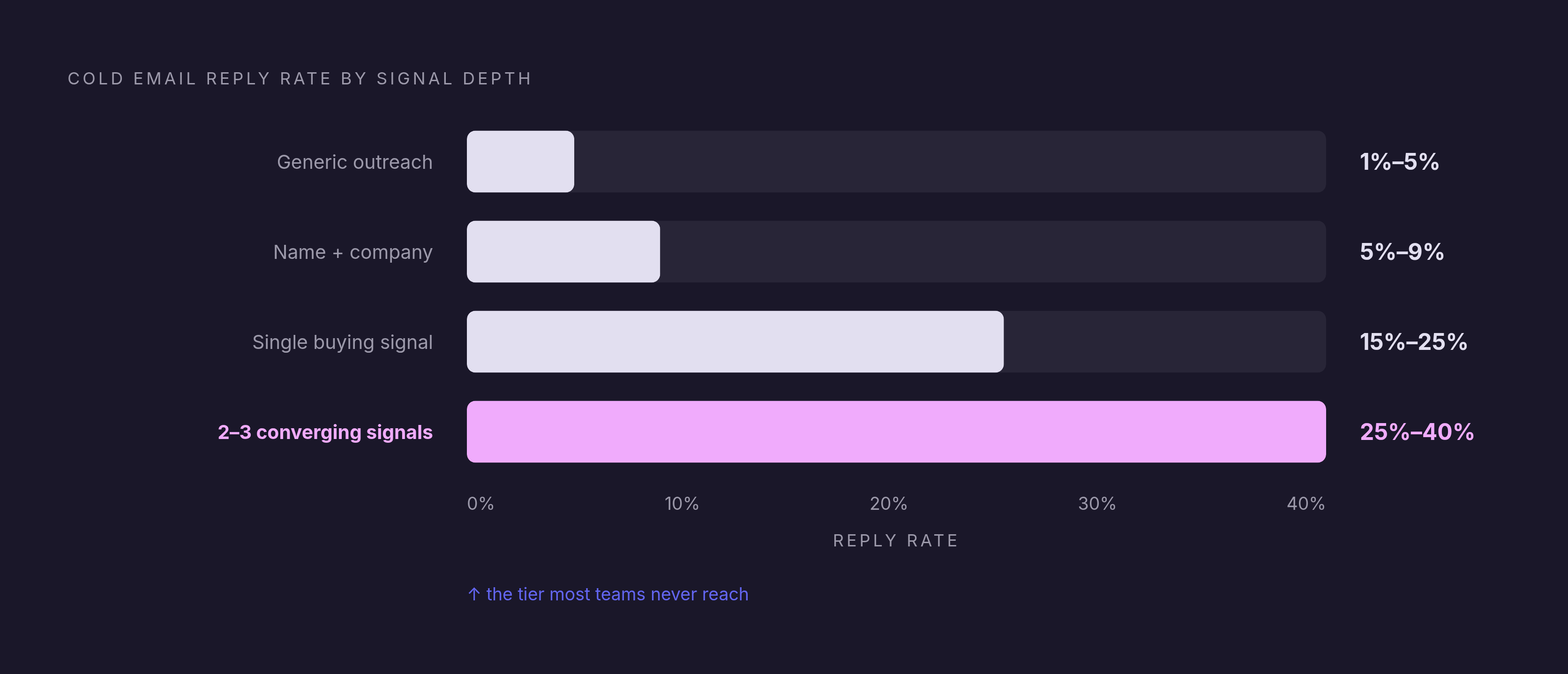
A buying signal is any behavioral or firmographic event that indicates active research or readiness to purchase: a pricing-page visit, a job-change alert, a funding announcement, an executive hire, an intent spike, a technology stack change. The signal is the reason for the message. Without it, there is no legitimate hook, only a cold ask with a first name dropped in to soften it.
The reply-rate tiers tell the story directly. Generic outreach sits in the 1% to 5% range. Basic name and company personalization gets you to somewhere around 5% to 9%. Signal-based outreach anchored to a specific event produces 15% to 25%. Stack two or three converging signals on the same prospect and you are looking at 25% to 40%. Each layer of specificity roughly doubles the response.
The operational standard for high-performing teams in 2026 is signal bundling. A new VP of Sales hire is interesting. A new VP of Sales hire plus a pricing-page visit plus a category intent spike is a qualified buying signal that warrants a personalized sequence immediately. One data point is a coincidence. Three is a pattern worth writing to.
Signals also have to be tiered by recency, because a job change three weeks ago matters more than one six months ago, and a pricing-page visit matters more than a blog read. When that hierarchy is established in advance, reps stop debating which signal to reference and start executing against a pre-decided framework. The blank-page problem largely disappears because the signal has already determined the message angle before anyone opens a document.
Teams that act on intent signals within 24 hours see a meaningful lift in opportunity creation compared to slower responders. That speed is only possible when the decision logic exists before the signal arrives, not as a response to it.
How to build message templates that don't read like templates
The structure that actually works is three layers stacked. Individual-level detail: role, recent activity, specific trigger event. Company-level context: growth stage, recent news, organizational moment. Industry-level relevance: sector-wide pain points that make the individual and company context meaningful. Stack all three, and template everything else.
The discipline this requires is deciding in advance exactly which three elements will be personalized per prospect. Not four, not six. Three. Everything else is fixed. This is the mechanism that makes scale possible without sacrificing relevance, because the writer's cognitive load is bounded and the variable fields have structured inputs feeding them rather than being composed fresh each time.
Email length is one of the clearest differentiating factors in current performance data. The reps achieving the strongest reply rates write under 50 words for initial outreach. Brevity forces message discipline. It eliminates the padding that signals to a reader, almost subliminally, that they are holding a template. A 50-word email that references a specific signal, names a real problem, and asks a single direct question reads nothing like a template even if the system behind it is highly systematized.
Subject lines are a discrete lever with disproportionate return. Including the prospect's company name improves open rates meaningfully and should be a standard variable field in every template, not an optional enhancement.
One thing worth naming because it catches teams off guard: customers on highly personalized journeys are significantly more likely to feel time pressure and overwhelmed. Over-personalization signals surveillance, not relevance. The goal is recognition, not a demonstration of how much data you have accumulated on someone. The line between "I understand your business" and "I have been watching you" is thinner than most senders think, and crossing it ends conversations before they begin.
The practical architecture, then: value proposition, call to action, and social proof are fixed. Signal reference, company name, and role-specific pain point are variable, pulled from structured inputs. The writer is filling three specific blanks, not composing from scratch.
Where AI fits in the workflow and where it doesn't
AI usage among sales reps roughly doubled between 2023 and 2024, and Salesforce's State of Sales 2026 puts current organizational adoption at 87%. Most of that usage, though, is shallow: drafting generic sequences, summarizing LinkedIn profiles, generating subject line variations. Useful, but not where the real multiplier lives.
The actual productivity story is in the research phase. AI-assisted personalization compresses a 45-minute manual research task to under five minutes when signal-based context is feeding the process. That compression is the difference between personalizing three prospects per hour and personalizing twelve. Sellers who effectively partner with AI are dramatically more likely to hit quota than those who do not, per Gartner research.
Where AI earns its place is in aggregating signal inputs across many sources simultaneously, surfacing the bundled signals that should trigger a sequence. It also drafts variable message elements from structured signal prompts, filling pre-decided variable fields against a fixed template rather than writing whole messages from nothing. And it routes signals to the right rep within the speed-to-signal window before human review.
Where human judgment stays is final message approval, read on tone and relationship context, and decisions about which signals to weight in the first place. Weighting signals is a strategic judgment that reflects positioning, ICP assumptions, and competitive context, none of which an AI can resolve on its own. Collapsing that distinction is how teams produce high-volume outreach that is technically personalized and substantively tone-deaf, which is worse than generic because it feels like it tried.
Gartner projects that nearly all seller research workflows will begin with AI by 2027. The teams building the framework now, specifically the signal hierarchy and the template architecture that gives AI structured inputs to work from, will have a compounding advantage as that shift accelerates.
Sequencing personalized outreach across channels without losing coherence
Single-channel email sequences average reply rates well below 5% in 2026. Properly coordinated multichannel sequences with tight ICP targeting push into the 15% to 25% range. The channel combination is itself a multiplier, independent of message quality, because running coordinated touchpoints creates recognition and authority that a single-channel send cannot produce.
Most successful sales require five or more follow-up touches, which means personalization has to be sustainable across a full sequence, not just the first message. If the templated scaffolding is weak, personalization degrades after touch two, and the remaining sequence reads exactly like the generic outreach the first message was trying to differentiate itself from. The framework has to hold across 10 or 12 touches. The current benchmark for mid-market cold outbound is 12 to 18 total touches over 20 to 40 days, which requires signal references that remain relevant across multiple weeks and channel choices that match how the persona actually buys.
Channel selection should follow the persona, not the preference of the sender. For champions, email and LinkedIn in parallel outperforms either alone. For decision-makers, LinkedIn and phone outperform email because executive-level inbox filtering has become aggressive enough to make email a low-probability channel for cold access. Deals where the seller engages all three buying personas, the champion, the decision-maker, and the gatekeeper, close significantly more often than deals where only one persona receives outreach. That finding from HubSpot's B2B buying research holds across industries and deal sizes.
One infrastructure requirement deserves explicit mention because it is an operational prerequisite, not a technical detail. Microsoft's requirements for domains sending at volume to Outlook and Hotmail mandate SPF, DKIM, and DMARC authentication. Without that in place, the framework never reaches the inbox, and reply rates measure delivery failure rather than message quality. Build the infrastructure before you build the sequences.
What a working personalization system looks like operationally
There is a sequence of decisions that must happen before any message is sent, and it is not flexible. ICP definition first. Then signal hierarchy. Then message layer architecture, meaning explicit documentation of what is fixed and what varies. Then channel and persona mapping. Then automation routing rules. Then human approval checkpoints. Teams that skip steps or run these in parallel tend to produce high volume at low relevance, not because their intent was wrong but because the mechanism requires the sequence to function.
Speed-to-signal is the operational metric that separates a functioning system from a theoretical one. Top-performing teams route signals to the right rep and trigger the appropriate play within 30 minutes of detection. That requires automation at every phase except final message approval. If you are building the play after the signal lands, you have already lost most of the timing advantage.
The scale payoff shows up in time recovery. SDRs using AI-assisted workflows save several hours per week in research time, per Outreach's 2025 prospecting data. Those recovered hours are only valuable if they flow back into strategic work: refining the signal hierarchy, auditing message performance by variable field, improving the ICP definition as pipeline data accumulates. Time savings that flow back into volume production just recreate the original problem at higher speed.
Campaigns under 50 recipients significantly outperform mass blasts on reply rate. Scale does not mean the largest possible send. It means the framework runs consistently across many small, well-targeted cohorts, producing many precise campaigns rather than one enormous one.
Three questions should be asked of every active sequence on a recurring basis: Does every message trace back to a specific signal? Are the variable fields pulling from structured inputs or being written fresh each time? Is the channel mix matched to the persona map? The teams who treat them as setup tasks watch their reply rates decay. The teams who treat them as ongoing operational standards watch them compound.