Daily Habits of High-Performing Sales Reps
Top reps block their calendar, research prospects before calling, and follow up when others quit.
Reps spend roughly two hours a day actually selling, according to research cited by salesgenie.com. The other six get swallowed by admin, tool-switching, and note-taking that nobody scheduled but everybody somehow does anyway. Most reps let the day organize itself around whichever email or Slack ping lands first, which means prospecting loses to the loudest interruption on a near-daily basis. Left unmanaged, the defaults win, quietly, and the rep never notices the day was decided for them before 9 a.m.
Sixty-eight percent of reps name note-taking and data entry as the single most time-consuming task on their plate. Run that across a ten-person field team and the org is looking at over 4,400 hours a year spent away from customers: a second, invisible headcount nobody hired, budgeted, or noticed until the pipeline started looking thin. Gartner surveyed 1,026 sellers in September 2024 and found 72% feel overwhelmed by the number of tools they're expected to juggle. Tool sprawl gets blamed for a lot of this, and it earns the blame; those overwhelmed sellers are 45% less likely to hit quota, which is a rough way to find out your tech stack was working against you.
Adding another app rarely solves this. What helps is a calendar that behaves like a production schedule instead of a to-do list at the mercy of whoever emails loudest. Mornings go to prospecting, when focus is sharpest and willpower hasn't been spent yet. Afternoons hold calls and demos. End of day is CRM cleanup, batched into one block instead of scattered across the hours in between like loose change. Reps who protect that structure aren't smarter than everyone else. They've just stopped renegotiating their calendar with themselves every single morning.
What top reps do before the first call that average reps skip
Eighty-two percent of top performers say they always research a prospect before making contact. Among everyone else, that number drops to 49%, one of the starkest behavioral splits in the data, and the whole gap opens before the phone ever rings. Forty-two percent of B2B sales professionals name company and challenge research as the single most effective path to closing, ahead of pitch quality, ahead of pricing flexibility, ahead of nearly anything a rep actually controls live on the call.
Here's the part that makes the gap costly rather than just interesting: the buyer on the other end has already done the reading. B2B buyers complete somewhere between 57% and 70% of their research before they ever pick up the phone. A rep who hasn't matched that homework starts the conversation already behind, and the buyer usually clocks it inside the first two minutes.
It's gotten more complicated, too. LinkedIn B2Believe research puts the average B2B buying group at 22 stakeholders, not one champion who happened to reply to an email. Preparation that stops at a single contact fails to account for the full buying group. Real pre-call work means knowing the company's recent earnings pressure or stated priorities, anticipating the objection specific to that industry, and having at least a rough map of who else in the room still needs convincing. Open a call referencing the prospect's actual Q3 problem, and trust builds fast; ask a question answerable by their own homepage, and it's gone before the second sentence, and it rarely comes back.
Why most reps quit the follow-up sequence exactly when persistence would pay off
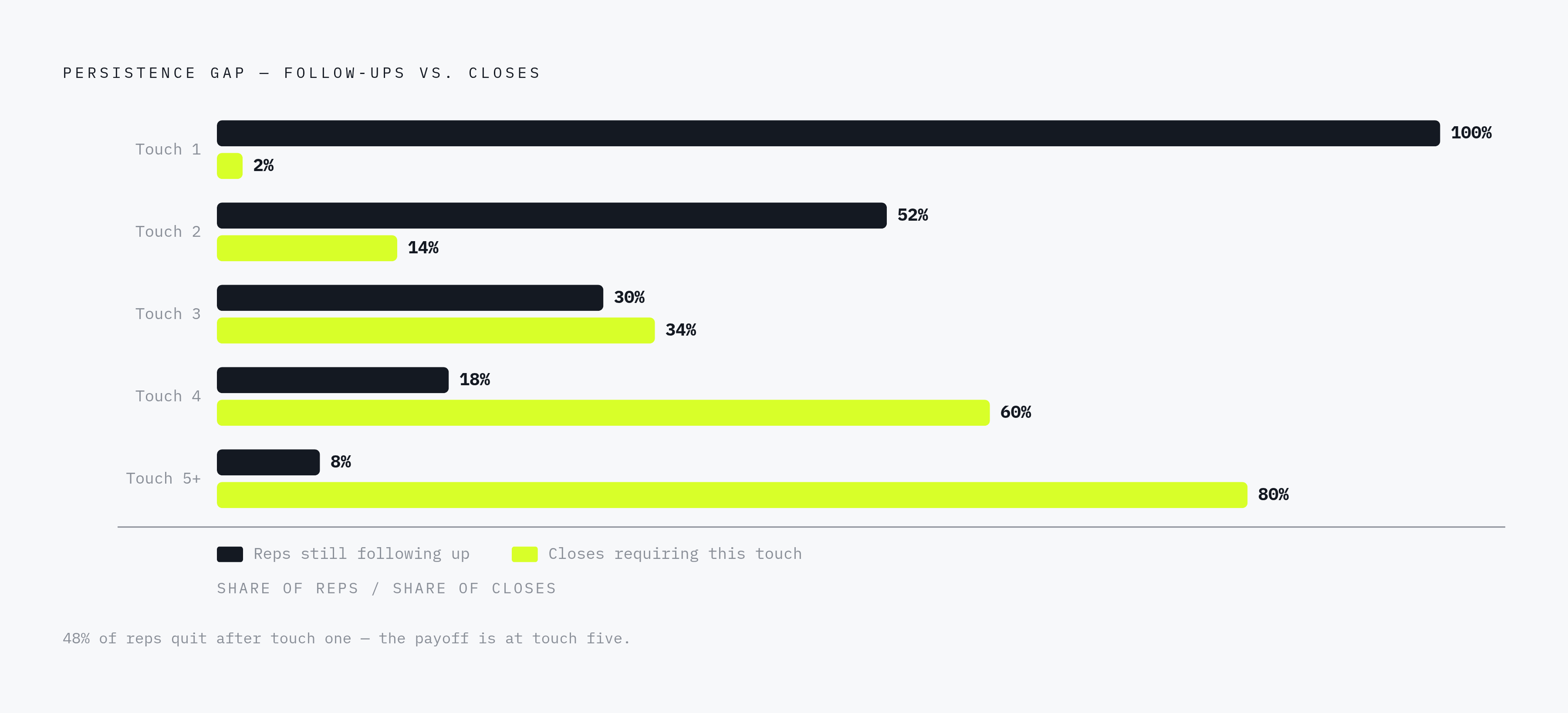
Here's the contradiction sitting at the center of most lost pipeline: 80% of successful sales require five or more follow-ups after the initial meeting, yet 48% of salespeople never attempt a single follow-up after a cold call. They call once, hear nothing, and walk away at the exact moment persistence starts paying off. This looks like caution, but it's really quitting a race in the first hundred meters because the crowd went quiet.
Sixty percent of customers say no four times before they say yes. That's a customer working through an ordinary internal decision process, not a rejection, and mistaking that rhythm for a closed door is where most sequences die early and unnecessarily. Only 2% of sales close on the first touch, which means the other 98% require multiple contacts as a matter of course. Follow-up is the sales process at that point, not an optional extension of it, and treating it as optional is the single most common way pipeline evaporates without anyone noticing it happening.
Speed still matters early. Responding to a new lead within five minutes increases engagement likelihood by nine times, and somewhere between 35% and 50% of sales go to whichever vendor responds first. Speed alone has limits, though, without personalization behind it. Generic templated emails get reply rates between 1% and 5%. Emails referencing something specific to that prospect, an actual detail and not a merge field, reach as high as 18%. That gap is the difference between a sequence that converts and one that fails silently while the rep assumes the lead just went cold.
Top performers build the cadence before the first touch ever goes out, typically 8 to 12 touchpoints spread across 10 to 15 business days for inbound leads. The plan exists on paper before the first no happens, so there's already a next move waiting for the moment a prospect goes quiet, instead of a scramble to invent one on the fly.
How CRM discipline creates compounding pipeline advantages over time
Top performers spend about 18% more time updating their CRM than average performers, according to the LinkedIn State of Sales Report. Nobody grows up dreaming of being excellent at data entry, so on its face this looks like a strange thing to be good at. Treated as a competitive asset instead of a chore, though, it pays off months later in ways that feel like luck and aren't.
Eighty-four percent of sales executives point to content search and retrieval as the biggest productivity gap on their teams, a polite way of saying reps burn real time hunting for the right case study before a call because nothing's filed where it should be. Sixty-five percent of reps don't fully follow their org's defined sales process, and that gap compounds quietly: deal stages that don't match reality, forecasts built on guesswork, follow-ups that fall through cracks nobody notices until the deal's already dead.
What disciplined CRM use looks like is almost boring, which is sort of the point: same-day logging of every interaction, deal stages that match where the conversation genuinely stands, a next-step date on every open opportunity, contact notes updated right after the call instead of reconstructed from memory three days later. Cleaner dashboards for leadership are a nice side effect. The real payoff is that the rep's own memory stops being the system of record. Offload that onto something reliable, and there's more bandwidth left for the conversation itself, which is the only part of the job that actually closes revenue.
How high performers are using AI daily to reclaim selling time
Fifty-six percent of sales professionals use AI daily, and those users are twice as likely to exceed target compared to reps who don't touch it. Bain & Company tracked usage climbing from 24% in 2023 to 43% more recently. The framing has flipped: doing everything by hand now makes a rep the outlier, and not the admirable kind.
Where does the reclaimed time actually go? Research summaries before a call instead of a ten-minute scramble beforehand. First-draft email personalization instead of a blinking cursor. CRM notes generated from a call recording instead of typed from memory an hour later, half-remembered and mostly wrong on the details that mattered. These are the exact mechanical tasks eating into the two hours of real selling time from the first section, the stuff that isn't selling but has to happen regardless.
None of this replaces judgment. A tool doesn't build trust on a call, and it doesn't hear the hesitation in a prospect's voice when they say "let me think about it." What it does is clear the mechanical clutter so judgment has room to work. Worth flagging directly: the same Gartner finding on tool overwhelm applies here too, and bolting a fourth AI tool onto three existing platforms doesn't help if it's just another login to remember. The reps getting a real lift are consolidating, choosing tools that pair AI output with genuine editorial quality so the draft doesn't need a half-hour rewrite before it's usable. Speed and quality stop trading off against each other only when the tool is actually good, not merely fast, which is a distinction worth sitting with before buying the fifth subscription.
Prospecting as a daily non-negotiable, not a monthly sprint
Benchmarks for outside sales lay the gap out bluntly: top-decile reps devote a much larger share of daily visits to prospecting, while bottom-decile reps put roughly 2% toward it. Talent has little to do with this gap. It's a scheduling decision, repeated daily, and it shows up directly in who hits quota and who spends the quarter explaining why they didn't.
Structure at the org level makes the habit easier to sustain. Reps at high-performing organizations are substantially more likely to report a structured sales process is in place than those at underperforming ones. Structure only survives a full calendar, though, if prospecting is built into the rhythm of the work rather than bolted on as a special request between meetings. One of the clearest patterns among top performers: they ask for introductions and referrals inside every customer conversation, not as a favor saved for the end of a happy renewal.
Social selling belongs in this same daily bucket, not off to the side as a marketing side quest somebody else owns. Research consistently finds that social sellers outsell peers who skip it entirely. Effective use looks less like broadcasting and more like relationship-building in public view: posting something that signals real expertise, commenting on a prospect's post before ever sliding into their inbox, using a voice note as a warm entry point instead of a template pulled off a shared drive. The rhythm that makes this work has a fixed time block, a minimum activity target, and a defined channel mix, none of it bumped just because the calendar filled up with meetings. Prospecting done "when there's time" is prospecting that quietly stops happening, and the pipeline six weeks out is where that decision eventually shows up, unpaid.
Why optimism is a daily practice for top reps, not a personality trait
Research has found optimistic sales professionals consistently outperform pessimistic ones, even when the pessimists know the product better. Sit with that, because it inverts a fairly common assumption in sales training, the one that treats product mastery as the thing worth obsessing over above everything else.
The pattern holds on longer timelines than most sales training bothers to measure: mindset appears to compete with raw aptitude in ways that accumulate over months, not just weeks.
Optimism here runs deeper than a vibe, and it isn't a fixed trait some reps are born with while others simply weren't issued one. It's a practice, rebuilt daily: reviewing wins instead of staring only at pipeline gaps, setting a specific numeric activity goal instead of a vague intention to "do more," treating one bad call as one bad call instead of evidence about the entire week. Consistent coaching and real-world practice appear to be what keeps optimism tethered to something other than wishful thinking. Formal sales training remains far from universal across organizations. The reps who build daily learning into their own routine, without waiting for the org to hand it to them, are quietly opening a lead that gets harder to close the longer it sits there unaddressed.
None of the reps sitting at 120% of quota are doing a fundamentally different job than the ones stuck at 58%. They're doing the same job, with a daily structure that stacks small, unglamorous advantages morning after morning, until the gap between them stops looking like a gap and starts looking like an entirely different category of work.