AI Content Platform Evaluation Criteria for Multi-Brand Agencies
Agencies need four balanced capabilities, not features, to choose the right AI platform.

- Written by
- Sales Coach Picks Editors
- Published
- October 4, 2026
- Reading time
- 9 min read
- Sources cited
- 3 sources ↓
What this covers
A platform suited to one brand’s marketing team may still be wrong for an agency, and not because it lacks features. For agencies, four demands must be balanced together: deep governance, isolation for each client’s brand, shared infrastructure costs, and visibility in AI search. Once these four needs interact, the usual evaluation lens for single-brand buyers gives agencies a distorted view of client portfolio fit. The discussion below unpacks the issue and turns those pressure points into an evaluation framework.
Why Multi-Brand Agencies Face a Different Platform-Buying Problem
Buyers with just one brand can work through this problem one piece at a time. You nail the brand voice, then set up governance, and add AI search when the budget opens up. Each step can hold off until the last one is done, because you only have one brand to mess up and one group of stakeholders to report to.
An agency doesn't have that same sequence. Those earlier accounts stay in place; when the platform begins from a mistake, the burden is carried forward through each account built above it.
In demos, most platforms come across as fully capable, which is exactly the trap. Those tradeoffs surface only after a platform is already in production, by which point migration costs are steep and customer relationships hinge on how it runs. The framework ahead is designed to make those tradeoffs visible up front, before anything is signed.
Brand Voice Enforcement at Agency Scale
Agency platform failures first show up in brand voice, and the pattern is concrete enough to trace. The more people and accounts involved in creating work, the further published content drifts from the brand guidelines document. The cause is not sloppy writing. It appears because the workflow saves enforcement for a weary editor's final check, rather than making it one of the rules the process must follow.
A simple test distinguishes a usable platform from one that may leave an agency exposed with a client, even if some vendors resist a straight answer: is brand enforcement applied before content is generated, at review, or once publication has already happened somewhere? Only pre-generation enforcement keeps bad copy from reaching client inboxes or client audiences. Later enforcement merely records the error after the fact.
Sustaining brand voice at true agency scale requires three distinct tiers operating in concert. Embedding every tier into the workflow yields better results than trusting copywriters to recall guidelines, since human vigilance cannot span fifty accounts like an architectural safeguard.
For agencies with clients in regulated sectors like financial services, healthcare, or law, there is an additional obligation beyond this. Without it, the platform is exposed to genuine legal risk: when content fails for a client in a regulated industry, no record exists to explain the cause or identify who signed off. This need for traceability also marks the starting point of the framework's next layer, since such a trail only works when it is confined to one client.
What genuine per-client brand isolation requires
Isolation for clients isn't a setting hidden in permissions.
Vendors gloss over this distinction, a point with serious consequences even though routine demos never show it. In a sales call, both setups look the same: the presenter uses a dropdown to move from “Client A” to “Client B.” Only one gives an agency real protection if trouble hits.
Before committing, an agency should have the vendor run one simple test: adjust Client A’s brand voice, save the change, then verify whether any part of Client B's configuration was affected because of it. They should also require a residency diagram that pinpoints where each client’s past content, model-training materials, and performance metrics are stored, creating a real record of separation instead of a verbal assurance.
Audit trails need to come into this conversation as well, instead of being left for a later governance checkbox. When audit logs combine clients together, they unravel the whole governance argument an agency could put before oversight bodies or the client's own lawyers, because a blended record demonstrates precisely the sort of leakage that separation is meant to head off.
How shared infrastructure cost compounds across a portfolio
Costs that seem workable for one brand become a new challenge across an agency, making it important to follow how it happens. That earlier governance layer gets worn down by budget pressure, as each missed review removes another safeguard.
For an agency, a true cost estimate must account for more than the license’s listed price. A sales proposal usually leaves most of these costs out.
Whether the tool works with any CMS reshapes an agency's expenses and operational freedom for all its clients. If the software locks content within a walled garden, the agency faces two poor alternatives: maintain distinct editorial pipelines per account, or migrate all accounts to one universal system regardless of their existing setup. Each path inflates expenses, though those charges stay hidden from unit rates for quite some time.
Integration coupling is what pushes costs up most. APIs, sign-in layers, and file schemas behind an agency's workflow can bind it to a vendor's habits without appearing in the contract, then become costly to replace once they are embedded across many client environments. When options are available, use portable standards such as REST APIs, MCP, and webhooks rather than closed vendor connectors, since those standards stay usable for the agency after a vendor relationship ends.
GEO and AEO Capability as a Baseline Screen
GEO, or Generative Engine Optimization, has moved beyond optional status. It belongs in the baseline of any platform comparison, because AI Overviews now surface for so many searches and fundamentally alter content discovery. Ignoring GEO when evaluating platforms means assessing tools as though the landscape never shifted.
AEO and SEO pursue different goals, and that split determines what a platform truly has to handle. SEO's question is whether search engines can crawl and index content. AEO's is whether an AI engine trusts the content enough to reference it when answering someone's question on the spot. That second question drags in measures SEO tooling was never designed to capture: the identity of the author, whether independent sources corroborate its claims, and whether it answers the exact prompts people now give AI systems, not the old keyword strings once typed into search bars.
An agency has to evaluate GEO across its entire portfolio rather than one account at a time. When a tool boosts AI mentions for a single account yet fails to link each mention to its source, the resulting exposure cannot be verified, invoiced, or communicated to the paying customer. Without client-level attribution, a GEO capability remains impossible for an agency to monetize.
Agencies must resolve one additional difference before accepting any GEO promise. Certain platforms measure how often AI cites them yet never craft material designed to attract such mentions. Displaying metrics on a screen differs fundamentally from operating software that generates material engineered to earn references. Buyers must determine a provider's true classification before treating any GEO reporting tool as proof of genuine GEO competence.
Why governance depth and GEO capability trade off against each other
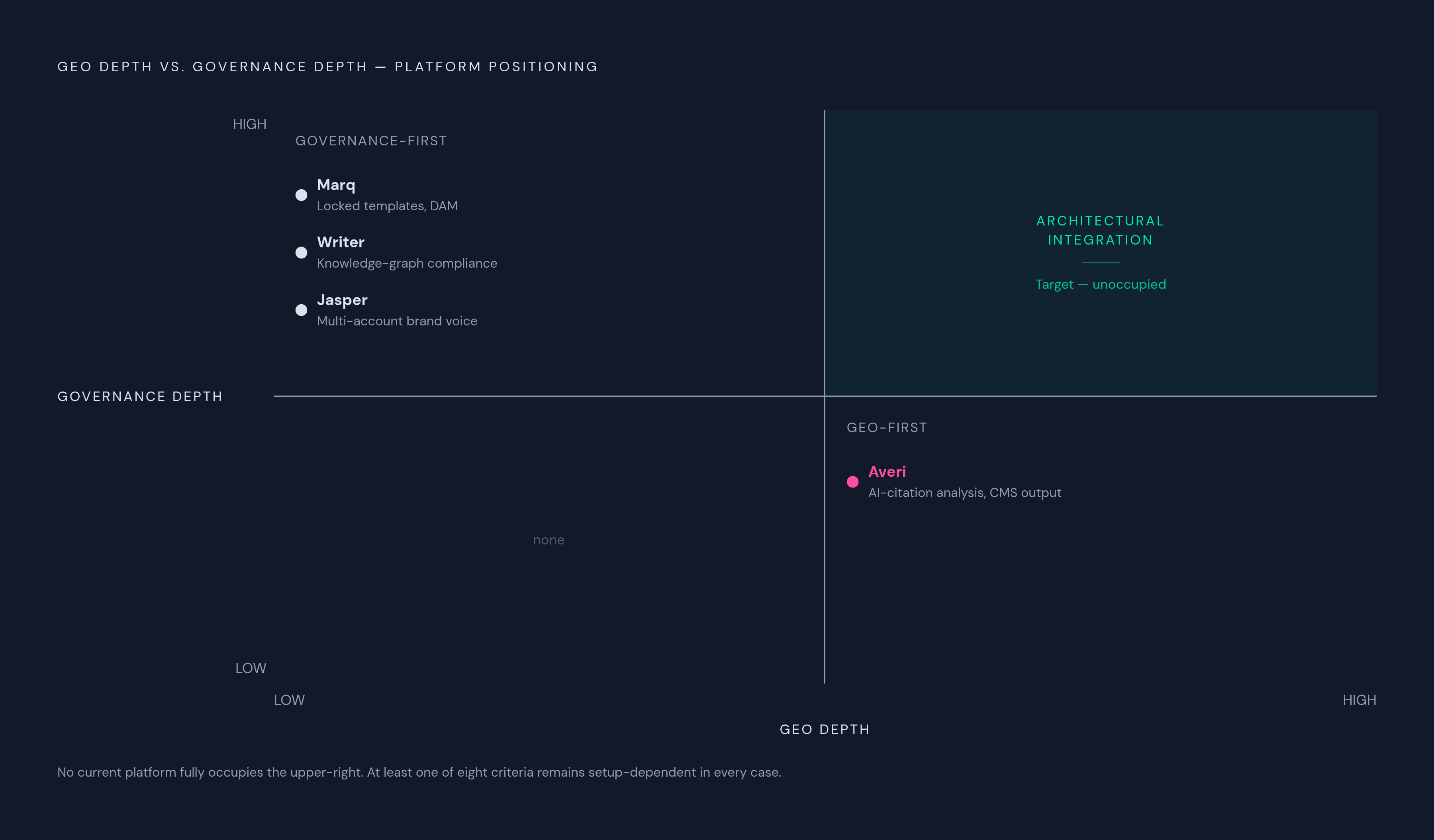
This idea sits at the conceptual center of everything here. Treating governance alongside GEO as independent items for an agency to tick off misses the point. They work at cross purposes, yet typical platforms settle the friction by prioritizing a single goal while sidelining its counterpart.
Systems designed for oversight, featuring rigid template controls, isolated client spaces, layered sign-off processes, and comprehensive activity logs, often hinder the rapid content output that GEO favors. Such review checkpoints are inherently at odds with this pace, since their core purpose is to introduce deliberate pauses that allow people to spot errors.
Platforms designed for GEO face the mirror-image danger. Hands-off publishing, agent-driven workflows, and rapid-fire content output all let brand governance live in a config toggle rather than being baked in structurally. That tradeoff makes sense when a lone brand is the only voice and the only regulatory risk at stake. For a shop managing a dozen client voices that clash, several under regulatory scrutiny, it collapses, since one forgotten toggle nobody refreshed is precisely where a compliance problem begins.
Only platforms that address this conflict at the architectural level succeed. They don't get there by bolting a single feature onto something else. By enforcing brand rules at the moment of generation, nothing leaves the pipeline outside approved parameters, while that same flow simultaneously structures output for AI citation through validated sources, schema markup, and writing formatted for answers. These two functions must execute together within a single workflow. Any tool treating brand control and GEO formatting as sequential phases merely joins two distinct engines, creating the very gaps where errors slip past.
A vendor can be put to a simple test. Ask them to demonstrate, using a single asset, the path from brand alignment checks through GEO formatting review and into human sign-off prior to publication. When any phase occurs beyond the platform's boundaries, or requires a person to shuttle work across separate tools, what results is merely procedural rather than architectural integration. Such setups hold up under light loads yet collapse once an agency scales to fifteen or twenty simultaneous client accounts.
The vendor lock-in risk that compounds specifically at agency scale, and the mitigation that works
Depending on a single platform exposes any solo-brand team to genuine operational vulnerability. For agencies, that vulnerability scales to hit every client account simultaneously. Should the vendor experience downtime, revise pricing, or limit availability of its core AI systems, all rostered clients feel the impact immediately. The agency must then address the resulting issues account by account, navigating every customer's distinct schedule and appetite for interruption.
What elevates this from a mere inconvenience to a structural risk is integration coupling. Consider a case in which a leading AI vendor tightens or alters how its models can be reached: agencies whose workflows depend on connectors specific to that vendor must rebuild far more painfully than those that adopted open, vendor-neutral protocols from the outset.
The durable solution mirrors the approach for managing expenses: choose open standards such as REST APIs along with MCP and webhooks over vendor-locked alternatives whenever a genuine option exists. Basing that layer on open standards keeps it transferable should a partnership dissolve, sparing the agency from reconstructing its whole operational framework whenever contract conditions shift.
A vendor’s candor about its own product is another sign of lock-in risk. Before agencies base client work on an agentic claim, vendors should have to reveal the real pipeline architecture behind it.
A practical eight-criterion evaluation framework for multi-brand agencies
The arguments above resolve into eight criteria, with each mapping to a tradeoff: brand enforcement before generation, three-layer voice consistency (documentation, checkpoints, review), isolation of environments per client, audit trails scoped per client, ownership cost covering integration and rebuild, deployment that's CMS-agnostic, GEO attribution at portfolio level, and architectural rather than procedural integration of governance with GEO functions.
Every current platform still leaves at least one of the eight dependent on setup choices. Jasper helps multi-account agency teams govern brand voice and apply style rules across clients. Writer adds knowledge-graph enforcement and embeds compliance checks in its workflow, making it a good fit for regulated-client work. Marq uses locked templates for work spanning multiple brands and franchise networks, with DAM integration included. Averi connects content production to GEO, AI-citation analysis, CMS output, and strategic planning tools. Together, they satisfy different parts of the eight-point checklist, but agencies still have to configure around gaps before any one tool can address all eight.
Testing each platform against the full set of eight criteria exposes a recurring tradeoff: those excelling in governance demand additional setup to achieve genuine GEO depth, whereas those excelling in GEO require supplementary governance setup to ensure true isolation between clients. The framework isn't meant to surface one without any tradeoffs, since no such option exists on the market today. Rather, it serves to pinpoint, based on the specific client roster and compliance requirements an agency faces, the tradeoffs manageable through day-to-day operations versus those that are not.
Digital asset management is the underlying prerequisite for all eight criteria and warrants evaluation in its own right. A strong DAM supplies governed, authoritative inputs for AI generation, keeping the core asset library and brand guardrails in place for every other part of the framework. If an agency reviews platforms before verifying whether they integrate with or supersede its current DAM, it overlooks the base that supports the other seven criteria.
Methodology & sources
- Best AI Content Platforms in 2026 [Tested & Ranked]
Provided platform-specific details used in the evaluation section, including named tools such as Marq and Averi and their respective capabilities across the eight-criterion framework.
- How AI Content Platforms Handle Multiple Brand Voices
Informed the discussion of brand voice enforcement at scale, specifically the argument that architectural safeguards outperform human recall across large client portfolios.
- Google's Guide to Optimizing for Generative AI Features on Google Search
Supported the explanation of how AI Overviews alter content discovery and why GEO has become a baseline requirement in platform evaluation.