Multi-Brand Content Operations for Agency Portfolio Teams
Choosing between synergistic and independent brand operations determines everything downstream.

- Written by
- Sales Coach Picks Editors
- Updated
- October 14, 2026
- Reading time
- 13 min read
- Sources cited
- 8 sources ↓
What this covers
- Undefined Portfolio Architecture and Brand Consistency as the First Operational Casualty
- AI adoption and the accelerated consistency problem
- The approval bottleneck as the largest unrealized efficiency gain in portfolio content ops
- Pod model vs. hub-and-spoke: how portfolio architecture should dictate team structure
Multi-brand content operations for agency portfolio teams start with one fork in the road, and almost everything downstream depends on which path gets chosen. Is the portfolio synergistic, with brands sharing audiences, channels, or category adjacency, or is it independent, with brands sitting in distinct categories with no real audience overlap? These are not variations on the same operational problem.
The choice is effectively irreversible once systems get built around it. Centralized governance designed for a synergistic portfolio, where a single voice and shared asset library make sense, breaks the moment it gets applied to brands that share nothing but a parent company's balance sheet. Running the logic in reverse reveals the same failure: fully siloed operations built for independence make shared-services leverage, the whole financial case for running a portfolio instead of separate businesses, structurally impossible to capture.
Skipping the decision leads an agency to default to one of two dysfunctional patterns. Either every brand gets its own team, which is expensive and does not survive a downturn, or one template gets stamped across every brand with a coat of superficial customization, which is cheap and produces content nobody outside the brand's own team can distinguish from a competitor's. Both failures trace back to the same root cause: nobody made the architecture decision on purpose, so the org chart made it by accident.
The complexity involved is easy to underestimate from the outside. A single social post across a multi-brand portfolio requires coordinated decisions across content creation matched to that brand's audience, voice alignment against that brand's specific guidelines, correct visual branding, the right platform routing to the correct brand accounts, and scheduling that does not collide with the rest of the portfolio's calendar. None of that scales additively. Add a second brand and coordination does not double, it multiplies, because every one of those five decisions now has to be made correctly across two contexts instead of one. Every workflow, staffing model, and governance layer discussed from here forward has to trace back to this one structural call, or the agency is just building more infrastructure on an undefined foundation.
Undefined Portfolio Architecture and Brand Consistency as the First Operational Casualty
Brand guidelines exist almost everywhere and get used almost nowhere. The barriers are not mysterious: the guidelines are hard to find when someone needs them, the documents are too dense to apply quickly under deadline pressure, and there is no mechanism that actually enforces compliance once the document is published.
That gap is not a cosmetic problem; it appears on the balance sheet. Companies where guidelines are actively used, not just filed away, see 41 percent better brand consistency scores according to Lucidpress research, and consistent brand presentation has been tied to revenue gains of up to 23 percent.
The trend line is moving the wrong direction, too. Every new channel is another surface where the brand can drift.
Layering a multi-brand portfolio on top of that compounds the problem rather than adding to it. Each additional brand brings its own voice profile, its own asset library, its own approval path, and every one of those is a place where drift can start. Without a documented portfolio architecture, there is no principled way to answer which elements are shared across the portfolio and which are brand-exclusive, so the answer ends up decided informally, brand by brand, by whoever happens to be under deadline that week. Brand guidelines that were never built with a portfolio structure in mind are, in practice, unenforceable once a second or third brand enters the mix. 62% of brand managers say brand consistency has gotten harder to maintain over the last two years, a direct function of channel expansion increasing content volume without a corresponding governance layer.
AI adoption and the accelerated consistency problem
The tools spread through every content team years before the governance needed to constrain them caught up, and that gap is exactly where output stops being consistent.
The approval data makes the size of the gap concrete. The efficiency promise attached to generative AI was never automatic: tools are widespread but the governance to constrain them is not.
The mechanism behind that is structural: the tools are not immature. Run that across a five-brand portfolio and each brand generating high-volume AI drafts against a poorly defined voice profile produces its own editing burden, and those burdens stack rather than average out.
The right way to think about AI in this context is as a force multiplier, and a multiplier is only as good as what gets fed into it. Brand DNA, the voice attributes, the vocabulary a brand avoids, the tone shifts by channel, has to be encoded into the system before volume gets scaled up, not patched in afterward once the backlog of off-brand drafts is already piling up in someone's review queue. Get that sequencing backward and AI does not make output consistent, it just produces inconsistency faster. Which raises the next question directly: if generation was never really the bottleneck, then what is?
The approval bottleneck as the largest unrealized efficiency gain in portfolio content ops
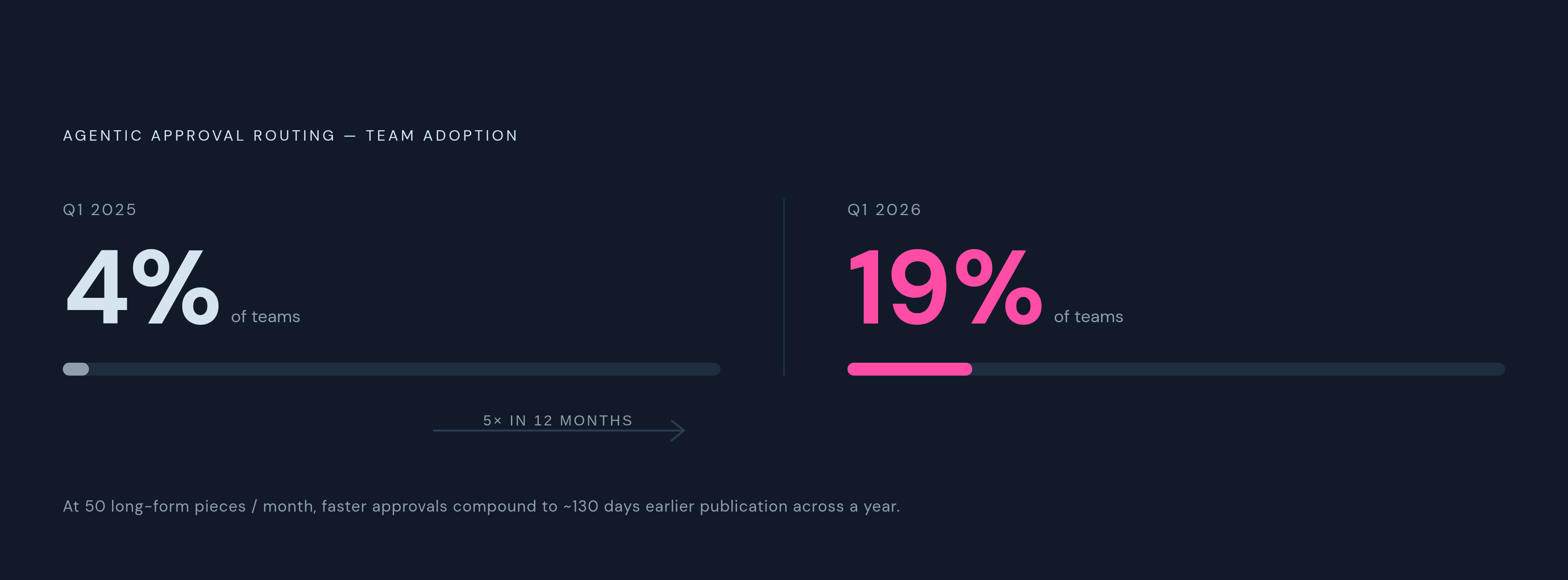
Approval is the single largest unrealized efficiency gain sitting inside most content operations teams right now, and it is not close. Not drafting speed, not measurement infrastructure, not which tool sits at the top of the stack. Approval.
The stakes get obvious fast in portfolio terms. One brand manager cannot personally approve 200 social posts, 50 email variants, and 30 ad creatives in a single week without becoming the ceiling on the entire team's output. When that load is multiplied across a five-brand portfolio, the bottleneck becomes structural rather than personal, since no amount of individual hustle fixes it.
Agentic approval routing (where AI handles routing, draft assembly, change detection, and stakeholder notifications while humans review only the final compiled output) was adopted by roughly 19 percent of teams as of Q1 2026, up from 4 percent a year earlier. That is a fivefold jump in a single year, which suggests the teams that tried it found something worth keeping.
The tempo difference compounds publication timing significantly. At a pace of 50 long-form pieces a month, that gap compounds to roughly 130 calendar days of earlier publication across a year.
There is a quieter failure mode buried in the approval data, too. Either way, the approval step itself becomes a source of drift instead of a check against it. Which means approval design is not a scheduling question or an HR staffing question, it is a brand governance question, and the portfolio architecture decided in section one determines who actually holds approval authority at each layer.
Pod model vs. hub-and-spoke: how portfolio architecture should dictate team structure
Two team structures dominate agency portfolio work, the pod model and hub-and-spoke, and neither one is correct in the abstract. The right answer follows directly from whether the portfolio is synergistic or independent, the split established at the very start.
The pod model organizes smaller groups around specific brands or goals, with each pod typically built from an AI capability, a designer, an analyst, and a writer. It scales cleanly for agencies handling multiple client accounts or brands that serve genuinely distinct audiences, which makes it the natural fit for independent portfolio architecture. Hub-and-spoke runs the opposite way: a central team owns tools, data, and strategy, while distributed teams handle creation and distribution closer to the brand. That structure holds consistency together while still giving each spoke room for creative judgment, and it suits synergistic portfolios best, since shared infrastructure has high reuse value when brands overlap on audience or category.
The pod model's chief risk is silo formation. Institutional knowledge, creative learnings, asset libraries, all of it fragments across pods unless someone is actively managing workload balance and cross-pod visibility. Shared roles, video production or conceptual design serving multiple pods at once, can bridge some of that gap, but the balance is delicate: lean too hard on shared resources and the pod model loses the autonomy that was its structural advantage.
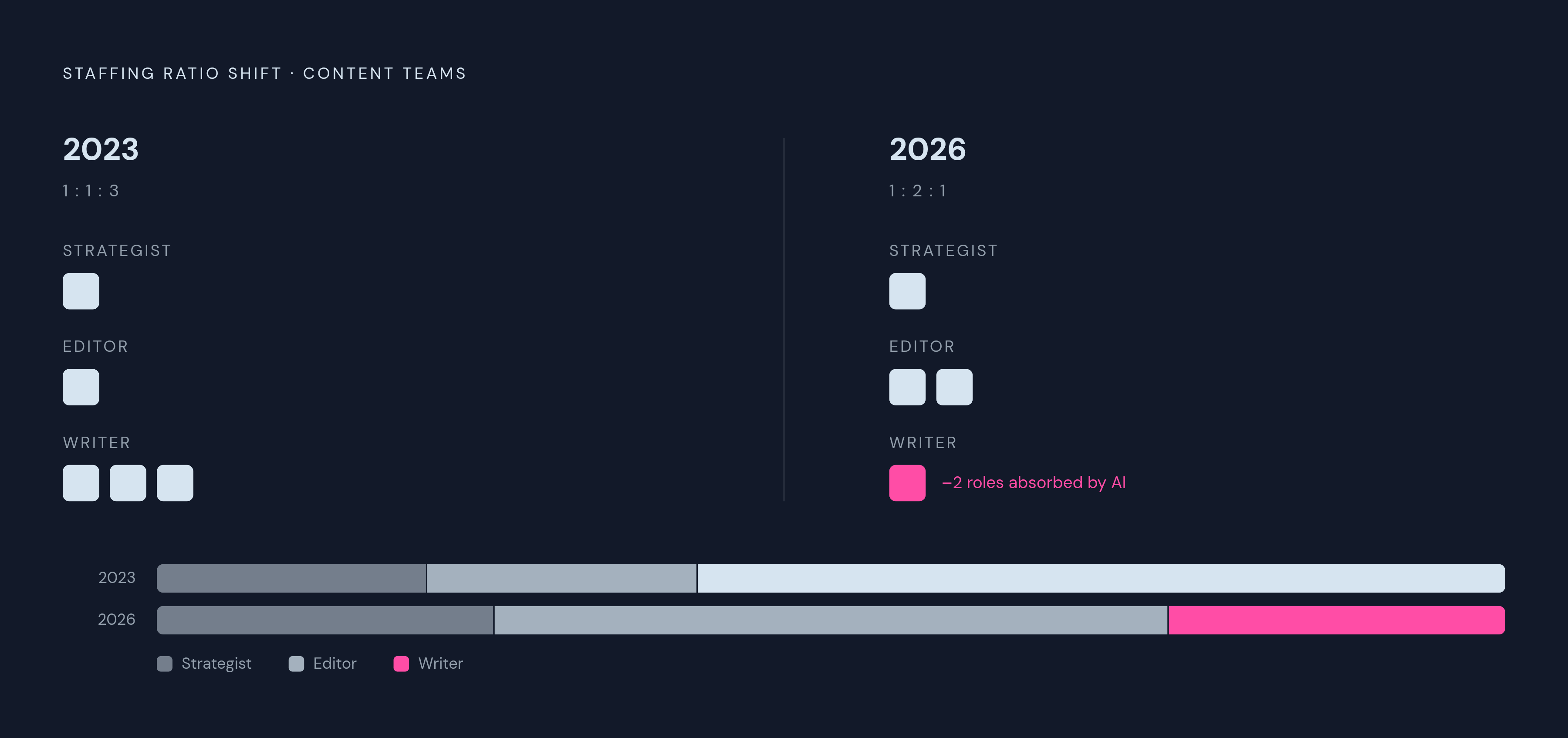
What has shifted is not headcount per dollar, which stays roughly flat, but the mix of roles: strategist-to-editor-to-writer ratios moved from 1:1:3 in 2023 to 1:2:1 in 2026 on AI-mature teams. Fewer writers, more editors, and a strategist layer that held steady. Staffing benchmark suggests roughly 1 FTE per $6M ARR through the $250M mark, above which process and tooling yield more leverage than adding heads, with a median team of 3.2 FTE at $10M ARR and 18.7 FTE at $250M+.
The content governance framework requirements across a multi-brand portfolio
Governance is the rulebook for who creates, who approves, and how the final product is supposed to look and feel. Without it, even a well-staffed, well-structured team drifts, because good people making reasonable individual judgment calls still produce inconsistent output at scale if there is no shared standard to check against.
A governance framework built to scale across a portfolio needs to cover several things at once: an audit of existing assets, clearly defined roles and permissions per brand, a centralized library of locked templates, tiered approval workflows sized to the risk of what is being published, automated personalization that stays inside defined limits, and ongoing tracking of adoption metrics so leadership knows whether any of it is actually being used.
Controlled variation is the core principle producing all of that. Governance is not uniformity but a deliberate line between what stays fixed, the logo, the legal boilerplate, the core voice attributes, and what is allowed to flex by market, channel, or brand variant. It is a deliberate line between what stays fixed, the logo, the legal boilerplate, the core voice attributes, and what is allowed to flex by market, channel, or brand variant.
Governance failure, in practice, is rarely a failure of the policy itself. It is a failure of accessibility and enforcement, and the 95 percent versus 25 to 30 percent gap from earlier in this piece is the clearest evidence of that. Nobody is short on written policy. For agencies running a portfolio specifically, governance has to answer three questions before a single tool gets purchased: which assets are shared across the portfolio, which are brand-exclusive, and who holds override authority when the two collide. Those answers need to exist on paper before procurement starts, not get improvised afterward. The controlled-variation principle holds that governance does not mean uniformity, it means defining which elements are fixed, such as logo, legal boilerplate, and core voice attributes, and which can flex by market, channel, or brand variant, and 81% of brands struggle to maintain unified identity across diverse markets precisely because this boundary is undefined.
Content operations platforms and brand management tools shortlisted for portfolio-scale teams in 2026
Content operations is not one tool category, it is three layers that have to work together: asset management as the single source of truth, brand governance that gets the right assets to the right team or market, and templated production that lets non-designers build on-brand content inside boundaries someone else already set.
Aprimo covers enterprise marketing resource management with AI content scoring and predictive analytics layered on top of a deep, configurable workflow engine. Bynder handles large-scale DAM with automated workflows that flag outdated assets, catch non-compliant uploads, and manage duplicates, backed by mature third-party integrations. Adobe Experience Manager covers the full content lifecycle, DAM through web delivery, with AI personalization running through Adobe Sensei.
Further down market, Optimizely CMP brings agentic AI and content optimization into end-to-end planning and delivery at a mid-enterprise price point, while Canto offers a more accessible mid-market DAM with AI tagging and a strong portal experience. Sprinklr unifies omnichannel marketing with AI content scoring and social listening for teams running truly global operations, and Contentful takes the headless CMS route, delivering structured content by API to any channel, with AI-assisted content modeling built in.
A few more names round out the field. Percolate, now folded into Seismic, brings strength in multi-market campaign planning and calendar visibility, though anyone evaluating it in 2026 should check where its roadmap sits inside Seismic's broader product portfolio before committing. Contently pairs a content platform with a freelance talent network aimed at ROI-linked content, Brandfolder paired with Smartsheet gives large asset libraries AI-driven visibility into how assets get used across teams, and Marq, used by more than 7 million people across distributed teams, focuses on digital brand governance and locked templates for teams where brand accuracy cannot bend.
A newer category is built specifically around agencies rather than single enterprises: platforms that treat the brand, not the individual post, as the core object, giving each brand its own voice profile, asset library, calendar, and client-facing approval portal. WRITER fits into this world by helping agencies turn ad hoc AI workflows into repeatable processes for briefs, campaign assets, client onboarding, and reviews. Zerply takes a different angle, tracking how ChatGPT, Claude, Gemini, and Perplexity talk about a brand and turning those answers into articles and landing pages on the client's own domain, designed for agencies running AI visibility and AEO work across multiple client brands from one workspace. The selection principle determines which category to prioritize: the governance framework built in the previous section shows that a team whose real gap is asset sprawl needs a different tool than one whose real gap is approval routing or voice enforcement. Papirfly is positioned for enterprise brand content ops, combining DAM, templated content creation, and brand governance in one suite with AI asset tagging and smart search, listed at the enterprise pricing tier, and shortlisted by enterprise marketing teams in 2026.
Using multi-agent AI systems to close the output gap without multiplying headcount
The operating question for 2026 was never whether to use AI, it is how. The shift underway is from basic AI writing assistants toward AI-powered workflow systems, agents that connect multiple apps, make decisions, and carry out multi-step tasks with minimal human input at each stage.
One pattern taking hold at agency scale is what some teams call the Editorial Mesh: five distinct agent roles, researcher, writer, editor, SEO, and QA, with defined handoff contracts between each one. The efficiency does not come from any single agent typing faster. It comes from removing the friction that used to sit between stages, the waiting, the re-briefing, the lost context every time work passed from one person to the next.
The results reported from multi-agent deployments are substantial: 73 percent faster campaign development and 68 percent shorter content creation timelines, with multi-agent systems outperforming single-agent setups by more than 90 percent on complex tasks. And the gap between the best teams and the average ones is not a small one.
Adoption of AI-assisted first drafts hit 68 percent in the first quarter of 2026, up from 22 percent in 2023, a 46-point swing that moved faster than AI adoption in SEO, paid media, or lifecycle marketing over the same stretch. But the labor did not disappear, it moved. Cost per asset on AI-assisted teams compressed 41 percent over two years, yet editor hours per asset rose 18 percent while writer hours dropped 53 percent. Strategy and editing absorbed what generation gave back. For a portfolio specifically, that means a multi-agent system cannot be configured once and pointed at every brand. Synergistic portfolios can share agent context across brands that already overlap in audience, but independent portfolios need isolated brand-DNA inputs per brand, or voice starts bleeding across brands that were never supposed to sound alike. The output gap between top-decile and median teams shows top-decile teams producing 3.2× the median output volume with the same headcount, with the differentiator being workflow design, not raw AI access.
Agencies that scale a portfolio cleanly versus those that multiply their overhead
The holding companies scaling fastest right now, PE-backed portfolios, roll-up CPG groups, multi-category DTC parents, share one habit: they centralized creative operations across brands before ad spend outran their internal team's bandwidth. Waiting until spend hits eight figures to fix the foundation makes the eventual fix slower and considerably more expensive.
The financial case for doing it early is not speculative.
The practical diagnostic is straightforward enough to run this week: map every current workflow decision, approval routing, team structure, tool selection, AI configuration, back to the portfolio architecture decision that supposedly justifies it. Any layer that was built independently of that decision is a candidate for redesign, full stop.
The overhead trap occurs in two mirror-image forms. Separate teams per brand multiply cost in a straight line with no offsetting leverage, while shared templates stamped across brands without real differentiation quietly suppress the revenue premium consistent branding is worth, up to that 23 percent figure cited earlier. The correct architecture threads between the two: it captures the shared-services leverage that justifies running a portfolio in the first place, without flattening the brand differences that justify the portfolio's diversity in the first place. Multi-brand content operations do not get built by buying a better tool or hiring another analyst. They get built by making one structural decision correctly, and then letting every choice that follows, staffing, governance, tooling, AI configuration, flow from that single answer. Superside's Forrester TEI Report cites 94% ROI from centralizing creative efforts under a cohesive approach, evidence that fragmentation has a measurable, not just operational, cost.
Methodology & sources
- 10 Creative Content Agencies Making Brands Shine in 2026
Provided the 94% ROI figure from Forrester TEI research cited in the closing section on centralizing creative operations.
- Compare the 10 best Content Operations software
Provided the shortlist description of Papirfly as an enterprise brand content ops platform combining DAM, templated creation, and brand governance.
- Content Operations Statistics 2026: Teams & Workflow
Supplied the staffing benchmarks, AI-assisted draft adoption figures, and the agentic routing adoption statistic cited throughout the article.
- Managing Content Across 5+ Brands Without Losing Your Mind: A Framework for Multi-Brand Portfolio Operators | GTM37
Informed the framework discussion on synergistic versus independent portfolio architecture and the dysfunctional patterns that arise without a deliberate architecture decision.
- https://www.marq.com/blog/digital-brand-governance/
Provided the statistic that 62% of brand managers say brand consistency has become harder to maintain, and the figure of 7 million Marq users cited in the tools section.
- https://insights.brandkitos.com/cross-channel-brand-consistency-guide-2026/
Provided the 23 percent revenue gain figure tied to consistent brand presentation and the 68 percent shorter content creation timelines from multi-agent systems.
- https://mindstudio.ai/blog/ai-agents-for-marketing-teams
Informed the description of multi-agent AI systems as agents that connect apps, make decisions, and carry out multi-step tasks with minimal human input.
- https://www.lytho.com/blog/ai-isnt-your-bottleneck-your-approval-process-is/
Provided the argument that approval, not drafting speed or tooling, is the single largest unrealized efficiency gain in content operations.