Leadership Coaching for Sales Managers
Most sales managers claim to coach, but their reps rarely experience it.

Ask a room of sales managers if they coach their reps and 94% will say yes without blinking. Ask their reps the same question and 53% will tell you coaching happens quarterly, if that; another 37% say whatever feedback trickles down isn't personalized to them at all. Two groups describing the same supposed conversation, landing on two different planets.
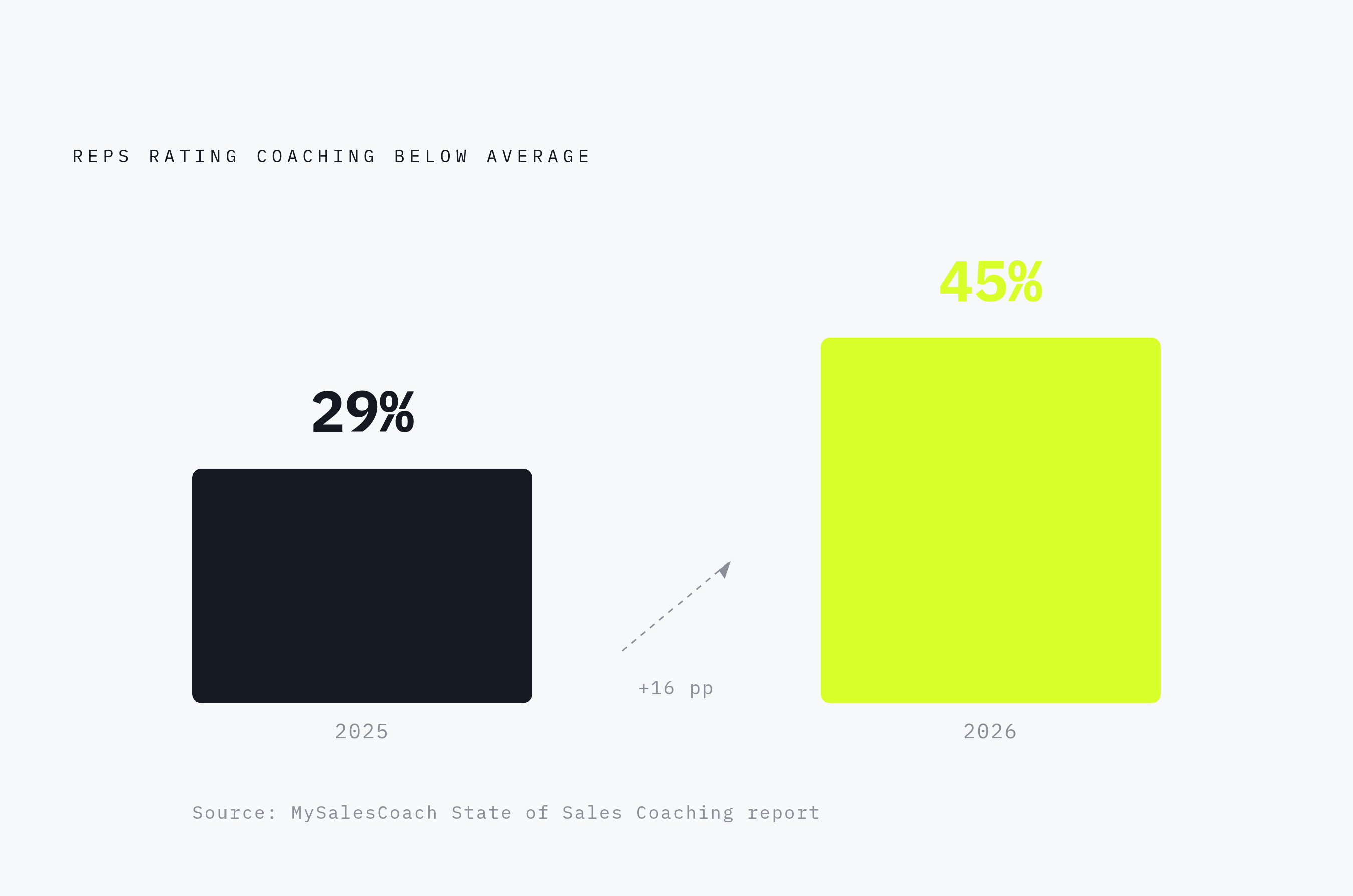
It's getting worse, not better. In 2025, 29% of reps rated their coaching below average. A year later that number hit 45%, according to MySalesCoach's State of Sales Coaching report. So what were managers actually doing in those rooms all along that they kept calling it coaching?
A likely culprit is that managers lump fixing a problem, answering a question, and dispensing advice under one label. Those pull on different muscles entirely, and treating them as interchangeable is how a manager convinces himself he's developing his team while the team quietly stalls underneath him.
Here's where it usually goes sideways. A pipeline review gets calendared as a "coaching call." The rep walks out with a punch list: call this account, update that field, chase the proposal that's gone quiet. Useful, sure, but none of it builds a skill that outlasts the meeting. Same list shows up again next week. Nothing changed in how he actually sells, only the account names did.
Split the three modes apart and most of the confusion falls away. Coaching is short-cycle and rep-led; the manager asks, and the rep does the thinking. Managing is deal-specific and manager-led, do this, on this account, right now. Mentoring is the long game, the "where do you want to be in three years" conversation nobody has time for on a Tuesday between two forecast calls. Cram all three into one 30-minute 1:1 and you get a manager who feels productive next to a scoreboard that refuses to move.
Why so many sales managers were never equipped to coach in the first place
Most sales managers got the job because they closed deals well, and closing draws on close to the opposite skill set coaching needs. Closing rewards decisiveness, controlling the room, getting to yes fast, not letting silence sit too long. Coaching rewards patience and the discipline to shut up long enough for someone else to find their own answer.
Handing a star closer a team to coach is a little like handing a star pitcher a whistle and calling him a coach. The fastball doesn't help him now. He's out of innings, and nobody in the dugout much wants to watch the windup.
Roughly three-quarters of sales managers report never having received any training on how to coach, per MySalesCoach. That's a missing rung nobody got around to building.
The Sales Management Association found a majority of firms budget for rep training, but only a smaller share budget for manager training, and even that smaller slice rarely targets coaching skill specifically. Usually it's forecasting, or comp plan mechanics, or some compliance module nobody remembers a week later. Train someone to sell, promote him for selling well, hope osmosis handles the rest of the job description. That pattern repeats across companies with nothing else in common.
Why does this keep happening, year after year? Because coaching lives permanently in the "important but not urgent" box, and no deal has ever collapsed in the exact moment a manager skipped a session. The cost shows up three months later as a missed number nobody bothers to trace back to a cause.
This is structural, tied to how organizations train and promote, more than a verdict on any individual manager's character. Organizations need to coach the managers on coaching, explicitly and more than once, instead of running one framework slide at an offsite and calling the box checked for the year.
How time and team size work against coaching cadence
Even a manager who genuinely wants to coach runs headfirst into arithmetic. McKinsey research suggests only a fraction of a manager's time is actually free for value-add work like coaching. The rest gets eaten by admin, status meetings, and the general sludge that fills a calendar without anyone quite noticing.
Span of control works against him too. Gallup data reported via Business Insider shows the average manager's span grew from roughly 11 direct reports in 2024 to slightly higher in 2025. One more person doesn't sound like much on paper. It's plenty, though, to snap a coaching cadence that was already fragile.
Stack those two pressures and the outcome writes itself: a large majority of sales managers spend only a tiny fraction of their time coaching. Nobody sat down and designed a week with room for it.
When the math breaks, managers default to whatever's loudest, which is deal inspection. The 1:1 quietly turns into a pipeline review wearing a different name on the calendar invite. And here's the part that should needle sales leaders more than it usually does: top performers get attention, strugglers get attention, each for their own reasons, and the middle 60%, the reps doing fine but not spectacularly, get almost nothing. Nobody decided that on purpose. Nobody decided otherwise either.
Cadence, then, is a design problem before it's ever a discipline problem. Managers need to build coaching into the week with the same discipline they'd bring to a forecast call the VP is dialing into personally.
What a repeatable coaching cadence actually looks like week to week
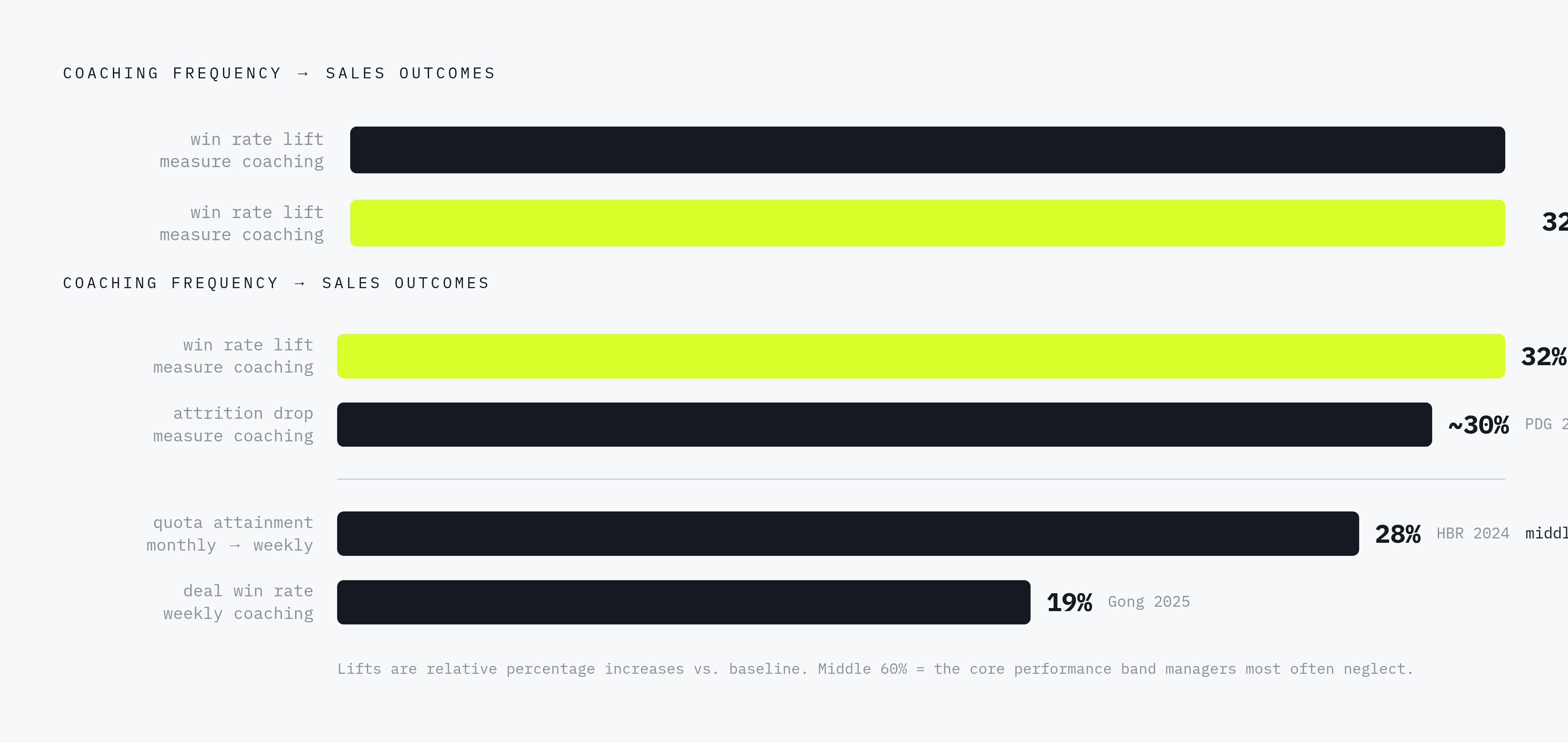
Gong's 2025 Revenue Intelligence report found reps who get one structured coaching conversation a week win 19% more deals than reps who get none. Frequency seems to matter more than any single conversation's brilliance, and weekly is roughly where that threshold sits.
HBR's 2024 research adds a wrinkle: moving from monthly to weekly coaching produced a 28% lift in quota attainment, and that lift landed specifically in the middle 60% of reps. Makes sense once you sit with it. That group already has enough skill foundation to act on feedback, once feedback actually shows up on a schedule instead of whenever the manager remembers.
Weekly doesn't mean long, which trips up managers who assume real coaching needs a full hour carved out of an already impossible day. A tight 20-minute conversation on one specific behavior beats an hour-long catch-all almost every time. The rep can actually hold onto one thing and go practice it before the next call.
The fix is simple to describe and much harder to protect: separate meeting types by purpose. One recurring slot for skill development, a different slot entirely for deal inspection. Merge the two and pipeline review eats coaching time every week, because deals feel urgent and skill-building doesn't, not until the quarter ends and the gap shows up in the number anyway.
A workable rhythm looks something like this: pre-call planning, then a live observation or call review, then a debrief where the rep does most of the talking. If the manager's the one narrating the whole session, that's the tell. Managing crept back in without anyone noticing.
Nearly half of reps, 46%, say manager coaching is the most effective way they build new skills, ahead of any course, certification, or vendor training. Frequency and structure aren't just performance levers. They're part of the reason a good rep stays through the next quarter instead of leaving for a competitor.
How the GROW model gives coaching conversations a repeatable structure
GROW is among the most widely referenced coaching frameworks for reasons that have nothing to do with novelty. It's simple enough to run in 20 minutes without collapsing into a checklist nobody actually follows. Goal, Reality, Options, Will: four stages, each doing genuinely distinct work.
Research shows that moving from monthly to weekly coaching produced a 28% lift in quota attainment. That's a real margin, and it suggests structure and cadence, independent of any one manager's natural gift for the job, support the process rather than merely dressing it up.
Mapped onto an actual call: Goal pins the rep to something concrete, "get the economic buyer on the next call, specifically, by name," rather than a vague ambition to improve discovery calls in the abstract. Reality surfaces what's actually happening in the rep's process, unfiltered by ego or optimism. Options generates multiple paths the rep might try, and this is exactly where managers sabotage themselves, jumping in with the answer before the rep gets there on his own. Will produces one commitment the rep owns walking out the door.
The whole model hinges on a single discipline: the manager asks, and does not tell. GROW only works if the rep generates his own answers during Options. The moment a manager fills that stage in himself, the conversation has quietly reverted to advice-giving, and the rep is back to holding a to-do list instead of building judgment he can reuse on the next ten calls.
Other formats exist, PRAISE, the Sales Assembly Five-Step, and they share the same logic underneath different labels: question first, let the rep lead, resist the urge to solve it for him. Believing coaching matters and actually running a repeatable version of it turn out to be two very different commitments — and the gap between managers who claim to coach and reps who report receiving it suggests most organizations are still on the wrong side of that divide.
Where feedback quality separates effective coaches from managers who just check in
There's a pattern worth saying out loud: managers often give vague feedback not because they lack insight, but because specificity feels risky. Vague feedback protects the relationship, sidesteps an awkward moment, and gets the meeting over with cleanly. The rep leaves feeling checked-in on while nothing about his actual behavior changes.
Compare two lines. "Work on your objection handling" gives a rep nothing to act on tomorrow morning. "In that second objection, you jumped to price before the buyer even finished the sentence" gives him one exact moment to notice and fix. That's the difference between feedback that lands and feedback that gets forgotten before the next call.
The quality gap shows up in the numbers, and it's bigger than the simple presence-or-absence gap you'd expect walking in. Reps who rate their coaching excellent or very good are 50% more likely to hit or beat quota than reps stuck with poor coaching. Quality carries as much weight as the box simply getting checked at all.
Call recording and conversation intelligence tools solve a small, unglamorous problem here. They give managers a timestamped moment to point to, so feedback anchors to something real instead of "I think you said something like this, roughly, around minute ten." It turns the conversation into a shared, specific review rather than a vague recollection.
One or two behaviors per session, never a comprehensive review of everything wrong with a call. Give a rep five things to fix and he'll remember none of them by Thursday; give him one thing to practice before the next call and there's an actual shot it sticks.
Managers rarely say this part out loud, but their own discomfort with direct feedback is probably the single biggest coaching killer in the building. Name that discomfort as a skill to build, the same way you'd name a rep's discovery skills as something worth building, and it stops being a personality quirk everyone quietly works around forever.
How to coach the middle 60% instead of defaulting to top performers and problem reps
A well-documented pattern holds up uncomfortably well: managers drift toward their best performers for relationship reasons, and toward their most visibly struggling reps out of pure urgency. Both pulls make sense on a human level. Neither one serves the middle of the roster, which ends up neglected by default, with nobody ever deciding it that way on purpose.
That 28% quota lift from weekly coaching, the one from HBR's research a couple sections back, landed squarely in the middle 60%. They're the group most primed to benefit, since they already have the skill base to act on feedback. They're just not getting any, week after week, while attention flows to the two loudest ends of the roster.
The diagnostic here doesn't need to be fancy. Map every rep on a simple grid: current performance against coaching hours received over the last 90 days. Most managers who actually run this exercise get surprised, sometimes uncomfortably so, by how lopsided the distribution turns out to be once it's on paper instead of in their head.
There's a retention thread worth pulling too. Weekly coaching gets reported by 26% of high-performing reps, versus 20% of low performers. Tenure and coaching frequency track together, which raises a fair question: is coaching a symptom of investing in your best people, or part of what actually makes them your best people to begin with?
MySalesCoach's State of Sales Coaching report has now found, for a second straight year, that the longer a rep has been selling, the less coaching he receives, even though tenured reps report wanting it the most of anyone. A strange inversion once you think it through: the most experienced reps are also the most under-coached, and arguably the most ready to use a good conversation the moment someone bothers to have it with them.
Coaching distribution deserves the same quarterly scrutiny most sales orgs already give pipeline coverage. Left to gut feel, a manager's sense of "who needs attention" will always skew toward the loudest signals, the top performer he enjoys talking to, the struggler whose numbers are visibly on fire. Track it like a metric instead, and the distribution has a way of evening out on its own, almost embarrassingly fast.
How to measure whether the coaching is actually working
PDG's 2024 State of Coaching report found organizations that implement regular coaching and measure its impact see a 32% increase in win rates, a 28% improvement in quota attainment, roughly double the seller engagement, and close to a 30% drop in attrition. That last clause deserves a second look. Measuring the coaching seems to be part of what makes it work, a driver in its own right rather than a passive side effect tacked onto a slide.
Leading indicators are the ones a manager can watch before the quota number ever moves: sessions completed per rep, which behavior got targeted, whether that behavior actually showed up differently on the very next call. These show up in weeks, not quarters.
Lagging indicators confirm whether any of it connected to revenue: quota attainment trend, average deal size, win rate on the specific deals a manager personally reviewed. If the leading indicators are moving and the lagging ones sit flat, that's worth digging into rather than shrugging past and hoping next quarter fixes itself.
At the manager level, one metric belongs right next to pipeline coverage on the weekly dashboard: coaching coverage, meaning what share of the team got at least one structured session this week. Treat it as a KPI and it stops being the thing that quietly vanishes the moment the quarter gets busy.
That gap between reps who rate their coaching well and reps who don't isn't a stat to cite once in a deck and forget about by Friday. It belongs in a quarterly business review, defended against every other item competing for a manager's calendar that week.
Session prep eating the time coaching is supposed to save undoes all of it fast, too. Pre-built call review templates, shared skill rubrics, AI-assisted summaries of what actually got said on a call: this kind of groundwork pays for itself by cutting the hour a manager used to burn scrolling through recordings before a session even started. Lose that specificity and you're right back to "work on your objection handling," which is where this whole piece started.
Cadence, GROW, sharper feedback, attention paid to the neglected middle of the roster. None of it is complicated in isolation. What's hard is protecting the time to run it, week after week, when everything else on a manager's calendar feels more urgent than it really is. A 16-point swing in reported coaching quality over a single year says the fight is worth having anyway, even on the weeks it doesn't feel like it.