CRM Hygiene Habits That Improve Forecast Accuracy
Dirty CRM data, not faulty models, is what kills most sales forecasts.

Forecast misses get blamed on the model almost every time: wrong formula, wrong tool, wrong methodology. Nobody wants to blame the records, which is strange, because the records are usually where the trouble starts. Per Xactly's 2024 Sales Forecasting Benchmark Report, only 20% of sales organizations land forecasts within 5% of their projections, and 43% miss by 10% or more, numbers that point straight at the data feeding the model. This piece walks through the habits that close that gap, and why most of them have nothing to do with math.
What CRM data quality actually means in practice
Five things decide whether a CRM record deserves your trust: accuracy, completeness, consistency, timeliness, and uniqueness. Each one breaks a forecast in its own particular way. A close date nobody's touched in four months is a timeliness problem, while a duplicated account record inflates pipeline value quietly, because now there are two "opportunities" sitting where there's really one buyer trying to decide whether to sign. An incomplete stage field wrecks the weighted calculation outright, since the model has nothing left to weight.
None of these five saves you on its own, either. A record can be accurate and complete and still so stale it actively misleads the forecast, because freshness and correctness are separate requirements, and a record needs both to be useful. So what does "clean enough" actually look like on paper? A workable target for active pipeline: a low duplicate rate, critical fields populated on the large majority of records, and a strong majority of active opportunities verified in the last 90 days. That gives a team something to aim at before we get into the habits below.
How fast data goes bad on its own
CRM data doesn't wait around for you to neglect it, and it decays on a schedule, whether anyone's watching or not. Validity's 2025 State of CRM Data Management report puts B2B data decay at roughly 34% a year, meaning a database left alone for twelve months has already lost a third of its accuracy. Most systems never log "changed jobs." Contacts go quiet, companies restructure, and the record just sits there, technically complete and functionally dead weight.
The decay rate isn't even across industries, either. SaaS and tech churn through role changes and headcount shifts far faster than manufacturing, so those pipelines rot quicker. The average professional doesn't stay in one seat very long, so a good chunk of your contact base can turn over inside a single enterprise sales cycle, which for a lot of B2B deals runs six to twelve months anyway. The pipeline you built six months back, untouched since, is running on inputs that already shifted underneath it. A one-time database cleanup scheduled for Q1 addresses a moment, not the ongoing problem. Decay never stops, so a single event can't be the fix; the work has to be continuous.
The real cost of leaving hygiene to chance
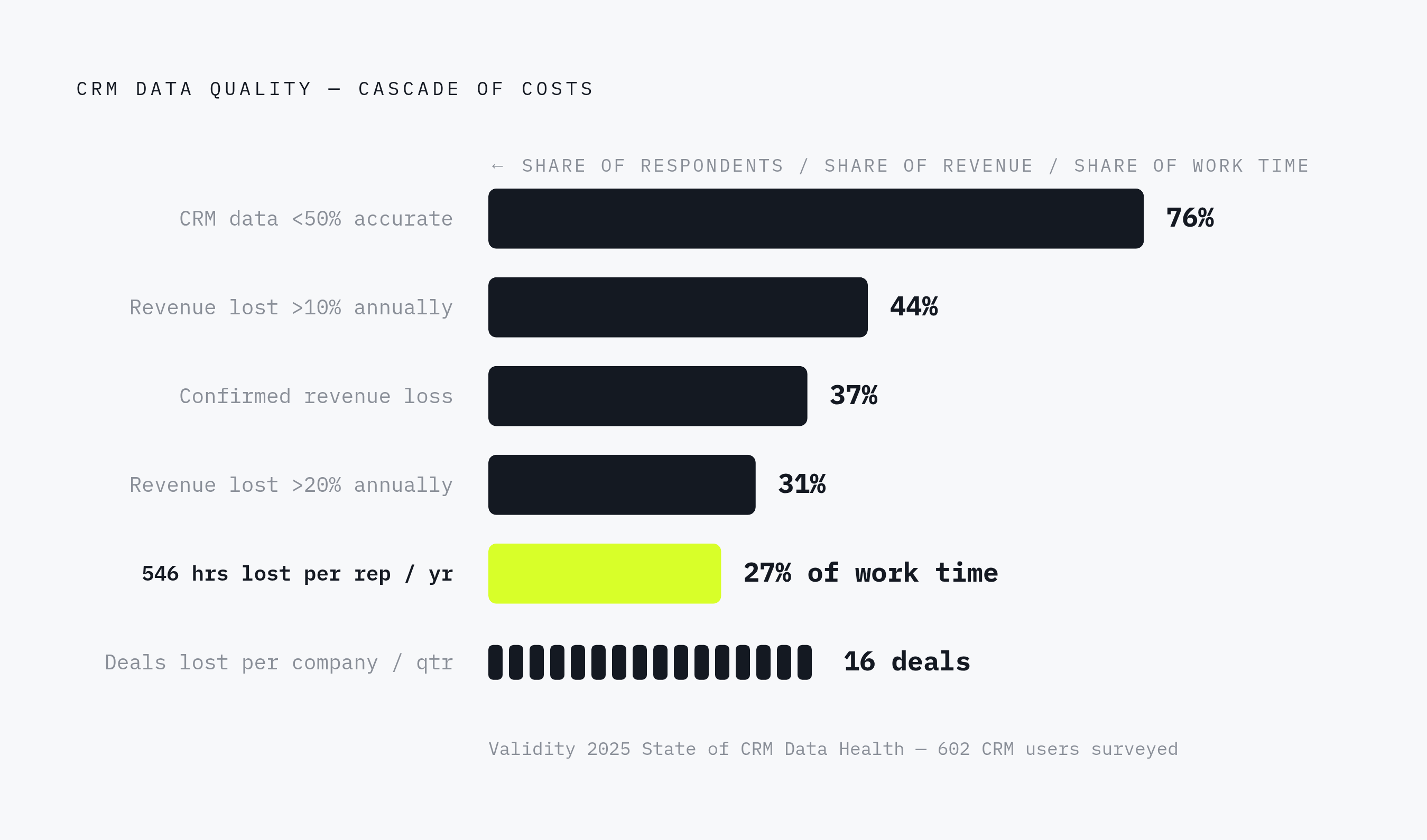
The numbers here aren't subtle. Validity's 2025 report, surveying 602 CRM users and stakeholders, found 37% had lost actual revenue to poor data quality, and 76% said less than half their CRM data was accurate and complete. That's roughly a coin flip on whether any given record can be trusted, and forecasts don't survive on coin-flip odds.
The same report found companies lose an average of 16 sales opportunities a quarter to unreliable data. For a lot of sales orgs, that's a full month of a rep's quota walking out the door. Reps themselves lose an estimated 546 hours a year, about 27% of their productive time, to data entry and chasing down records that should've been right the first time. Workers report burning 13 hours a week just hunting for information inside the CRM, roughly two full workdays spent looking for things that were already typed in somewhere. Add it up, and 44% of companies in Validity's survey estimated they lose more than 10% of annual revenue to bad CRM data, with 31% putting that number at 20% or more. These costs recur every quarter, and the leak keeps widening on its own unless someone actively closes it.
Why pipeline stage alone is a weak forecasting signal
Most CRMs assign a win probability to a stage, not to a deal. "Proposal" gets a flat 60% chance to close whether the buyer is leaning in or has gone completely dark. A deal in "proposal" with a confirmed budget, an internal champion, and a fixed decision date looks, to the system, identical to a deal in "proposal" with none of that, because the CRM can't tell them apart, since nobody ever asked it to.
Stage-only forecasting is widely recognized as a weak signal, and the problem compounds with volume. A large share of B2B pipeline in the average CRM is stale at any given time, which means the weighted math is busy applying real probabilities to deals that were never going to close in the first place. Two things fix this: pulling the deals that shouldn't be counted at all, and tying stage movement to something the buyer actually did instead of something a rep typed into a field on a Friday afternoon.
Enforcing stage exit criteria tied to buyer actions
"Sent proposal" is a rep action. "Buyer confirmed evaluation criteria and requested pricing" is a buyer action. Only one of those tells you anything real about the deal, and most CRMs don't currently require it, which is worth sitting with for a second, because the whole stage-gaming problem lives right there.
That distinction is your main defense against reps quietly self-promoting opportunities based on their own effort instead of any signal from the other side of the table. The fix is mechanical, not motivational: define two or three buyer-side signals required for each stage transition, and make those fields mandatory before a rep can move the deal forward. Once that's live, a rep can't advance a deal just by sending an email; they have to document what the buyer actually did, which forces an honest conversation about where things stand. Managers get something out of this too. Pipeline reviews shift from a rep's optimistic narration toward a check against what's actually written down, and the Monday morning meeting stops feeling like theater.
Treating close date changes as a forecast signal, not an admin task
Close dates should be grounded in something the buyer said, never in a rep's internal hope or a quarter-end deadline dressed up as a plan. When a deal slides from this quarter into next, that's new information about the deal's actual odds, and it deserves to be treated as exactly that instead of quietly logged and forgotten.
Here's the habit worth building: every close date change should trigger a probability review, not a silent field update everyone pretends didn't happen. One useful gut check for managers is looking at how much of "committed" pipeline is made up of deals that already slipped once from a prior quarter. If that share is large, the forecast is leaning on opportunities that have already proven they slip, which undermines the entire projection. A change log on close dates matters here too, since it shows the pattern over time instead of just today's snapshot, and a date with no history behind it is a date you can't trust.
Removing stale deals from active pipeline
Call it the no-next-step rule: if a deal doesn't have a real next step logged with a real date attached, it doesn't belong in active pipeline. It belongs in a parked or nurture bucket, out of the way of the weighted math entirely.
This is arithmetic. It's not a judgment call about the deal's merit or the rep's effort, and it shouldn't feel personal, even though it usually does. If a meaningful chunk of pipeline is stale, the weighted calculation keeps assigning win probabilities to deals that are functionally dead, and that inflates the forecast in a way that feels great right up until the quarter ends and it doesn't close. Pull those deals out, or reclassify them, and the forecast gets honest immediately, even if the resulting number is smaller and less fun to present at the all-hands. The resistance here is predictable, since nobody loves watching their visible pipeline shrink. A smaller, real number beats a bigger fictional one, though, especially once that number feeds hiring plans or a board deck. A practical trigger: flag any deal with no logged activity in the last 30 days (adjust for your own sales cycle) for automatic manager review.
Running a hygiene review before every forecast call
Think of this as a 15-to-30-minute structured pass through the pipeline that happens before the forecast call, separate from the call itself and no substitute for it.
What you're looking for: open deals with no contact attached, deals that blew past a typical sales cycle length with no close date update, overdue tasks, missing next steps, orphaned contacts with no opportunity linked anywhere. Practitioners consistently find that teams reviewing pipeline health weekly land better forecast accuracy than teams checking in sporadically, which suggests the discipline of showing up matters almost as much as the checklist itself. There's a compounding payoff, too: the same data problems keep resurfacing week after week, which trains reps on what "correct" looks like faster than any training deck could manage. None of it sticks unless leadership actually protects the time and follows up on what gets flagged, since an unenforced checklist tends to get ignored, and everyone knows it.
Standardizing field entry to prevent errors at the source
Free-text fields are where most inconsistency gets born. Ten reps typing the same job title ten different ways makes that field unsortable, and "Software," "SaaS," and "tech" describing the same industry breaks any segmentation filter that touches it. The field technically has data sitting in it; that data becomes functionally useless the moment anyone tries to filter on it.
The fix is structural, not behavioral. Swap free-text for dropdowns, picklists, and validation rules anywhere the field feeds filtering, scoring, or forecasting. Required fields at stage entry work the same way: if the system won't let a deal advance without a close date, a named contact, and a logged next step, the data shows up clean instead of needing correction three weeks later by someone in ops who's already annoyed about it. A one-page data entry guide, spelling out exactly what counts as a valid job title or how company size gets bucketed, tends to speed adoption faster than any policy memo buried in a shared drive somewhere. Most bad data comes from speed and missing standards, not malice, and structural constraints remove the guesswork that produces the mess.
Assigning explicit data ownership across roles
Hygiene with no named owner is everyone's job on paper and nobody's job the moment things get busy. That's not a knock on any particular team; it's just how diffuse responsibility behaves, in sales orgs and pretty much everywhere else.
A workable split: sales reps own contact and opportunity accuracy in their own territories, marketing owns the integrity of lead data flowing in from campaigns, customer success owns the account record once the deal closes and the relationship changes hands. When ownership is clear, forecasting errors become traceable, and traceable errors are fixable ones. When it's diffuse, you're stuck guessing who dropped the ball while everyone points at everyone else. New hires make this worse without something written down: every rep who joins without a documented standard imports their own habits, and the CRM slowly starts reflecting a dozen individual quirks instead of one process. Put ownership in role descriptions and onboarding docs, not in a slide from last quarter's team meeting that nobody opened twice. Written accountability tends to stick, where a verbal one quietly gets reassigned to whoever's easiest to blame.
Using automated enrichment to keep records current between reviews
Manual review can't outrun continuous decay by itself, which is where enrichment earns its keep. Organizations using automation and AI in their enrichment process broadly report improved data accuracy, with the gains coming from continuous refresh rather than a quarterly batch job that catches everyone up once and then goes stale again immediately.
There are two flavors worth telling apart. Static enrichment pulls in company and contact details from outside databases; dynamic enrichment updates deal and relationship context based on what's actually happening in the interaction right now. The second one moves forecast accuracy more, since it reflects what buyers are doing this week rather than who they were six months back. A reasonable baseline is a 90-day refresh cycle for active pipeline, with real-time verification triggered whenever an outbound campaign is about to touch a record. High-priority accounts deserve a tighter cadence, since funding rounds and leadership shuffles hit high-growth targets more often than the average logo in your database. One catch worth flagging: enrichment only helps the forecast if the refreshed data actually flows back into the fields that scoring and weighted pipeline calculations read. A clean external record sitting next to a stale CRM field just means you now have two systems disagreeing with each other.
Building hygiene standards into onboarding before bad habits form
Trace most CRM data problems back far enough, and you usually land on a small handful of users, often new hires logging activity inconsistently because nobody ever told them what "correct" looks like. Nobody's being careless on purpose here; they just never got the guidance, because the guidance never existed in the first place.
Onboarding is the cheapest place to fix this, by a wide margin. Training someone before they touch the CRM costs a fraction of what it costs to untangle six months of inconsistent entries later, one field at a time, usually right before a board meeting when everyone's already stressed about something else. Cover how to log activity, what each required field actually means, what stage criteria demand, and, bluntly, what happens to forecast accuracy when hygiene slips. The pitch that tends to land with reps is simple: stale pipeline inflates their own number, which sets them up to miss their own target later. That's their commission on the line, a stake far more concrete than an abstract company metric sitting on a dashboard nobody opens. Keep hygiene metrics, like field completion rates and activity logging, visible in regular one-on-ones so the standard doesn't quietly fade once new-hire training wraps up.
What better CRM hygiene actually does to a forecast
Any one of these habits, taken alone, moves the needle a little. Together, they hit all five data quality dimensions, accuracy, completeness, consistency, timeliness, uniqueness, at once, and that's usually where forecast accuracy stops inching and starts shifting in a way you'd actually notice on a quarterly chart.
Stage exit criteria remove subjective advancement. Close date discipline surfaces slippage while it's still useful instead of after the deal's already dead, and removing stale deals fixes the weighted math directly, no modeling required. Pre-call reviews catch problems before they compound into a bad forecast call in front of the board. Field standardization stops new errors from being born in the first place, instead of cleaning them up after, and ownership makes the whole thing accountable instead of diffuse. Enrichment fights decay in the gaps between reviews, and onboarding keeps the standard alive once the initial push fades, which it always does eventually.
Gartner research suggests companies that tighten CRM hygiene see a meaningful lift in forecast accuracy, and the gap between the 20% of organizations landing within 5% of their forecast and the large share missing by double digits or more looks a lot more like a data problem than a math problem. The model's probably fine, and the inputs are what need the work.