Sales Battle Cards That Win Competitive Deals
Winning reps know exactly what to say when a competitor's name appears.
Sellers encounter competitors in 68% of deals, per Crayon's 2025 State of Competitive Intelligence report. Nearly seven in ten opportunities are contested, yet the tools most teams hand reps to handle those moments are either too dense to open mid-call or too stale to trust. The average B2B win rate sits around 20 to 21%, with top performers clearing 30%, per Hyperbound's 2025 benchmark. That gap isn't primarily a product gap. The teams winning at higher rates show up better prepared, and the difference often collapses into a single moment: a competitor's name enters the conversation and the rep knows exactly what to say.
A battle card is a one-to-two-page tactical reference built for speed. Not an atlas of everything that exists about a competitor, but turn-by-turn directions for exactly where the rep is right now. A rep should find the talking point they need in seconds. That constraint isn't aesthetic; it's the entire design premise.
It is not a product brochure. Not a full competitive analysis. Not a feature comparison spreadsheet. Those artifacts serve real purposes for real audiences. The rep mid-call is not one of them.
The audience is narrow: an AE who just heard a prospect mention a competitor, a BDR preparing for discovery, a customer success manager holding a renewal while a rival is actively circling the account. The test is blunt. Can a rep pull the card up mid-call and immediately know what to say? If not, it's research. Not a battle card.
Everything downstream about structure, content, sourcing, and distribution is governed by that constraint. Break it early and the rest of the work is wasted.
The six types of battle cards and when each one earns its place
Most teams build one kind of battle card and wonder why it doesn't cover every situation. The format has to match the moment, and conflating moments is where the system quietly falls apart.
Competitor battle cards are head-to-head references built for a named rival that keeps showing up in the pipeline. Build one for each of your top three to five competitors, prioritized by deal frequency, not by how much you dislike them.
Product battle cards give reps clear positioning for a specific product or bundle. They earn their place when a team sells multiple offerings or when demos meaningfully diverge by use case. Without them, reps default to a one-size-fits-all pitch that fits no one particularly well.
Objection handling cards address the five to seven objections that recur regardless of which competitor is in the room: pricing pushback, perceived feature gaps, incumbent inertia, procurement delays rooted in risk aversion. These deserve their own format because they appear too consistently to bury inside a competitor-specific document.
Discovery cards are the most underused format in the set. They hold probing questions designed to surface real pain early and begin constructing a competitive frame before any competitor is even named. The rep who controls the discovery criteria controls the evaluation. That's not a minor edge.
Late-stage cards serve a different function entirely. By the time a deal is in formal evaluation, the intelligence a rep needs is more surgical. Early positioning language reads as hollow in a final-stage conversation; late-stage cards are built for precision, not breadth.
Competitor overview cards are designed for executive-level conversations where going granular on features signals you've missed the room. A brief, confident, high-level narrative lands better in those contexts than a detailed feature comparison ever will.
The discipline here isn't building all six. It's being honest about which format fits which moment and refusing to conflate them. A mismatch between format and moment is why most battle cards go unused before anyone notices.
The components that make a battle card work in a live conversation
Structure determines whether a rep opens a card or skips it. Get this wrong and the content doesn't matter.
Start with a competitor snapshot: two to three sentences on their target market, their core positioning, their primary use case. Context only. If it starts reading like a summary of their investor deck, cut it back.
Follow with differentiators framed as buyer outcomes, not feature lists. Three to five reasons you win, written from the buyer's perspective. "We include X in the base package so your team doesn't face a surprise invoice at scale" lands differently than "we have feature X." The first is a business argument. The second is a spec sheet entry.
Include a pricing comparison that shows what's bundled versus what costs extra. Reps field pricing questions on nearly every call, and leaving them without current numbers isn't a minor gap. It's a preparation failure they'll paper over by improvising, which is worse.
Objection handling sections should offer two to three response frameworks per common objection, not scripts. Scripts break under follow-up questions; frameworks hold. Acknowledge the concern, reframe the underlying criteria, redirect toward a proof point.
Trap-setting questions are among the most overlooked components on any card. These are questions directed at the prospect to expose a known competitor weakness before the competitor can position it as a strength. If a rival's product requires a three-month implementation, a well-placed discovery question about go-live timelines surfaces that issue on your terms, not theirs.
Customer proof points belong on the card as a short reference list, each paired with a one-line explanation of why that specific customer chose you over that specific competitor. Generic case study links are not proof points for a live conversation.
The "We Win When / We Lose When" framing is honest and specific, and that honesty is part of what makes it useful. Reps who know precisely where they lose are more credible when they claim where they win. Buyers can sense when a rep has never seriously grappled with where their product falls short, and that evasiveness costs trust faster than almost anything else.
Organize the whole card across three layers: the intelligence (Know), the talk track (Say), the proof (Show). Every layer must fit on one screen. If the rep has to scroll mid-call, the card won't get used. One structural trap worth naming: if the card opens with a feature comparison chart, you've triggered a spec war. The buyer starts treating the decision as a commodity selection, and that's a much harder frame to exit than it was to enter.
Where competitive intelligence actually comes from (and which sources are worth the effort)
The quality of a battle card's talk tracks is a direct function of its intelligence inputs. Cards built from internal assumptions produce generic positioning, and reps learn to distrust generic positioning quickly. Some platforms build workflows around curated external inputs rather than internal assumptions. Then they stop opening the card, which is a rational response, not a discipline problem.
Win/loss interviews are the highest-signal source available. Asking buyers who chose or rejected a competitor why they made that decision gives you the objections that actually mattered and the language the competitor uses to pitch against you. Roughly three quarters of organizations running formal win-loss programs use that data to improve product strategy and roadmap, per Klue's 2025 Win-Loss Trends Report. The direct sales application is just as immediate, and most teams neglect it.
Sales call recordings are a primary source most teams systematically underuse. What buyers actually say on recorded calls, versus what reps remember they said, are different datasets. The recordings are more reliable, and the competitive objections buried in them are often more specific and actionable than anything that surfaces in a post-mortem debrief.
Competitor-facing review platforms like G2 and TrustRadius are public and perpetually updated. Complaints in competitor reviews are your differentiators in raw form. Praise in those same reviews is your threat list. Both are worth reading regularly.
Competitor websites, pricing pages, and help documentation matter not as static snapshots but as signals tracked over time. A pricing page restructure or a new feature category appearing in the navigation is intelligence worth capturing the day it happens.
The sourcing gap is real. According to Crayon's 2025 data, 44% of sales teams still lack visibility into which competitors are active in their deals. You cannot build accurate cards around competitors you aren't formally tracking, which means the sourcing infrastructure has to come before the card itself.
Why most battle cards never get opened (and what drives the gap)
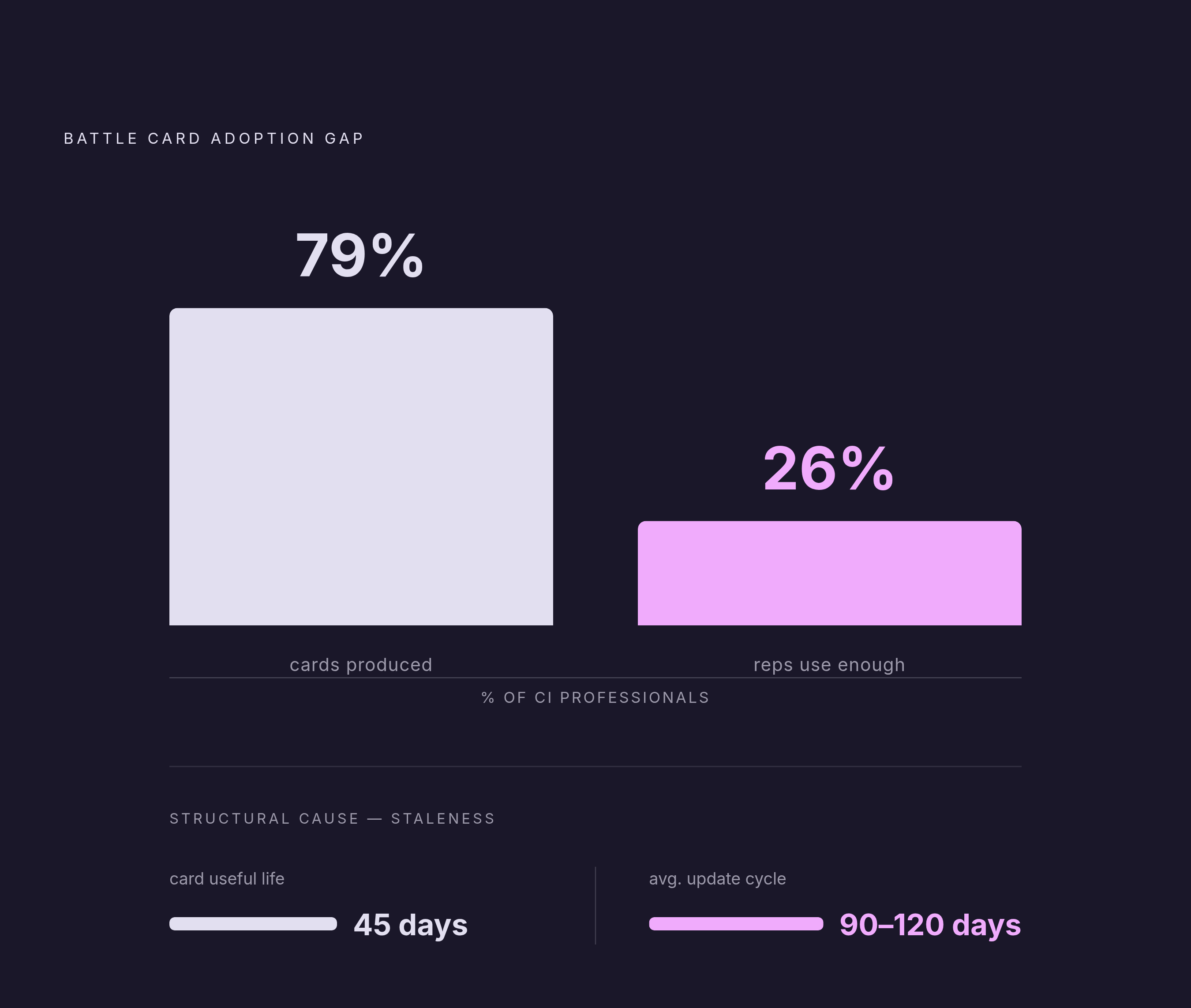
The adoption reality is stark. Crayon's State of Competitive Intelligence research found that 79% of competitive intelligence professionals say they produce battle cards for their sales teams. Only 26% report that reps use them enough. Creation is not adoption, and the distance between those two numbers is where most CI programs quietly die.
Staleness is the primary trust-killer. Seismic's 2025 Sales Enablement Benchmark found that 65% of reps at mid-market SaaS companies report their battle cards are outdated or irrelevant. Crayon's 2025 data puts the median card's useful life at around 45 days before it becomes materially outdated, and the average update cycle without automation runs 90 to 120 days. A rep encounters stale information once, then twice. After that, the card is effectively dead. The distrust is rational.
Three consequences follow from non-use, and they compound. Messaging becomes inconsistent across the team, and buyers talking to multiple reps during an evaluation notice the variance. New hire ramp times extend because new sellers learn the competitive landscape through expensive trial and error instead of a reliable reference. Live moments get fumbled, not because the rep lacked the intelligence to respond, but because hesitation in those moments reads as uncertainty to the buyer, and uncertainty is contagious.
The root cause isn't rep discipline. Battle cards fail to get opened because they are built for the creator's convenience: comprehensive, structured like a report, organized around everything the creator knows rather than the specific moment the rep is standing in. That's a structural design failure, and structural failures don't yield to cultural pressure. You cannot solve a design problem by asking people to behave differently.
Where battle cards need to live to actually get used
The accessibility test is unforgiving. The rep needs the card now, in a live conversation, not after navigating a SharePoint folder three levels deep or breaking out of their CRM to go hunting.
Battle cards need to live where reps already work. Inside your CRM, the card surfaces in the context of the deal without inventing a new workflow. Pinned in Slack or Teams channels organized by competitor or deal stage, it's one search away. Embedded in Notion or Confluence, it stays accessible without requiring a dedicated tool. Dedicated competitive intelligence platforms take this further by surfacing the right card at the right moment through integrations with the tools reps already use daily.
Tagging structure matters more than most teams realize. Tag by competitor and by deal stage. A rep in early discovery against a specific competitor needs different content than the same rep navigating a late-stage evaluation against the same rival. A card tagged only by competitor collapses those two very different moments into one undifferentiated document, and the rep in the late-stage conversation will feel it immediately.
Usage patterns also differ by experience level. Newer reps pull cards during calls as real-time reference. Seasoned reps tend to use them as a pre-call refresher before facing a competitor they haven't encountered recently. Distribution design has to serve both patterns without optimizing so hard for one that it breaks the other.
Battle cards that create a new workflow get abandoned. Cards embedded in the existing workflow become habits. That's not a theory; it's what the usage data shows every time.
How often battle cards need to be updated (and who owns that work)
Cadence is not a process detail. It's the mechanism by which a card stays trustworthy or quietly becomes a liability. Teams updating battle cards at least weekly saw 15% higher competitive win rates than those on monthly or quarterly cycles, per the SCIP 2025 benchmark. With a 45-day staleness threshold and competitors shipping features and repricing continuously, quarterly refresh cycles are structurally too slow before the first quarter is even finished.
Calendar cadence is necessary but not sufficient. Reactive triggers matter as much as scheduled reviews. A competitor product launch warrants an immediate update. A pricing change surfaced in a lost deal debrief warrants an immediate update. A messaging shift on a competitor's homepage, a new case study they're actively promoting, a pattern of losses featuring an objection you haven't seen before: each of these is a trigger, not an item to queue for next quarter.
The manual maintenance cost is real. SCIP's 2025 benchmark puts the time investment at 8 to 15 hours per week of dedicated CI work for teams operating without automation. That's what accurate cards actually cost, and teams that don't budget for it get inaccurate cards.
Ownership structure that actually functions looks like this: centralized ownership of the card itself sits with a CI manager, enablement lead, or product marketing owner. Distributed input flows from the field. Reps who just lost a deal to a specific competitor have intelligence worth capturing immediately, but they shouldn't be responsible for maintaining the document. Those are different jobs requiring different skill sets, and conflating them is how both tasks get done poorly.
A battle card carrying last year's competitor pricing or a feature that's since been deprecated doesn't function as neutral noise. It makes the rep look uninformed in exactly the moment they need to look sharp, and that's an active cost, not a passive one.
What the win rate data says when battle cards are built and maintained correctly
The outcome signal is consistent across sources. Per Crayon's State of Competitive Intelligence, 71% of businesses using battle cards report increased win rates, and of those, 93% say the increase exceeds 20%. Gartner's 2025 Sales Enablement Benchmark adds specificity: reps using current battle cards in competitive deals see a 23% higher win rate on average. Current. Not battle cards in the abstract.
An operational example grounds the numbers. A heavy machinery rental provider that implemented battle cards for key offerings saw a 26% increase in win rates and a 21% reduction in sales cycle length within the first year. Higher close rates and shorter cycles moving together aren't independent events; the revenue impact compounds, and the investment math resolves quickly.
The qualification running through all of these figures is identical: the win rate gains attach to battle cards that are current, accessible, and built around the moment of use. That's the whole thing. Build the card for the moment the rep is actually standing in, keep it current, put it where the rep already works.