Reducing Non-Selling Time in a Sales Role
Sales reps waste 11 percentage points of their week on admin work they shouldn't need to do.

Here is the number that should end every underperformance conversation you are currently having: only 28 percent of sales reps hit their annual quota, the lowest figure in six years according to Salesforce's State of Sales report. When you look at the spread between reps who hit quota and those who don't, the pattern is not about skill or motivation. Top performers spend around 34 to 35 percent of their week in direct selling activity. Bottom performers spend closer to 23. That 11-percentage-point difference compounds into five to eight additional selling weeks per year for the higher performer, on the same calendar, the same payroll, the same product.
Not a skills gap. A time allocation gap, largely self-inflicted by organizational structure. The first question your leadership team should be asking when quota attainment is low is not "who do we need to replace?" It is "what are these reps doing for the other 28 hours every week?" That question is where the leverage lives, and most organizations have never seriously tried to answer it.
Where the Other 28 Hours Actually Go
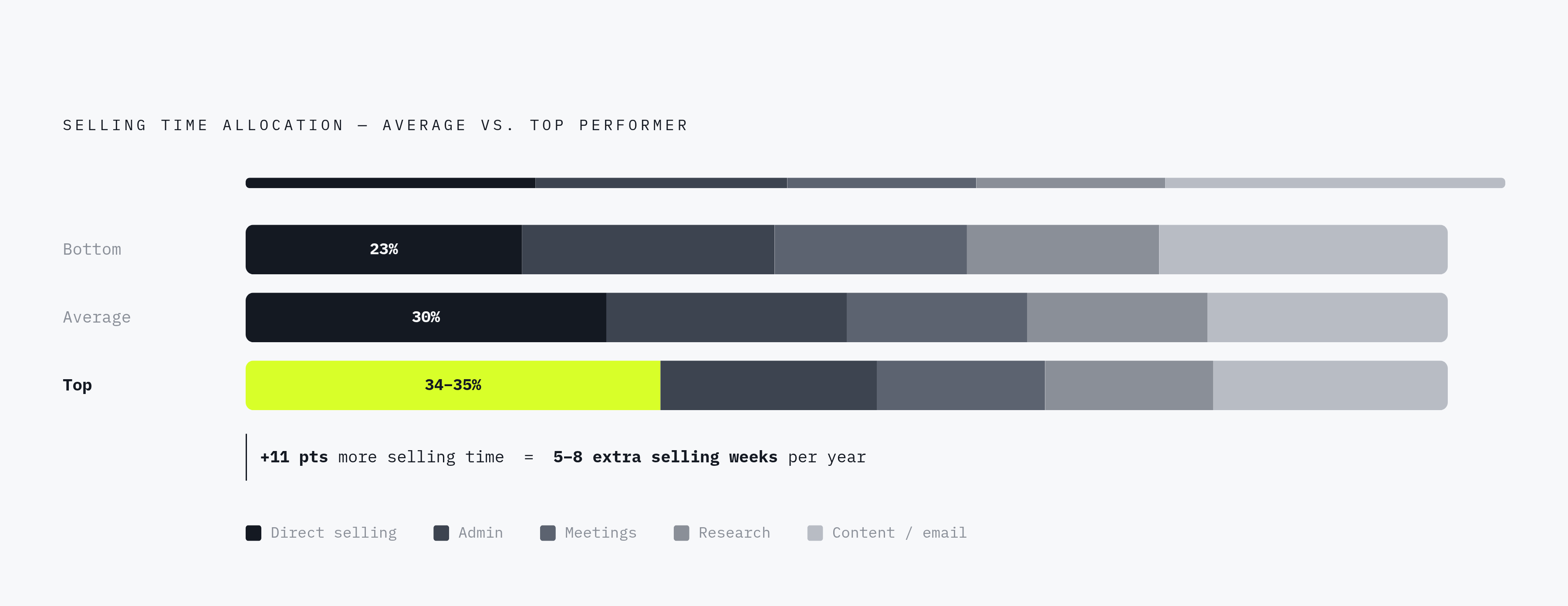
The breakdown is more granular than most leaders realize, and it is remarkably consistent across industries. Administrative work and data entry eat roughly 20 percent of the week. Internal meetings claim another 15. Prospect research takes a comparable slice. Email and inbox management absorbs most of what remains.
Dig into any single category and the numbers become genuinely uncomfortable. A significant share of reps report spending between 10 and 20 hours a week on pure administrative work. Sellers without centralized content resources spend roughly 10 hours a week just finding or revising materials. That is 440 hours a year, nearly a quarter of a working year, consumed entirely by content logistics. For a field rep team of 10, admin alone translates to more than 4,400 hours annually that are simply not spent in front of customers. You could hire two full-time quota-carrying reps for that capacity.
Some documentation is non-negotiable. Some preparation is genuine pre-sale work. But most organizations have never actually mapped which is which, so they manage outcomes while remaining blind to the inputs producing them.
Why Adding More Tools Has Made the Problem Worse, Not Better
The instinct when reps are underperforming is to give them more resources: more tools, more automations, more dashboards. This instinct has backfired badly, consistently, and the data is unequivocal about it. The average rep now navigates eight different tools to close a single deal, and nearly three-quarters of sellers in a Gartner survey of more than 1,000 respondents reported feeling overwhelmed by the technology they are expected to use. Sellers in that state of cognitive overload are 45 percent less likely to hit quota than those who are not.
Here is the paradox nobody wants to name plainly: each individual tool has a defensible ROI argument, but the cumulative cost of switching between eight systems, reconciling conflicting data, and maintaining basic proficiency across all of them erases most of those individual gains. Tools also add work before they save it. Setup time, training time, ongoing data entry to keep the tool functional, the quiet drag of maintenance when integrations break. Every addition to the stack is a new debt.
The reframe that changes every decision that follows is this: stop asking "which new tool should we add?" and start asking "how do we reduce the number of surfaces reps have to touch?"
Starting with a Time Audit Before Buying Anything
Most sales leaders, when asked to estimate how their reps actually spend their time, are wrong. Not slightly off. Wrong in ways that lead to expensive misdiagnoses and interventions aimed at the wrong problem entirely.
The corrective is unglamorous: have reps log all their activities for one week in 30-minute blocks, then categorize each entry as direct selling, pre-sale research, admin, internal meeting, or content work. External benchmarks put selling at around 30 percent of the week, admin at 20, meetings at 15, research at 15. Run your team's actual numbers against that baseline and see where the divergence lives. That is the diagnosis. Everything else is treatment.
The audit also does something a dashboard cannot do: it separates necessary non-selling work from habitual or redundant work. Deal documentation is non-negotiable. A standing sync with no defined outcome is worth nothing. You cannot make that distinction from a P&L report, or a CRM dashboard, or a conversation with a sales manager who is themselves guessing. You can only make it from the activity log itself.
Nothing that follows is worth deploying without first understanding which waste category it actually targets. Solutions applied to the wrong problem do not reduce overhead; they compound it.
Fixing CRM Data Entry Without Gutting Adoption
Ninety-one percent of companies with ten or more employees use CRM software. Between 20 and 55 percent of those implementations fail on actual user adoption. The technology is nearly ubiquitous; the meaningful use of it is not.
The culprit is friction. Roughly a third of reps spend more than an hour a day on manual data entry, losing close to six hours a week to it. And despite that effort, approximately 79 percent of opportunity-related data never gets entered into the CRM at all, according to Forrester. The forecasting model most organizations treat as gospel is built on a fundamentally incomplete data set. Everyone downstream is making decisions based on a lie the system tells with great confidence.
The solution is not a new CRM. It is eliminating the manual entry requirement entirely. Call recording with AI transcription, automatic activity logging, email sync: these capture the data without requiring the rep to generate it separately. McKinsey research suggests that automating non-customer-facing activities along these lines recovers roughly 20 percent of a sales team's total capacity. That is structural, not marginal, and it does not require anyone to change their workflow or develop a new habit.
Centralizing Content So Reps Stop Recreating It from Scratch
Sixty-five percent of marketing content goes completely unused by sales. The reason is almost never lack of relevance. Reps cannot find the material when they need it, so they rebuild it from memory and instinct, or they skip it entirely and wing the conversation. Neither outcome serves the buyer.
Organizations that implement centralized, searchable content libraries see meaningfully higher usage rates than those relying on scattered shared drives. Companies with formal sales enablement programs achieve win rates roughly 49 percent higher than those without, with an ROI that multiple studies place around four to one.
The structural requirement is specific: one searchable repository, tagged by deal stage and buyer persona, maintained by marketing. Not a shared drive with folders organized by quarter. The tagging infrastructure is what makes the repository actually usable. Without it, centralization is just a tidier version of the same problem, and reps will route around it just as efficiently as they route around the current chaos.
For teams rebuilding their content infrastructure from the ground up, platforms like Letterstory offer pre-built templates and on-brand frameworks. Whatever tool a team uses, the operational goal is the same: make finding the right content faster than building it. Because right now, for most teams, building it is faster, and that tells you everything about the state of the infrastructure.
Auditing Internal Meetings as a Recoverable Block of Selling Time
Internal meetings consume roughly 15 percent of the average rep's week. Six hours. Comparable in scale to CRM data entry, and consistently the most overlooked category in time-reduction efforts, because meetings feel productive in the moment even when they are producing nothing actionable.
Deal reviews where someone reads the CRM data aloud to a room full of people who have already read it happen somewhere in your organization every week. Forty-five minutes. Nobody says anything new.
The meetings worth keeping are genuinely high-information exchanges: pipeline inspections with specific coaching feedback, deal reviews that involve real decision-making authority, forecast calls where the data is actually interrogated. The recoverable categories are standing syncs with no defined agenda, cross-functional updates that are purely informational and are better served as a shared document, forecast recaps that simply restate what is already in the system.
Apply the same qualification rigor to a calendar invite that a competent rep applies to a prospect call. Does this meeting have a clear objective, a decision-maker, and a defined outcome? Any recurring meeting that has never produced a changed decision or a new action item should be canceled or halved. The time is sitting there.
Role Specialization as a Structural Alternative to Individual Time Management
Many organizations eliminated sales assistants, account coordinators, and technical support roles during cost-cutting cycles. The Center for Sales Strategy and others who have studied this pattern argue it is a false economy, and the time allocation data supports that argument plainly.
If the goal is to increase selling capacity by 25 percent, adding new quota-carrying reps is often the slower and more expensive path. A rep who moves from 23 percent selling time to 34 percent is, in terms of selling output, operating at a categorically different level on the same base salary.
The specialization options are predictable: sales development reps who handle prospecting and early-stage research so closers can concentrate on qualified pipeline; sales operations staff who own reporting, CRM hygiene, and forecasting so reps don't have to; content teams that produce and tag materials so sellers are not generating their own collateral between calls. The qualifying test is simple enough that it should not require debate: if a task does not require a customer relationship or a genuine judgment call, it should not be executed by your highest-cost quota-carrying headcount.
Not every team has the budget for dedicated roles. But even partial specialization — a shared SDR, a fractional ops resource, a part-time content coordinator — moves the selling time figure in a measurable direction. The economics of specialization consistently outperform the economics of asking expensive people to do cheap work.
Where AI Reduces Drag Without Adding Tool Overhead
The paradox that applies to conventional tools applies to AI with equal force. An AI tool that requires its own login, its own data entry, and its own training curve reproduces the exact problem it is supposed to solve. The rep goes from eight tools to nine, cognitive overhead increases, and whoever bought the tool writes a frustrated internal memo about change management six months later.
The AI interventions that actually deliver share one characteristic: they reduce the number of surfaces a rep has to touch rather than adding one. Automatic call summarization with CRM logging captures conversation data without any rep action. AI-generated first drafts of outreach, personalized to prospect context, eliminate the blank-page problem in cold sequencing. Intent signal aggregation replaces manual research with a synthesized, prioritized input the rep can act on in minutes rather than an hour from now.
McKinsey has noted that AI-assisted lead management approaches increase selling time by 15 to 20 percent, with most of that gain coming from eliminating research and outreach preparation steps. There is a customer-experience dimension worth naming here too: a majority of B2B buyers report that reps do not take adequate time to understand their specific business challenges, according to Gartner. AI that handles background research and preparation gives reps the context to actually close that gap when they are in the room.
The evaluative frame for any AI addition to the stack: it earns its place by replacing one or more of the existing eight tools, not by becoming the ninth. AI workflows that operate within a defined process, rather than generating output ad hoc, produce the most consistent time savings because they eliminate the downstream judgment call about what to do with the output once it arrives.
Measuring Whether the Changes Are Working
The one-week activity log that starts this process is also how you close the loop. Run it again 60 days after any significant intervention. Measure actual shift in selling time, not proxy metrics like tool login frequency or content upload counts. Those metrics measure activity inside the tools. They do not measure time in front of buyers.
The target is not perfection. Moving a rep from 28 percent selling time to 34 percent — the threshold where top-performer behavior begins to manifest — is achievable within a single quarter with well-targeted interventions. Five to eight additional selling weeks per rep per year, same payroll.
Watch the leading indicators alongside selling time: response speed to buying signals matters more than most teams track. Top performers act on buying signals the day they surface. Time-constrained reps delay, and delayed engagement reduces win rates in ways that only show up in the lagging data months later, by which point the postmortem is cold.
Lagging indicators include quota attainment rate, pipeline velocity, and win rate. All three should move if selling time genuinely increases. If they don't, the audit needs to go deeper, because the recaptured time is migrating to a different non-selling category rather than to direct sales activity. Solvable, but only if you are measuring the right thing.
The audit loop also serves as a check on tool creep. If the stack has grown again by the next review cycle, the paradox is reasserting itself. Treat that as the signal it is.