Transformational Leadership in Sales Management
Sales reps lose motivation when their managers only track metrics, not meaning.

Only a quarter of sales reps hit 100% of quota in 2025, according to Salesforce's 2026 Trends in Sales Compensation Report. That means three out of every four reps you know, the ones grinding through CRM updates and cold calls right now, are falling short of a number somebody else set for them without asking. This piece looks at transformational leadership, a decades-old management theory, and asks whether it actually holds up better than commission-and-quota management in sales specifically, or whether that's wishful thinking dressed up in academic language.
Where transformational leadership comes from and what it actually claims
James MacGregor Burns coined the term in 1978, and his original idea was almost quaint: leaders and followers raise each other up together, both climbing toward something neither reaches alone. Bernard Bass picked it up in 1985 and turned it into something you could actually test, four measurable parts now usually called the Four I's: Idealized Influence, Inspirational Motivation, Intellectual Stimulation, and Individualized Consideration.
Bass argued that transformational and transactional leadership serve different functions rather than competing for the same job description. Roughly three decades of meta-analytic research backs him up: both styles predict performance, just through different mechanisms. Transactional leadership buys compliance for as long as the incentive is in front of someone. Transformational leadership builds motivation that tends to outlast the external incentive, which matters once you remember commission checks eventually get cashed and forgotten.
Here's the wrinkle before this gets too tidy: a 2025 study found transformational leadership's direct effect on job performance actually turned negative in certain contexts. Context beat the label. So treat this framework as strong evidence with real edges, something worth testing on your own floor rather than assuming it works identically across every market and team.
How transactional management actually fails a sales team over time
Hit the number, get the reward. That loop produces real short-term results; commission structures do work, at least for a while. Run that same loop for three years straight, though, and watch what happens to a rep who's only ever been praised for output and never for anything else.
They plateau. Nobody recognized growth or initiative along the way, only the number on the board, and intrinsic motivation drains out slowly enough that you don't notice it's gone until it's gone. Loyalty in this model gets priced rather than earned. The moment a competitor dangles a marginally better commission plan, the rep leaves, because there was never anything deeper holding them there in the first place.
Gallup found manager engagement dropped to 27% globally in 2024, and Gallup's own research attributes roughly 70% of the variance in team engagement to the manager alone. A disengaged manager doesn't just underperform personally; they drag the whole team down with them. A 2024 LinkedIn survey found 7 in 10 U.S. workers would leave a job specifically because of a bad manager. Retention, it turns out, is a leadership problem that got mistaken for a compensation problem. The transactional model has no mechanism for building resilience or initiative, and modern selling demands both constantly, in every stalled deal and every six-person buying committee that won't just say yes already.
Idealized influence: what it means for a sales manager to lead by example
Stripped of jargon: the leader acts as a role model, earns trust through consistent behavior, and only asks more of the team because they're already holding themselves to the same bar. Easy to say. Much harder to do when you're three dashboards deep in pipeline reports and running fifteen minutes late to your own QBR.
Picture two sales managers. One runs calls alongside reps, owns lost deals out loud in the team meeting instead of quietly writing them off, and holds themselves to the exact standard they expect from everyone else. The other manages entirely from a screen, forecasts and stage-conversion rates, never actually in the room where the selling happens. You already know which one the team trusts more; you've probably worked for both.
That gap isn't hypothetical. Trust in managers fell from 46% to 29% in just two years, from 2022 to 2024. Idealized influence answers that erosion directly, grounded in behavior instead of some abstract virtue pulled off a business school syllabus. Burns himself flagged the trap here: a vision centered on the leader instead of something larger collapses into cult of personality, what gets labeled pseudo-transformational leadership once it's dressed up in the right vocabulary. Real idealized influence points away from the leader. A decent gut check: can your reps describe what you actually stand for, or only what you track in the CRM?
Inspirational motivation: giving a sales team something larger than quota to work toward
There's a real difference between "we need to hit a big number this quarter" and explaining why the product matters to the people buying it, and why this particular team is the one built to deliver it. Both statements can be true at once, and the second one tends to be the one that makes a rep want to show up Tuesday morning with any actual enthusiasm in the tank.
A study of 512 people across service and knowledge-based sectors found transformational leadership strongly tied to employee engagement. The mechanism isn't mysterious: people put in more hours and more effort for something that connects to meaning, not just a spreadsheet cell turning from red to green. Bass was explicit that the vision has to point beyond the leader, or inspirational motivation curdles into motivational-poster language that gets ignored by the second week of the quarter.
Here's the awkward part for a lot of sales managers: most of them got promoted for hitting their own number, not for articulating a vision anyone else could repeat back. Those are different skills entirely. One got them the promotion; the other is the actual job now, and it doesn't develop on its own just because someone used to close deals well.
Intellectual stimulation: treating a sales team as a source of insight, not just execution
Ask a rep why a deal stalled instead of pulling up the CRM and reading off the stage it died at. Intellectual stimulation means challenging assumptions, reframing problems, and treating dissent as useful information instead of a threat that needs managing before it spreads.
Use pipeline reviews to surface patterns rather than assign blame. Let reps experiment with their own approach on a call instead of scripting every word they're supposed to say. This is exactly the component missing from cult-of-personality managers, the ones who need to be right in every room, and it's exactly what complex, multi-stakeholder selling demands. Nobody scripts a conversation with a six-person buying committee and gets away with it. Somebody on your team has probably already found a workaround you haven't heard about yet, because nobody asked.
A peer-reviewed study of 477 sales agents found transformational leader behaviors had stronger direct and indirect ties to salesperson performance than transactional behaviors, with trust and role clarity doing the mediating work underneath. Intellectual stimulation builds both. What it asks of a manager, honestly, is a bit of humility: comfort with not being the smartest person in the room, and a willingness to update your own read because a rep just told you something from the field your dashboard couldn't show you.
Individualized consideration and why it translates directly into coaching outcomes
This is where the theory stops being abstract and starts showing up on a spreadsheet. Individualized consideration means attending to each rep's actual needs, growth trajectory, and skill gaps, then adjusting coaching and delegation instead of managing the whole team like one uniform blob of quota.
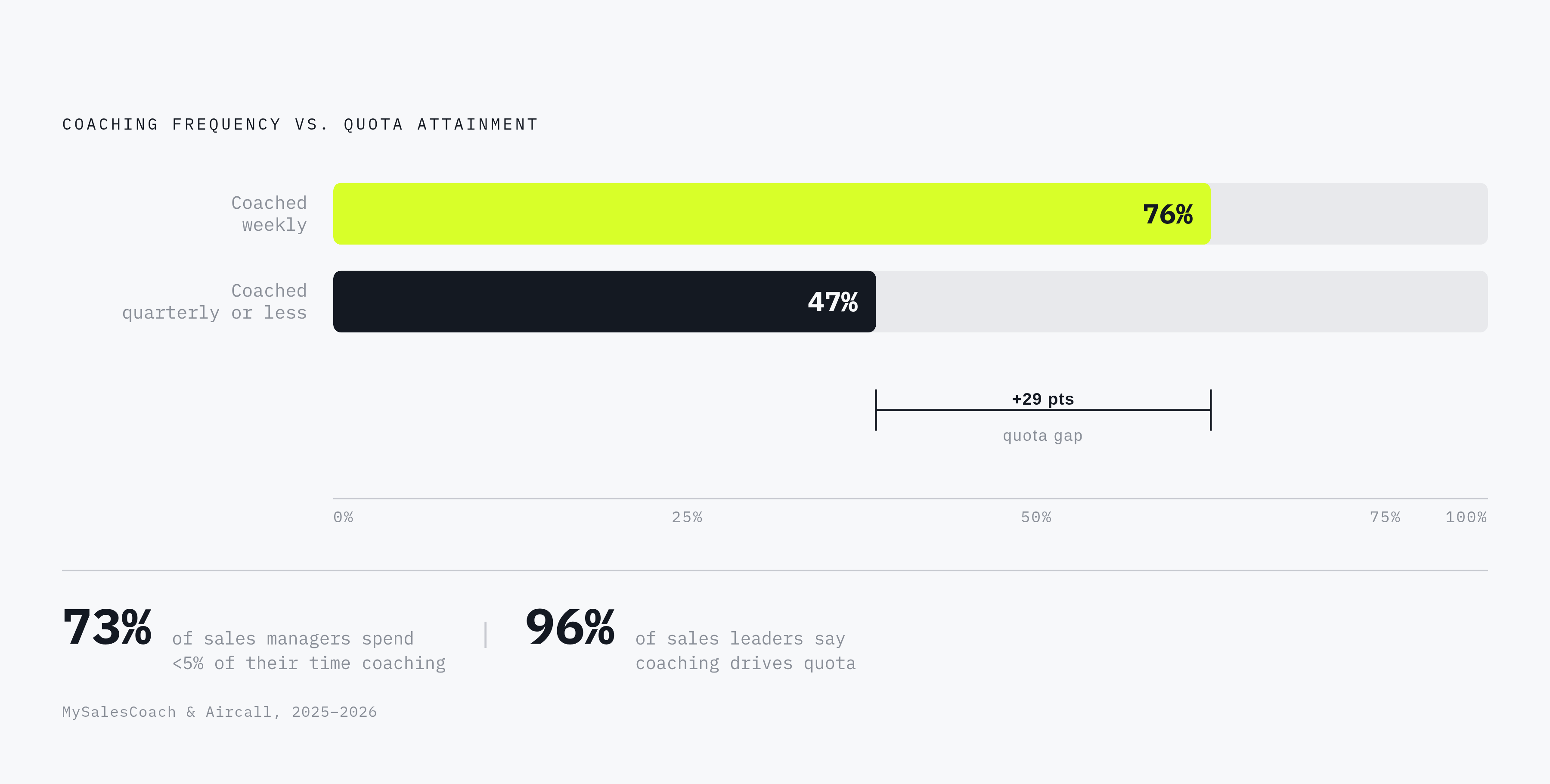
A group pipeline review gives you the aggregate number. A one-on-one that digs into why this particular rep keeps losing deals at the demo stage gives you an actual diagnosis, which is a different thing entirely. The data backs this up without much ambiguity: reps who rate their coaching as "very good" or "excellent" are 50% more likely to hit quota than reps who rate it poorly, per MySalesCoach and Aircall's The State of Sales Coaching 2025. MySalesCoach's 2026 report found a 29-point gap between reps coached weekly (76% quota attainment) and reps coached quarterly or less (47%). That gap is individualized consideration, measured in dollars and cents.
Retention numbers are starker still. MySalesCoach's State of the SDR Q4 2023 report found 74% of SDRs getting frequent coaching plan to stay 12 months, versus 34% of those who aren't, a 40-point spread that should concern any VP of Sales reading this. And yet 73% of sales managers spend less than 5% of their time coaching. The evidence is sitting right there. Something else keeps getting in the way.
What makes coaching fail even when managers intend to do it well
So what's actually blocking coaching, when everybody already agrees it works? MySalesCoach's 2026 data breaks it down: lack of time (32.6%), difficulty measuring impact (22.65%), needing more guidance on how to coach well (15.47%), and lacking the range to coach different roles (14.92%).
These are real constraints, not excuses. A sales manager carrying a full administrative load, sitting through executive reporting cycles, and fielding escalations all day genuinely runs out of coaching bandwidth by 4pm most days. And the managers themselves are running low: 71% of middle managers, a group that includes most sales managers, reported burnout in a recent U.S. survey. A burned-out manager can't deliver individualized consideration, because diagnosing someone else's development edge takes energy the manager doesn't have left to spend by that point in the day.
Here's the gap that actually matters: 96% of sales leaders say coaching influenced quota attainment, and 94% of reps say it improved their performance. Nearly everyone believes it works. Almost nobody has the structural room to do it consistently, week after week, quarter after quarter. That's a resourcing problem more than a belief problem, and it's exactly where transformational leadership on paper runs into organizational reality on the ground floor.
How transformational leadership shifts team outcomes beyond quota
A 2025 study found transformational leadership has a real, positive effect on employee career growth, and that shows up directly in retention math: employees who feel well-supported by their manager are 4.5 times less likely to be eyeing the exit.
A study of 650 pharmaceutical employees found employee engagement significantly mediates the link between transformational leadership and retention, while transactional leadership showed no significant direct effect on engagement in that same sample. The paycheck-and-quota model, running entirely on its own, didn't move engagement at all. Other research ties transformational leadership to higher self-efficacy, lower stress, and less turnover, outcomes that matter enormously in sales, where the pressure isn't seasonal so much as it's just always there.
73% of leadership teams in sales, media, and marketing saw significant turnover in a recent measurement period. Transformational leadership doesn't erase that cost. It builds the underlying conditions, engagement, trust, self-efficacy, growth, that make sustained results more likely rather than lucky, without letting anyone off the hook for the number itself.
Putting the Four I's into practice as a sales manager
Companies that invest in leadership development see 25% better business outcomes. Treat this as an investment decision, then, a skill built deliberately over time rather than some trait a handful of managers happened to be born with.
In practice: idealized influence means showing up visibly on the hard calls, owning failures out loud in team settings, and naming your actual values rather than just your sales targets. Inspirational motivation means tying the team's work to customer outcomes, not revenue alone, concrete enough that a brand-new rep could repeat the mission back to you without a script in front of them. Intellectual stimulation means using win-loss reviews to pull insight out of reps instead of assigning blame, and rewarding the rep who flags a broken process about as much as the one who blows past quota that month. Individualized consideration means knowing each rep's actual development edge, not just their pipeline stage, and building one-on-ones around growth trajectory instead of deal status alone.
None of this happens by accident, and articulating a vision that actually lands is where most managers stumble hardest, especially with a board deck due Friday and three deals wobbling on the forecast. Letterstory is one tool built around that specific gap, helping a manager turn a vision that's clear in their own head into language a team can actually repeat back instead of paraphrase badly in a hallway conversation. Whether or not you use a tool for it, the discipline is the same: say the vision out loud, in words other people can use without you standing there to translate.
77% of organizations report a shortage of leadership depth. A manager who builds these four behaviors is filling a hole most companies don't know how to patch, and won't, until the exit interviews start piling up. The Four I's are behaviors: learnable, practiced badly at first, improved with feedback over time. A manager waiting to feel naturally transformational before acting like one is going to be waiting a long while, probably right up until their best rep takes a call from a recruiter and doesn't mention it until it's done.