Unique Ways to Increase Sales Without Adding Headcount
Recover three months of selling time per rep annually through automation, coaching, and content.

Sales teams have a productivity problem: reps spend roughly a quarter of their working hours actually selling. Everything else, the CRM data entry, the internal meetings, the last-minute hunt for the right case study before a call starts, eats the other three-quarters. Nobody budgeted for that ratio, and yet almost every sales org I've watched responds to a bad quarter the same way: post a req, hire another rep, hope the math shakes out differently this time.
Usually, it doesn't. If the existing team only sells six hours out of a supposed forty, adding a body doesn't fix the ratio; it adds another person operating at 25% capacity, plus the recruiting cost, plus meaningful ramp time before that hire produces anything you can point to. When performance shortfalls trace back to bad process or thin pipeline, and they usually do, a new rep inherits the mess instead of solving it. This piece walks through four ways to claw back the majority of lost time without opening a single job posting: automation, coaching, content, and the revenue already sitting inside the customer base and partner network. None of these four is exotic. What's rare is a company that runs them in the right order, and that's the thread the rest of this piece is pulling on.
How automation gives back the 75% of the day that isn't selling
Automation gives back roughly 12 hours per rep, per week, according to salesso.com's data. Annualized, that's close to three months of selling time recovered from one person without touching the org chart. That's three months a year, per rep, sitting unclaimed, and most sales leaders would rather write a job listing than go looking for it.
Where does the time actually go? CRM updates alone eat about 19% of a rep's day, and administrative work broadly consumes close to a third of it. That's data entry with a quota attached, and nobody signed up to be a data entry clerk when they took the sales job.
The highest-return automation targets are the boring ones. Lead enrichment, call logging, CRM sync, scheduling, follow-up sequences: pick whichever one currently eats the most manual effort on your team and start there, not with the flashiest tool on a vendor's homepage. AI adoption in sales jumped from 68% in 2024 to 78% in 2025, so the question is how far behind everyone else you already are.
The revenue case compounds in a way that's easy to underrate. Companies that automate lead management see a 10% revenue increase within six to nine months, according to McKinsey, climbing to 15% by month twelve. A benchmark across 938 B2B companies found something that cuts against instinct: AI-augmented reps generated 41% higher revenue per rep while performing 18% fewer activities. Fewer, better-aimed actions beat a bigger pile of dialing and emailing, and that should unsettle anyone still measuring reps on call volume.
There's a diagnostic layer too, and it's the part that actually changes what a manager's Monday looks like. AI performance alerts can flag a rep's decline two to three days before a manager would notice it by eyeballing a pipeline report, and early intervention lifted recovery success from 38% to 86% in one sample. Catching a slump in week one instead of month three is the difference between a coaching conversation and a performance improvement plan.
None of this is free, and the value depends entirely on how it gets rolled out. Integrated AI-CRM layers typically run $15 to $50 per user per month, cheap next to a hire, but tool sprawl is the real cost nobody puts on a spreadsheet. The average rep already juggles at least six disconnected tools, and stacking a seventh without integrating it just builds a new data silo with its own login screen. Start with one high-volume task, measure the time actually recovered, then expand from there.
What structured coaching does that automation alone cannot
Automation buys back time. That gap is where coaching lives, because reclaimed hours still need direction before they turn into results. The baseline right now is rough: only 28% of reps hit annual quota, per Salesforce's State of Sales report. There's a pool of underperforming capacity sitting inside the headcount companies already have, and a lot of it has nothing to do with effort.
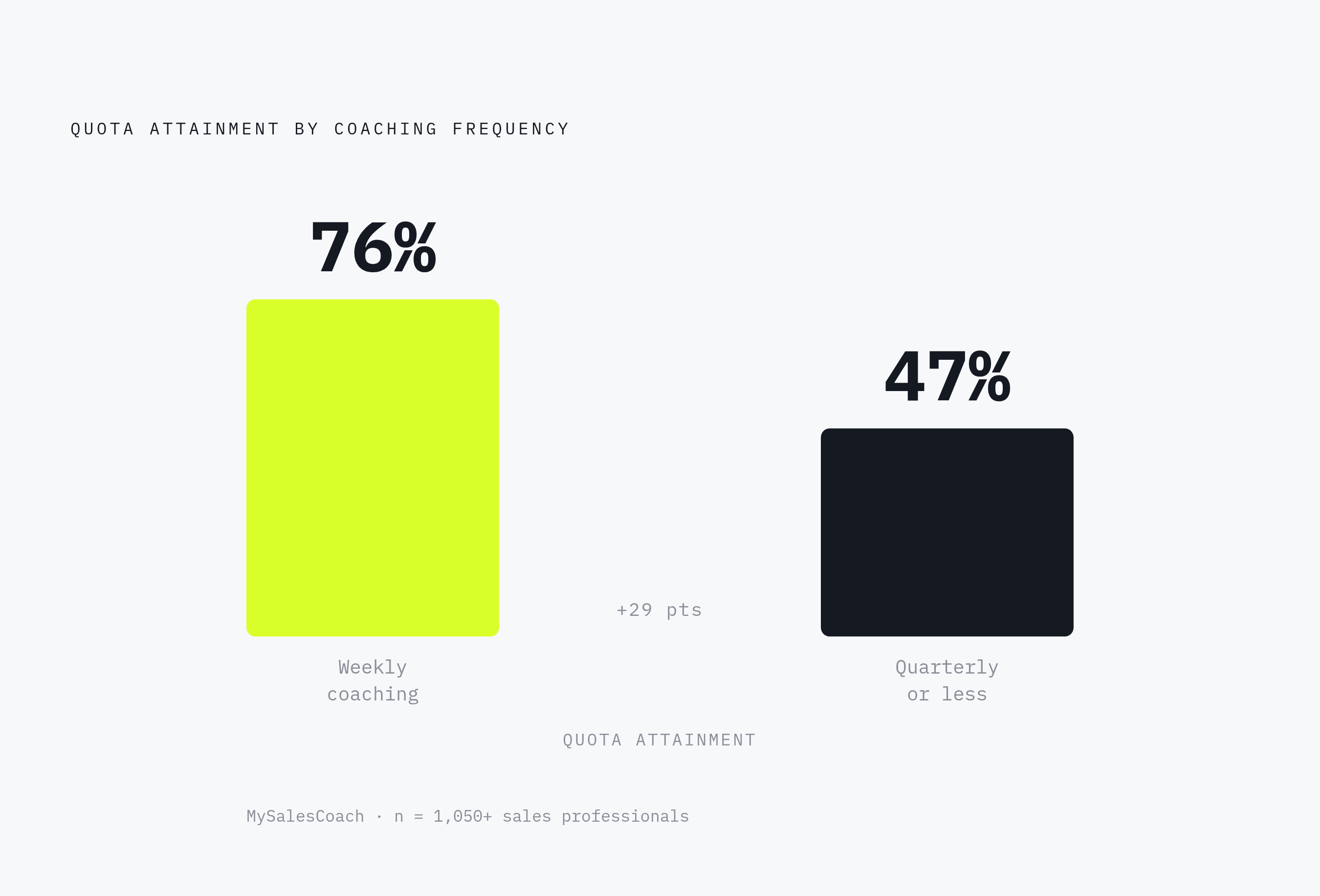
Frequency matters more than most sales leaders assume, and by a wider margin than feels intuitive. Teams coached weekly hit 76% quota attainment versus 47% for teams coached quarterly or less, according to MySalesCoach research covering more than 1,050 sales professionals. That's the gap between a team that hits its number and one that spends every QBR explaining why it didn't.
Formal coaching programs correlate with 25 to 40% improvements in deal size, win rate, and pipeline, per LLCBuddy. Most of what reps learn in a one-time training session evaporates within months without reinforcement behind it, though, which means the annual kickoff is largely wasted money unless there's weekly follow-through after it.
That's what's pushed coaching out of the quarterly-event bucket and into the weekly workflow, and it's built a real software category around doing that at scale. The sales coaching software market hit $2 billion in 2025 and is headed toward $7 billion by 2033, enabling one manager to coach twenty reps without sitting in on every single call.
The payoff isn't small. One analysis of a large sample of enterprise sales interactions found a substantial chunk of unrealized revenue tied to execution improvements alone. No new hires, no new pipeline, just better conversations with the pipeline already there.
Content plays a coaching role here too, and it's worth mentioning before the next section runs off with it: battlecards, objection guides, competitor one-pagers, all of it lets a rep self-serve the right answer mid-call instead of muting the line to text a manager. Packaged as a document instead of a person, it still functions as coaching, minus the calendar invite.
How content enables selling without consuming rep time
A rep's time is finite. Content isn't, and that asymmetry is the whole case for this section: content that answers a buyer's real question or nudges a stalled deal forward scales in a way headcount never can.
The failure mode is familiar to anyone who's opened a sales enablement folder and found forty assets, thirty-five of them unopened, because none of them match the actual conversation a rep is having that afternoon. Volume rarely fixes that. Specificity does, and most enablement libraries have plenty of the former and almost none of the latter.
The assets with real leverage cluster by funnel stage: case studies matched to the buyer's exact industry, ROI calculators that put a dollar figure on doing nothing, competitive one-pagers for the late-stage "why not the other guys" objection, nurture sequences that keep cold pipeline from going stone cold. None of it works if it's built on guesswork. The strongest content briefs come from mining actual call recordings and CRM notes, not a marketer's best guess at what a buyer probably cares about.
Speed matters more than it gets credit for. A deal that stalls three weeks waiting on a requested one-pager is a deal that's had three weeks to cool off, get reprioritized, or lose to whoever answered faster. AI-assisted content workflows can compress that turnaround from weeks to days. Letterstory, which pairs AI-assisted production with editorial review, is built around getting a deal-specific battlecard in front of a rep while the deal is still warm enough to save.
Measurement matters as much as production speed does. Track which assets reps actually share, which ones show up in closed-won deals, then cut the rest, because a big content library that mostly sits unused just carries a storage cost and a false sense of preparedness.
The revenue hiding inside the existing customer base
Here's a ratio worth sitting with: the odds of selling to an existing customer run 60 to 70%, against a small fraction of that for a net-new prospect. Companies keep chasing new logos with the same old intensity while an easier sale waits inside accounts they've already closed. Why the imbalance? Mostly habit: new-logo hunting is the default motion everyone learned first, and old habits don't check the math before running the same play again.
Upselling and cross-selling can lift revenue by 20 to 30%, and yet many organizations still underinvest in these plays despite the return being well documented. That's an ownership gap more than a knowledge gap, and it shows up again a few paragraphs from now.
The lifetime value math compounds too. Cross-selling lifts customer lifetime value meaningfully, upselling by a significant margin. Personalization is the variable that actually executes on this, and the mechanism is relevance, not volume of outreach. Buyers want the upgrade that solves the specific problem they mentioned to support last Tuesday, the one still sitting in a ticket somewhere, more than they want a blanket "upgrade now" email blast.
The practical triggers already live in the CRM: usage milestones, renewal windows, new product launches, support tickets that reveal a gap the current package doesn't cover. None of this needs new infrastructure. It just needs someone to actually look.
That's the catch, though. Upsell plays fail most often not because the opportunity isn't real, but because nobody owns it. Customer success assumes account management is watching. Account management assumes marketing has it covered. It evaporates in the handoff between teams that all assumed someone else had the ball. Worth connecting back to the coaching section: reps who miss upsell signals are usually undertrained on the expanded product line rather than unmotivated to sell it, and coaching frequency shows up again as the variable that moves this number.
Extending reach through channel partners and referral programs
Channel partners let a fixed internal team cover markets direct reps can't reach cost-effectively. A partner already embedded in a market your reps have never touched brings something a territory rep starting from zero has to build slowly over time: trust that already exists before the first call.
The numbers here lean almost sideways. Referred pipeline consistently closes at a higher rate and carries higher lifetime value than pipeline sourced any other way. That gap is the entire point: partners already embedded in a market bring trust that translates into better-converting opportunities.
So why do so few companies lean into this? The honest answer is enablement, or the lack of it. Most channel programs underperform not because partners lack motivation, but because nobody armed them with the materials to sell the product properly. The enablement gap mirrors what the internal coaching numbers showed: without structured support, potential goes unrealized.
The build here is small. Identify two or three partners whose customers already have the problem your product solves, hand them the same battlecards your internal reps use, and set a 90-day check-in to see what's working. Referral programs need the same content infrastructure as direct selling does, and the library built for reps does double duty here, provided someone remembers to actually share it with them.
Sequencing the levers: where to start and what to measure
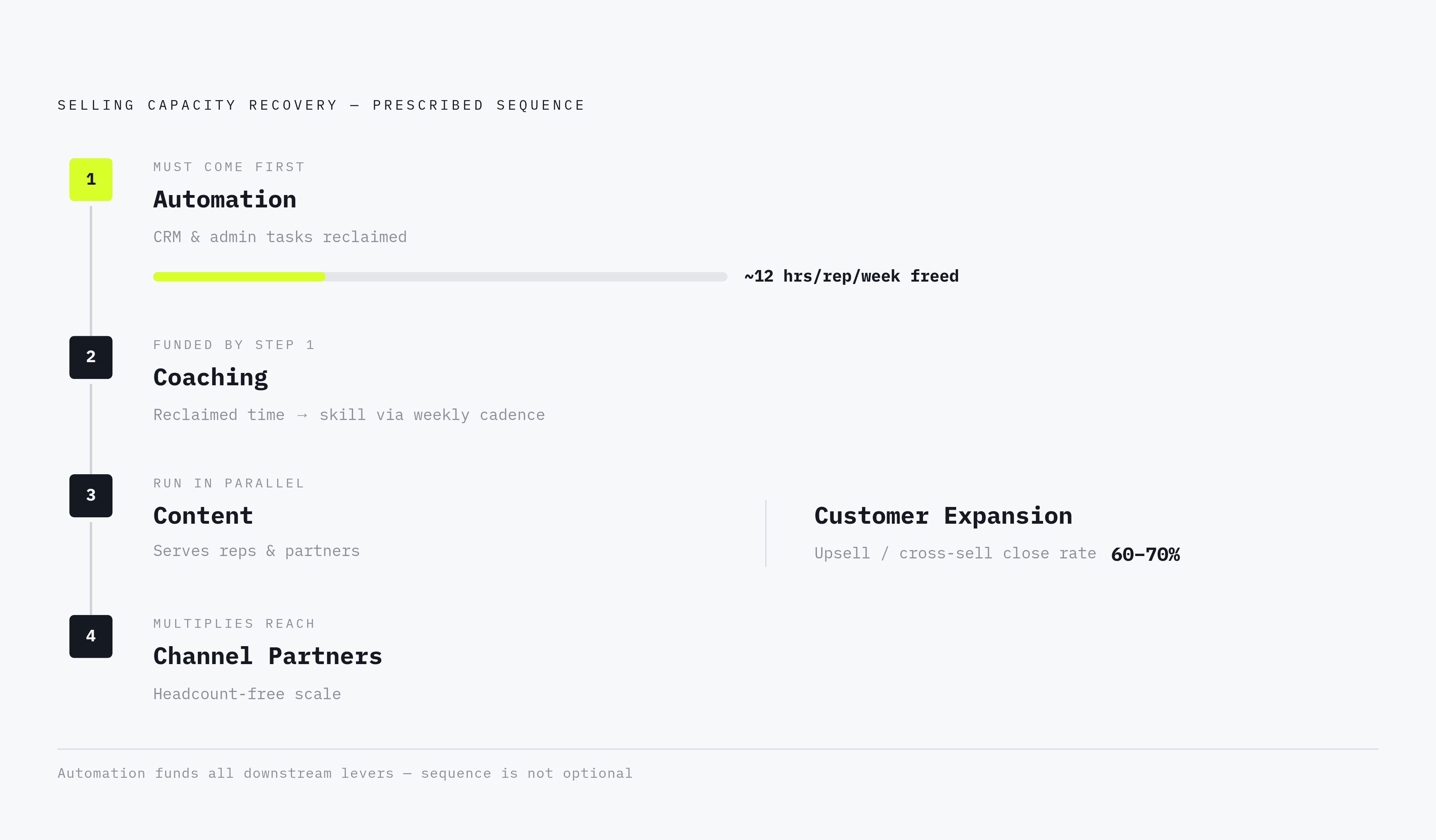
Order matters more than most companies assume. Automation goes first, because it funds everything downstream by freeing the time that coaching, expansion, and partner management all depend on. No amount of great coaching helps a rep who's still buried in data entry for a third of the day.
Coaching comes second. Reclaimed time has no revenue value by itself; it needs skill and process behind it to turn into anything, and weekly cadence is the forcing function that makes the skill stick, unlike the training that evaporates within months of the kickoff.
Content and customer expansion can run in parallel once the first two are turning. The content library serves reps and partners at the same time, and the upsell plays capture the highest-probability revenue already sitting in the base. Neither one waits on the other to finish first.
What actually belongs on a dashboard: active selling time as a share of total hours, the leading indicator that tells you automation is working before revenue catches up, plus quota attainment, revenue per rep, upsell and cross-sell revenue as a percentage of total, and partner-sourced pipeline. Five numbers, not fifty. A dashboard that needs more than that is probably tracking things nobody's actually going to act on.
Automation gives reps time. Coaching turns that time into skill. Content turns skill into closed deals, and existing customers and partners multiply the surface area of all three without a single new line on the org chart. The headcount question doesn't disappear. It just moves to the end of the list, a deliberate choice made after the current team's capacity has actually been used, rather than the reflexive first move after a bad quarter.